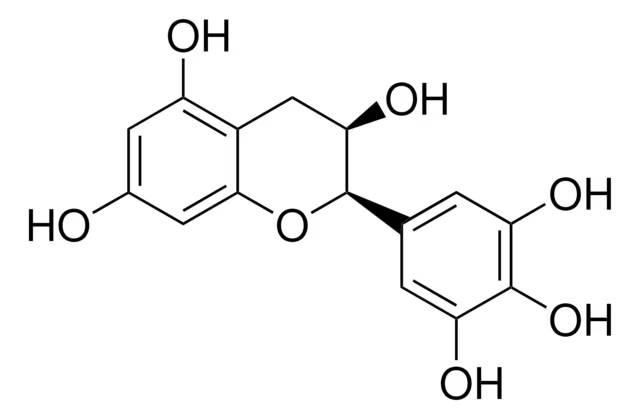
CAS Number970-74-1
SynonymsEGC; MFCD00075939; Galloepicatechin; epigallocatechol; Sunphenon EGC; (-)-Epigallo catechin; (-)-Epigallocatechin; (−)-Epigallocatechin; (-)-Epigallocatechin (EGC); (2R,3R)-2-(3,4,5-Trihydroxyphenyl)-3,5,7-chromanetriol; Teacatechin II; EPIGALLOCATECHIN; (2R,3R)-2-(3,4,5-Trihydroxyphenyl)chromane-3,5,7-triol; Greenteacatechins; (-)-EGC:2H-1-Benzopyran-3,5,7-triol,3,4-dihydro-2-(3,4,5-trihydroxyphenyl)-, (2R-cis)-,; epi
Molecular FormulaC15H14O7
Molecular Weight306.27
Purity≥95 (HPLC)%
Density1.7±0.1 g/cm3
Boiling Point685.6±55.0 °C at 760 mmHg
Melting Point208-210°C
Appearancewhite powder
Symbol
Signal WordWarning
| Chemical & Physical Properties | |
|---|---|
| CAS Number | 970-74-1 |
| Catalog No. | 2A-9025801 |
| Chinese Name | 表没食子儿茶素 |
| Synonyms | EGC; MFCD00075939; Galloepicatechin; epigallocatechol; Sunphenon EGC; (-)-Epigallo catechin; (-)-Epigallocatechin; (−)-Epigallocatechin; (-)-Epigallocatechin (EGC); (2R,3R)-2-(3,4,5-Trihydroxyphenyl)-3,5,7-chromanetriol; Teacatechin II; EPIGALLOCATECHIN; (2R,3R)-2-(3,4,5-Trihydroxyphenyl)chromane-3,5,7-triol; Greenteacatechins; (-)-EGC:2H-1-Benzopyran-3,5,7-triol,3,4-dihydro-2-(3,4,5-trihydroxyphenyl)-, (2R-cis)-,; epi |
| Molecular Formula | C15H14O7 |
| Molecular Weight | 306.27 |
| Purity | ≥95 (HPLC) |
| Density | 1.7±0.1 g/cm3 |
| Boiling Point | 685.6±55.0 °C at 760 mmHg |
| Melting Point | 208-210°C |
| Appearance | white powder |
| Storage Condition | Store airtight at 2-8°C |
| Application | Epigallocatechin is the most abundant flavonoid in green tea and can bind unfolded polypeptides and prevent conversion into amyloid fibers. |
| HTC | 2932999099 |
| PubChem ID | 24894529 |
| MDL Number | MFCD00075939 |
| SMILES | O[C@@H]1Cc2c(O)cc(O)cc2O[C@@H]1c3cc(O)c(O)c(O)c3 |
| InChI | 1S/C15H14O7/c16-7-3-9(17)8-5-12(20)15(22-13(8)4-7)6-1-10(18)14(21)11(19)2-6/h1-4,12,15-21H,5H2/t12-,15-/m1/s1 |
| InChI Key | XMOCLSLCDHWDHP-IUODEOHRSA-N |
| NACRES Code | NA.21 |
| UNSPSC | 12352205 |
| Hazard Symbols | transportation |
| MSDS | msds/25801_1_970_74_1.pdf |
| Bioactivity | (-)-Epigallocatechin is the most abundant flavonoid in green tea, can bind to unfolded native polypeptides and prevent conversion to amyloid fibrils.IC50 value:Target: in vitro: EGCG is a potent inhibitor of amyloidogenic cystatin I66Q amyloid fibril formation in vitro. Computational analysis suggests that EGCG prevents amyloidogenic cystatin fibril formation by stabilizing the molecule in its native-like state as opposed to redirecting aggregation to disordered, amorphous aggregates [1]. Combined curcumin and EGCG treatment reduced the cancer stem-like Cluster of differentiation 44 (CD44)-positive cell population. Western blot and immunoprecipitation analyses revealed that curcumin and EGCG specifically inhibited STAT3 phosphorylation and STAT3-NFkB interaction was retained [2]. EGCG exhibited a MIC and MBC of 5μg/mL and 20μg/mL respectively and effectively eradicated E. faecalis biofilms. EGCG induced the formation of hydroxyl radicals in E. faecalis. The addition of DIP protected E. faecalis against EGCG-mediated antibacterial effects. At sub-MIC, EGCG induced significant down-regulation of E. faecalis virulence genes [3]. Related Catalog Natural Products >> Flavonoids Research Areas >> Others References [1]. Wang N, et al. (-)-Epigallocatechin-3-gallate Inhibits Fibrillogenesis of Chicken Cystatin. J Agric Food Chem. 2015 Jan 26 [2]. Chung SS, et al. Curcumin and Epigallocatechin Gallate Inhibit the Cancer Stem Cell Phenotype via Down-regulation of STAT3-NFκB Signaling. Anticancer Res. 2015 Jan;35(1):39-46. [3]. Lee P, et al. Effects of Epigallocatechin gallate against Enterococcus faecalis biofilm and virulence. Arch Oral Biol. 2015 Mar;60(3):393-9. Chemical & Physical Properties Density 1.7±0.1 g/cm3 Boiling Point 685.6±55.0 °C at 760 mmHg Melting Point 208-210°C Molecular Formula C15H14O7 Molecular Weight 306.267 Flash Point 368.5±31.5 °C Exact Mass 306.073944 PSA 130.61000 LogP -0.10 Vapour Pressure 0.0±2.2 mmHg at 25°C Index of Refraction 1.776 InChIKey XMOCLSLCDHWDHP-IUODEOHRSA-N SMILES Oc1cc(O)c2c(c1)OC(c1cc(O)c(O)c(O)c1)C(O)C2 |
| Use of | (-)-Epigallocatechin is the most abundant flavonoid in green tea, can bind to unfolded native polypeptides and prevent conversion to amyloid fibrils.IC50 value:Target: in vitro: EGCG is a potent inhibitor of amyloidogenic cystatin I66Q amyloid fibril formation in vitro. Computational analysis suggests that EGCG prevents amyloidogenic cystatin fibril formation by stabilizing the molecule in its native-like state as opposed to redirecting aggregation to disordered, amorphous aggregates [1]. Combined curcumin and EGCG treatment reduced the cancer stem-like Cluster of differentiation 44 (CD44)-positive cell population. Western blot and immunoprecipitation analyses revealed that curcumin and EGCG specifically inhibited STAT3 phosphorylation and STAT3-NFkB interaction was retained [2]. EGCG exhibited a MIC and MBC of 5μg/mL and 20μg/mL respectively and effectively eradicated E. faecalis biofilms. EGCG induced the formation of hydroxyl radicals in E. faecalis. The addition of DIP protected E. faecalis against EGCG-mediated antibacterial effects. At sub-MIC, EGCG induced significant down-regulation of E. faecalis virulence genes [3]. Properties Articles51 Name (-)-epigallocatechin Synonym More Synonyms (-)-Epigallocatechin(EGC) Biological Activity Description (-)-Epigallocatechin is the most abundant flavonoid in green tea, can bind to unfolded native polypeptides and prevent conversion to amyloid fibrils.IC50 value:Target: in vitro: EGCG is a potent inhibitor of amyloidogenic cystatin I66Q amyloid fibril formation in vitro. Computational analysis suggests that EGCG prevents amyloidogenic cystatin fibril formation by stabilizing the molecule in its native-like state as opposed to redirecting aggregation to disordered, amorphous aggregates [1]. Combined curcumin and EGCG treatment reduced the cancer stem-like Cluster of differentiation 44 (CD44)-positive cell population. Western blot and immunoprecipitation analyses revealed that curcumin and EGCG specifically inhibited STAT3 phosphorylation and STAT3-NFkB interaction was retained [2]. EGCG exhibited a MIC and MBC of 5μg/mL and 20μg/mL respectively and effectively eradicated E. faecalis biofilms. EGCG induced the formation of hydroxyl radicals in E. faecalis. The addition of DIP protected E. faecalis against EGCG-mediated antibacterial effects. At sub-MIC, EGCG induced significant down-regulation of E. faecalis virulence genes [3]. Related Catalog Natural Products >> Flavonoids Research Areas >> Others References [1]. Wang N, et al. (-)-Epigallocatechin-3-gallate Inhibits Fibrillogenesis of Chicken Cystatin. J Agric Food Chem. 2015 Jan 26 [2]. Chung SS, et al. Curcumin and Epigallocatechin Gallate Inhibit the Cancer Stem Cell Phenotype via Down-regulation of STAT3-NFκB Signaling. Anticancer Res. 2015 Jan;35(1):39-46. [3]. Lee P, et al. Effects of Epigallocatechin gallate against Enterococcus faecalis biofilm and virulence. Arch Oral Biol. 2015 Mar;60(3):393-9. Chemical & Physical Properties Molecular Formula C15H14O7 Exact Mass 306.073944 PSA 130.61000 LogP -0.10 Index of Refraction 1.776 InChIKey XMOCLSLCDHWDHP-IUODEOHRSA-N |
| Tax Rebate | 13.0% |
| Supervision | None. MFN tariff: 6.5%. Ordinary tariff: 20.0% |
| Transport Info | Product name: Purity: 98.0% |
| MSDS Transport Info | Module 14. Shipping information 14.1 UN dangerous goods number European Land Transport Dangerous Regulations: -International Maritime Dangerous Regulations: -International Air Transport Dangerous Regulations: - 14.2 Names specified by the United Nations (UN) European Land Transport Dangerous Regulations: Non-dangerous goods IMDG Code: Non-dangerous goods International air transport dangerous goods regulations: non-dangerous goods 14.3 Transport hazard categories European Land Transport Dangerous Regulations: -International Maritime Dangerous Regulations: -International Air Transport Dangerous Regulations: - 14.4 Package group European Land Transport Dangerous Regulations: -International Maritime Dangerous Regulations: -International Air Transport Dangerous Regulations: - 14.5 Environmental hazards European Land Transport Dangerous Regulations: No International Maritime Transport Dangerous Regulations Maritime Pollutants: No International Air Transport Risk Regulations: No 14.6 Special reminder to users No data available See reverse side of invoice or packing slip. |
| Related Products in Botanical Reference Standards | ||
|---|---|---|
| Cryptochlorogenic acid | 905-99-7 | 2A-9025569 |
| Neochlorogenic acid | 906-33-2 | 2A-9025570 |
| 4'-Chlorochalcone | 956-02-5 | 2A-9025777 |
| 4-Chlorochalcone | 956-04-7 | 2A-9025778 |
| Isoliquiritigenin | 961-29-5 | 2A-9025791 |
| 3-Epiursolic acid | 989-30-0 | 2A-9025822 |
| (-)-Epigallocatechin gallate | 989-51-5 | 2A-9025824 |
| 2-Nitrophenyl beta-D-thiogalactopyranoside | 1158-17-4 | 2A-9026353 |
| Cholesterol sulfate | 1256-86-6 | 2A-9026545 |
| (-)-Epicatechin gallate | 1257-08-5 | 2A-9026546 |
| Browse all Botanical Reference Standards products » | ||
Phone:
630-322-8886
630-322-8887
Email:
Office Locations:
Chicago, IL, USA
San Francisco, CA, USA


 EN
EN


 SDS
SDS