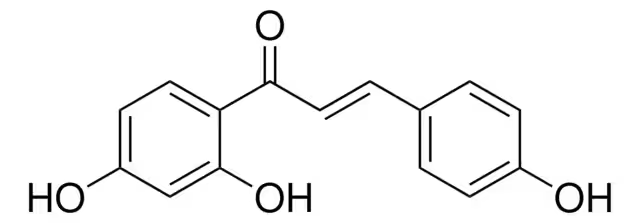
CAS Number961-29-5
Synonymsiso-Liquiritigenin; Isoliquiritigenin; QR CQ DV1U1R DQ &&E Form; ISL; (2E)-1-(2,4-dihydroxyphenyl)-3-(4-hydroxyphenyl)prop-2-en-1-one; gu17; MFCD00075907; (2E)-1-(2,4-Dihydroxyphenyl)-3-(4-hydroxyphenyl)-2-propen-1-one; (E)-1-(2,4-Dihydroxyphenyl)-3-(4-hydroxyphenyl)-2-propen-1-one; ISOLIQUIRTIGENIN; 4,2',4'-TRIHYDROXYCHALCONE; Isqliquiritigenin; 2',4',4-TRIHYDROXYCHALCONE; (E)-1-(2,4-Dihydroxyphenyl)-3-(4-hydroxyphenyl)prop-2-en-1-one; 2',4,4'-Trihydroxychalcone
Molecular FormulaC15H12O4
Molecular Weight256.25
Purity98.00%
Density1.4±0.1 g/cm3
Boiling Point504.0±42.0 °C at 760 mmHg
Melting Point206-210°C
Appearancepowder
| Chemical & Physical Properties | |
|---|---|
| CAS Number | 961-29-5 |
| Catalog No. | 2A-9025791 |
| Chinese Name | 异甘草素; 4,2',4'-三羟基查耳酮 |
| Synonyms | iso-Liquiritigenin; Isoliquiritigenin; QR CQ DV1U1R DQ &&E Form; ISL; (2E)-1-(2,4-dihydroxyphenyl)-3-(4-hydroxyphenyl)prop-2-en-1-one; gu17; MFCD00075907; (2E)-1-(2,4-Dihydroxyphenyl)-3-(4-hydroxyphenyl)-2-propen-1-one; (E)-1-(2,4-Dihydroxyphenyl)-3-(4-hydroxyphenyl)-2-propen-1-one; ISOLIQUIRTIGENIN; 4,2',4'-TRIHYDROXYCHALCONE; Isqliquiritigenin; 2',4',4-TRIHYDROXYCHALCONE; (E)-1-(2,4-Dihydroxyphenyl)-3-(4-hydroxyphenyl)prop-2-en-1-one; 2',4,4'-Trihydroxychalcone |
| Molecular Formula | C15H12O4 |
| Molecular Weight | 256.25 |
| Purity | 98.00 |
| Density | 1.4±0.1 g/cm3 |
| Boiling Point | 504.0±42.0 °C at 760 mmHg |
| Melting Point | 206-210°C |
| Appearance | powder |
| Water Solubility | H2O: <0.1 mg/mL |
| Storage Condition | Keep sealed and protected from light |
| Application | Isoliquiritigenin is a flavonoid isolated from the roots of Glycyrrhiza glabra. It has anti-tumor activity and can inhibit the activity of aldose reductase with an IC50 value of 320 nM. |
| HTC | 2914501900 |
| PubChem ID | 24278037 |
| MDL Number | MFCD00075907 |
| SMILES | Oc1ccc(cc1)\C=C\C(=O)c2ccc(O)cc2O |
| InChI | 1S/C15H12O4/c16-11-4-1-10(2-5-11)3-8-14(18)13-7-6-12(17)9-15(13)19/h1-9,16-17,19H/b8-3+ |
| InChI Key | DXDRHHKMWQZJHT-FPYGCLRLSA-N |
| Beilstein/REAXYS | 1914296 |
| NACRES Code | NA.77 |
| UNSPSC | 41106305 |
| MSDS | msds/25791_1_961_29_5.pdf |
| Bioactivity | Isoliquiritigenin is an anti-tumor flavonoid from the root of Glycyrrhiza glabra, which inhibits aldose reductase with an IC50 of 320 nM. Related Catalog Signaling Pathways >> Metabolic Enzyme/Protease >> Aldose Reductase Signaling Pathways >> Autophagy >> Autophagy Research Areas >> Cancer Natural Products >> Flavonoids Target IC50: 320 nM (Aldose reductase) In Vitro Isoliquiritigenin may prevent diabetic complications through inhibiting rat lens aldose reductase with an IC50 of 320 nM and sorbitol accumulation in human red blood cells with an IC50 of 2.0 μM[1]. Isoliquiritigenin (100 μM) markedly inhibits the hypoxia-induced prolonged TPS and TR90 of cardiomyocytes. Isoliquiritigenin significantly triggers AMPK Thr172 phosphorylation as compared with vehicle group. Isoliquiritigenin treatment also induces extracellular signal-regulated kinase (ERK) signaling pathway in the cardiomyocytes. Isoliquiritigenin treatment significantly decreases the intracellular ROS levels of isolated cardiomyocytes during hypoxia/reoxygenation[3]. Isoliquiritigenin not only downregulates IL-6 expression but also significantly decreases levels of phosphorylated ERK and STAT3 and can inhibit phosphorylation levels of ERK and STAT3 induced by recombinant human IL-6, which are critical signaling proteins in IL-6 signaling regulation networks[4]. In Vivo Isoliquiritigenin shows concentration-dependent inhibition of the tonic contraction of mouse jejunum induced by various types of stimulants such as CCh (1 mM), KCl (60 mM) and BaCl2 (0.3 mM) with IC50 values of 4.96±1.97 mM, 4.03±1.34 mM and 3.70±0.58 mM, respectively[2]. Isoliquiritigenin exhibits significant anti-tumor activity in MM xenograft models and synergistically enhances the anti-myeloma activity of adriamycin[4]. References [1]. Aida K, et al. Isoliquiritigenin: a new aldose reductase inhibitor from glycyrrhizae radix. Planta Med. 1990 Jun;56(3):254-8. [2]. Sato Y, et al. Isoliquiritigenin, one of the antispasmodic principles of Glycyrrhiza ularensis roots, acts in the lower part of intestine. Biol Pharm Bull. 2007 Jan;30(1):145-9. [3]. Zhang X. Natural antioxidant-isoliquiritigenin ameliorates contractile dysfunction of hypoxic cardiomyocytes via AMPK signaling pathway. Mediators Inflamm. 2013;2013:390890. [4]. Chen X, et al. Isoliquiritigenin inhibits the growth of multiple myeloma via blocking IL-6 signaling. J Mol Med (Berl). 2012 Nov;90(11):1311-9. Chemical & Physical Properties Density 1.4±0.1 g/cm3 Boiling Point 504.0±42.0 °C at 760 mmHg Melting Point 206-210°C Molecular Formula C15H12O4 Molecular Weight 256.253 Flash Point 272.7±24.4 °C Exact Mass 256.073547 PSA 77.76000 LogP 3.11 Vapour Pressure 0.0±1.3 mmHg at 25°C Index of Refraction 1.715 InChIKey DXDRHHKMWQZJHT-FPYGCLRLSA-N SMILES O=C(C=Cc1ccc(O)cc1)c1ccc(O)cc1O Storage condition 2-8°C Water Solubility H2O: <0.1 mg/mL |
| Use of | Isoliquiritigenin is an anti-tumor flavonoid from the root of Glycyrrhiza glabra, which inhibits aldose reductase with an IC50 of 320 nM. Properties Articles38 Name isoliquiritigenin Synonym More Synonyms Isoliquiritigenin Biological Activity Description Isoliquiritigenin is an anti-tumor flavonoid from the root of Glycyrrhiza glabra, which inhibits aldose reductase with an IC50 of 320 nM. Related Catalog Signaling Pathways >> Metabolic Enzyme/Protease >> Aldose Reductase Signaling Pathways >> Autophagy >> Autophagy Research Areas >> Cancer Natural Products >> Flavonoids IC50: 320 nM (Aldose reductase) In Vitro Isoliquiritigenin may prevent diabetic complications through inhibiting rat lens aldose reductase with an IC50 of 320 nM and sorbitol accumulation in human red blood cells with an IC50 of 2.0 μM[1]. Isoliquiritigenin (100 μM) markedly inhibits the hypoxia-induced prolonged TPS and TR90 of cardiomyocytes. Isoliquiritigenin significantly triggers AMPK Thr172 phosphorylation as compared with vehicle group. Isoliquiritigenin treatment also induces extracellular signal-regulated kinase (ERK) signaling pathway in the cardiomyocytes. Isoliquiritigenin treatment significantly decreases the intracellular ROS levels of isolated cardiomyocytes during hypoxia/reoxygenation[3]. Isoliquiritigenin not only downregulates IL-6 expression but also significantly decreases levels of phosphorylated ERK and STAT3 and can inhibit phosphorylation levels of ERK and STAT3 induced by recombinant human IL-6, which are critical signaling proteins in IL-6 signaling regulation networks[4]. References [1]. Aida K, et al. Isoliquiritigenin: a new aldose reductase inhibitor from glycyrrhizae radix. Planta Med. 1990 Jun;56(3):254-8. [2]. Sato Y, et al. Isoliquiritigenin, one of the antispasmodic principles of Glycyrrhiza ularensis roots, acts in the lower part of intestine. Biol Pharm Bull. 2007 Jan;30(1):145-9. [3]. Zhang X. Natural antioxidant-isoliquiritigenin ameliorates contractile dysfunction of hypoxic cardiomyocytes via AMPK signaling pathway. Mediators Inflamm. 2013;2013:390890. [4]. Chen X, et al. Isoliquiritigenin inhibits the growth of multiple myeloma via blocking IL-6 signaling. J Mol Med (Berl). 2012 Nov;90(11):1311-9. Chemical & Physical Properties Molecular Formula C15H12O4 Exact Mass 256.073547 PSA 77.76000 Index of Refraction 1.715 InChIKey DXDRHHKMWQZJHT-FPYGCLRLSA-N |
| Tax Rebate | 9.0% |
| Supervision | none |
| Transport Info | Product name: Purity: 98.0% |
| MSDS Transport Info | Module 14. Shipping information United Nations classification: inconsistent with United Nations classification standards UN number: not specified |
| Related Products in Botanical Reference Standards | ||
|---|---|---|
| Isoscopoletin | 776-86-3 | 2A-9025229 |
| Cryptochlorogenic acid | 905-99-7 | 2A-9025569 |
| Neochlorogenic acid | 906-33-2 | 2A-9025570 |
| 4'-Chlorochalcone | 956-02-5 | 2A-9025777 |
| 4-Chlorochalcone | 956-04-7 | 2A-9025778 |
| (-)-Epigallocatechin | 970-74-1 | 2A-9025801 |
| 3-Epiursolic acid | 989-30-0 | 2A-9025822 |
| (-)-Epigallocatechin gallate | 989-51-5 | 2A-9025824 |
| 2-Nitrophenyl beta-D-thiogalactopyranoside | 1158-17-4 | 2A-9026353 |
| Cholesterol sulfate | 1256-86-6 | 2A-9026545 |
| Browse all Botanical Reference Standards products » | ||
Phone:
630-322-8886
630-322-8887
Email:
Office Locations:
Chicago, IL, USA
San Francisco, CA, USA


 EN
EN


 SDS
SDS