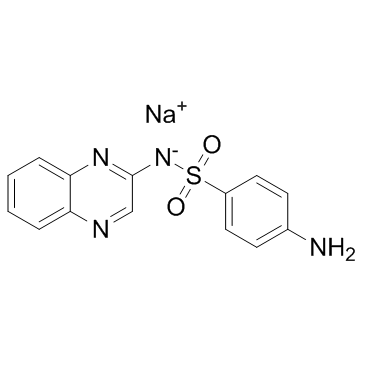
CAS Number967-80-6
SynonymsSodium sulfaquinoxaline; SULFQUINOXALINE SODIUM; Sodium [(4-aminophenyl)sulfonyl](2-quinoxalinyl)azanide; SULFAQUINOXAINESODIUM; MFCD00799608; SULFAQUINOXALINE SOD.; SULFAQUINOXALINE SODIUM CP2000; n'1-quinoxalin-2-ylsulphanilamide sodium salt; Einecs 213-526-2; EMbazin; SULFAQUINOXALINE SODIUM
Molecular FormulaC14H11N4NaO2S
Molecular Weight322.318
Purity98.00%
Boiling Point551.1ºC at 760 mmHg
Melting Point>296ºC (dec.)
Symbol
Signal WordWarning
| Chemical & Physical Properties | |
|---|---|
| CAS Number | 967-80-6 |
| Catalog No. | 2A-9025797 |
| Chinese Name | 磺胺喹恶啉钠 |
| Synonyms | Sodium sulfaquinoxaline; SULFQUINOXALINE SODIUM; Sodium [(4-aminophenyl)sulfonyl](2-quinoxalinyl)azanide; SULFAQUINOXAINESODIUM; MFCD00799608; SULFAQUINOXALINE SOD.; SULFAQUINOXALINE SODIUM CP2000; n'1-quinoxalin-2-ylsulphanilamide sodium salt; Einecs 213-526-2; EMbazin; SULFAQUINOXALINE SODIUM |
| Molecular Formula | C14H11N4NaO2S |
| Molecular Weight | 322.318 |
| Purity | 98.00 |
| Boiling Point | 551.1ºC at 760 mmHg |
| Melting Point | >296ºC (dec.) |
| Water Solubility | H2O: 50 mg/mL, clear to almost clear, dark yellow |
| Storage Condition | 0-6°C |
| Application | Sulfaquinoxaline sodium salt is a broad-spectrum antibiotic with inhibitory activity against a variety of Gram-negative and Gram-positive bacteria. |
| HTC | 2935009090 |
| SMILES | Nc1ccc(S(=O)(=O)[N-]c2cnc3ccccc3n2)cc1.[Na+] |
| InChI | InChI=1S/C14H12N4O2S.Na/c15-10-5-7-11(8-6-10)21(19,20)18-14-9-16-12-3-1-2-4-13(12)17-14;/h1-9H,15H2,(H,17,18,19,20);/q;+1/p-1 |
| InChI Key | WXUQBKOBXREBBX-UHFFFAOYSA-N |
| Hazard Symbols | transportation |
| MSDS | msds/25797_2_967_80_6.pdf |
| Bioactivity | Sulfaquinoxaline sodium salt is an antibiotic which has activity against a broad spectrum of Gram-negative and Gram-positive bacteria. Related Catalog Signaling Pathways >> Anti-infection >> Bacterial Research Areas >> Infection Target Bacterial[1] In Vivo The antimicrobial Sulfaquinoxaline sodium salt has activity against a broad spectrum of Gram-negative and Gram-positive bacteria and is widely used in poultry production as therapeutic or prophylactic agent. Concentrations of Sulfaquinoxaline sodium salt that are higher than the drug's maximum residue limit (MRL) (100 μg/kg) are found in the breast muscle until the 36th day of breeding in this study[1]. Animal Admin For the depletion studies, 240 1-day-old Cobb chicks are used. The chickens are housed in pens that contains 30 birds each (10 birds/m2) and are provided ad libitum access to water and non-medicated feed. The chickens are randomly allocated into four experimental groups, labeled from A to D, containing 80 birds each. Chickens in group A form the untreated control group, whereas those in group C are treated with 10 mg/kg bw of Sulfaquinoxaline sodium salt, which is administered via drinking water from the 32nd to 34th day of breeding[1]. References [1]. de Assis DC, et al. Evaluation of the Presence and Levels of Enrofloxacin, Ciprofloxacin, Sulfaquinoxaline and Oxytetracycline in Broiler Chickens after Drug Administration. PLoS One. 2016 Nov 15;11(11):e0166402. Chemical & Physical Properties Boiling Point 551.1ºC at 760 mmHg Melting Point >296ºC (dec.) Molecular Formula C14H11N4NaO2S Molecular Weight 322.318 Flash Point 287.1ºC Exact Mass 322.050049 PSA 94.32000 LogP 4.26810 InChIKey WXUQBKOBXREBBX-UHFFFAOYSA-N SMILES Nc1ccc(S(=O)(=O)[N-]c2cnc3ccccc3n2)cc1.[Na+] Storage condition 0-6°C Water Solubility H2O: 50 mg/mL, clear to almost clear, dark yellow |
| Use of | Sulfaquinoxaline sodium salt is an antibiotic which has activity against a broad spectrum of Gram-negative and Gram-positive bacteria. Properties Name sulfaquinoxaline sodium salt Synonym More Synonyms Sulfaquinoxaline sodium salt Biological Activity Description Sulfaquinoxaline sodium salt is an antibiotic which has activity against a broad spectrum of Gram-negative and Gram-positive bacteria. Related Catalog Signaling Pathways >> Anti-infection >> Bacterial Research Areas >> Infection Bacterial[1] In Vivo The antimicrobial Sulfaquinoxaline sodium salt has activity against a broad spectrum of Gram-negative and Gram-positive bacteria and is widely used in poultry production as therapeutic or prophylactic agent. Concentrations of Sulfaquinoxaline sodium salt that are higher than the drug's maximum residue limit (MRL) (100 μg/kg) are found in the breast muscle until the 36th day of breeding in this study[1]. References [1]. de Assis DC, et al. Evaluation of the Presence and Levels of Enrofloxacin, Ciprofloxacin, Sulfaquinoxaline and Oxytetracycline in Broiler Chickens after Drug Administration. PLoS One. 2016 Nov 15;11(11):e0166402. Chemical & Physical Properties Molecular Formula C14H11N4NaO2S Exact Mass 322.050049 PSA 94.32000 LogP 4.26810 InChIKey WXUQBKOBXREBBX-UHFFFAOYSA-N |
| Tax Rebate | 9.0% |
| Supervision | None MFN tariff: 6.5% Ordinary tariff: 35.0% |
| Transport Info | Shipping Name: UN |
| MSDS Transport Info | Module 14. Shipping information 14.1 UN dangerous goods number European Land Transport Dangerous Regulations: -International Maritime Dangerous Regulations: -International Air Transport Dangerous Regulations: - 14.2 United Nations shipping name European Land Transport Dangerous Regulations: Non-dangerous goods IMDG Code: Non-dangerous goods International air transport dangerous goods regulations: non-dangerous goods 14.3 Transport hazard categories European Land Transport Dangerous Regulations: -International Maritime Dangerous Regulations: -International Air Transport Dangerous Regulations: - 14.4 Package group European Land Transport Dangerous Regulations: -International Maritime Dangerous Regulations: -International Air Transport Dangerous Regulations: - 14.5 Environmental hazards European Land Transport Danger Regulations: No International Maritime Danger Regulations International Air Transport Danger Regulations: No Marine pollutants (yes/no): No 14.6 Special reminder to users No data available The above information is believed to be correct, but is not all-inclusive and should be used as a guide only. The information in this document is based on our current knowledge and is Correct safety instructions apply to this product. This information does not represent a warranty as to the properties of this product. See reverse side of invoice or packing slip. |
| Related Products in Pharmaceutical Intermediates | ||
|---|---|---|
| 6-Nitrobicyclo[2.2.1]hept-2-ene | 874-44-2 | 2A-9025504 |
| 3-BROMO-8-METHOXYIMIDAZO[1,2-A]PYRAZINE | 91775-62-1 | 2A-9025596 |
| (R)-2-Aminocyclohenanol | 931-16-8 | 2A-9025661 |
| 5-Methylimidazo[1,2-a]pyridine | 933-69-7 | 2A-9025687 |
| (R)-(-)-1-Methyl-3-phenylpropylamine | 937-52-0 | 2A-9025716 |
| (2R,3S)-2-Amino-3-methylsuccinic acid | 1114-07-4 | 2A-9026146 |
| (R)-2-Phenoxypropionic acid | 1129-46-0 | 2A-9026280 |
| 4-Ethoxybenzenesulfonyl chloride | 1132-17-8 | 2A-9026291 |
| 4-Fluorophenyl isocyanate | 1195-45-5 | 2A-9026440 |
| Butanoic acid, 4-[[2-[(1R,2R,3R)-3-hydroxy-2-[(1E,3S)-3-hydroxy-4-[3-(methoxymethyl)phenyl]-1-butenyl]-5-oxocyclopentyl]ethyl]thio]-, methyl ester | 256382-08-8 | 2A-9026624 |
| Browse all Pharmaceutical Intermediates products » | ||
Phone:
630-322-8886
630-322-8887
Email:
Office Locations:
Chicago, IL, USA
San Francisco, CA, USA


 EN
EN


 SDS
SDS