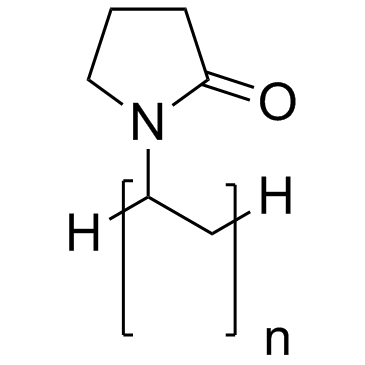
CAS Number9003-39-8
Synonymsk60; Polyvinylpyrrolidone; PVP; Kollidon K25; Kollidon K-90; k25; MFCD00149016; POP; Kollidon 25; k115; pvp2; pvp3; K-30; pvp4; PVPD
Molecular Formula(C6H9NO)n
Molecular Weight111.1418 (monomer)
Purity95.00%
Density1.144g/cm3
Boiling Point217.6ºC at 760 mmHg
Melting Point130ºC
Appearancepowder
Symbol
Signal WordWarning
| Chemical & Physical Properties | |
|---|---|
| CAS Number | 9003-39-8 |
| Catalog No. | 2A-0200315 |
| Chinese Name | 聚乙烯吡咯烷酮 |
| Synonyms | k60; Polyvinylpyrrolidone; PVP; Kollidon K25; Kollidon K-90; k25; MFCD00149016; POP; Kollidon 25; k115; pvp2; pvp3; K-30; pvp4; PVPD |
| Molecular Formula | (C6H9NO)n |
| Molecular Weight | 111.1418 (monomer) |
| Purity | 95.00 |
| Density | 1.144g/cm3 |
| Boiling Point | 217.6ºC at 760 mmHg |
| Melting Point | 130ºC |
| Appearance | powder |
| Water Solubility | H2O: soluble100mg/mL |
| Storage Condition | Sealed at room temperature, protected from light, |
| Application | Polyvinylpyrrolidone is widely used in human and veterinary medicine as an effective wound healing promoter and disinfectant when combined with iodine and other compounds. |
| HTC | 3905990000 |
| PubChem ID | 24899319 |
| MDL Number | MFCD00149016 |
| SMILES | C=CN1CCCC1=O |
| InChI | 1S/C6H9NO/c1-2-7-5-3-4-6(7)8/h2H,1,3-5H2 |
| InChI Key | WHNWPMSKXPGLAX-UHFFFAOYSA-N |
| NACRES Code | NA.25 |
| UNSPSC | 12161700 |
| Hazard Symbols | transportation |
| MSDS | msds/25050_1_9003_39_8.pdf |
| Bioactivity | Polyvinylpyrrolidone is a compound which has been widely tested and used in human and veterinary medicine as an effective wound healing accelerator and disinfectant when combined with iodine and other compounds. Related Catalog Signaling Pathways >> Others >> Others Research Areas >> Infection Biochemical Assay Reagents In Vivo Goldfishes which are treated with salt have significantly lower mucus weights at 25 h. Goldfishes treated with Polyvinylpyrrolidone (PVP) have significantly higher mucus weights at 25 h. Koi treated with salt and Polyvinylpyrrolidone (PVP) has significantly lower mucus weight at 1 and 25 h. Control koi has significantly higher mucus at 25 h. At the end of 2 weeks, it is determined that the three koi treated with salt and Polyvinylpyrrolidone(PVP) remain healthy and show a higher degree of healing than other treatment koi and the control group[1]. Animal Admin Each fish within a tank serves as a replicate. Treatments are designated as Polyvinylpyrrolidone (at a dose of 10 mL/10 gallon) and saline/salt at 3g/L. A control group that does not receive any chemical is also included in the study. All fishes from each treatment group are sampled at 0 min, 15 min, 1 h, 4 h and 25 h. At each time interval, all fishes from each treatment group are anaesthetized using buffered tricaine methanesulfonate, weighed, and slime is scraped from one 1 cm2 area over the epaxial musculature using a preweighed plastic coverslip[1]. References [1]. Shivappa RB, et al. Laboratory evaluation of different formulations of Stress Coat? for slime production in goldfish (Carassius auratus) and koi (Cyprinus carpio). PeerJ. 2017 Sep 6;5:e3759. Chemical & Physical Properties Density 1.144g/cm3 Boiling Point 217.6ºC at 760 mmHg Melting Point 130ºC Molecular Formula (C6H9NO)n Molecular Weight 111.1418 (monomer) Flash Point 93.9ºC PSA 20.31000 LogP 0.69020 Storage condition Store at RT. Water Solubility H2O: soluble100mg/mL |
| Use of | Polyvinylpyrrolidone is a compound which has been widely tested and used in human and veterinary medicine as an effective wound healing accelerator and disinfectant when combined with iodine and other compounds. Properties Articles125 Name poly(vinylpyrrolidone) Synonym More Synonyms Polyvinylpyrrolidone Biological Activity Description Polyvinylpyrrolidone is a compound which has been widely tested and used in human and veterinary medicine as an effective wound healing accelerator and disinfectant when combined with iodine and other compounds. Related Catalog Signaling Pathways >> Others >> Others Research Areas >> Infection Biochemical Assay Reagents In Vivo Goldfishes which are treated with salt have significantly lower mucus weights at 25 h. Goldfishes treated with Polyvinylpyrrolidone (PVP) have significantly higher mucus weights at 25 h. Koi treated with salt and Polyvinylpyrrolidone (PVP) has significantly lower mucus weight at 1 and 25 h. Control koi has significantly higher mucus at 25 h. At the end of 2 weeks, it is determined that the three koi treated with salt and Polyvinylpyrrolidone(PVP) remain healthy and show a higher degree of healing than other treatment koi and the control group[1]. References [1]. Shivappa RB, et al. Laboratory evaluation of different formulations of Stress Coat? for slime production in goldfish (Carassius auratus) and koi (Cyprinus carpio). PeerJ. 2017 Sep 6;5:e3759. Chemical & Physical Properties Molecular Formula (C6H9NO)n PSA 20.31000 LogP 0.69020 Storage condition Store at RT. |
| Transport Info | Product name: Purity: 0.0% |
| MSDS Transport Info | Module 14. Shipping information 14.1 UN number European Land Transport Dangerous Regulations: -International Maritime Dangerous Regulations: -International Air Transport Dangerous Regulations: - 14.2 Names specified by the United Nations (UN) European Land Transport Dangerous Regulations: No dangerous goods IMDG Code: No dangerous goods International Air Transport Dangerous Regulations: No dangerous goods 14.3 Transport hazard categories European Land Transport Dangerous Regulations: -International Maritime Dangerous Regulations: -International Air Transport Dangerous Regulations: - 14.4 Package group European Land Transport Dangerous Regulations: -International Maritime Dangerous Regulations: -International Air Transport Dangerous Regulations: - 14.5 Environmental hazards European Land Transport Dangerous Regulations: No International Maritime Transport Dangerous Regulations Maritime Pollutants: No International Air Transport Risk Regulations: No 14.6 Special precautions for users No data available |
| Related Products in Specialty Chemicals | ||
|---|---|---|
| Ethyl 4-phenylacetoacetate | 718-08-1 | 2A-9025041 |
| Ethylphenylcyano-acetic acid ethyl ester | 718-71-8 | 2A-9025042 |
| 2,6-Di-tert-butyl-p-benzoquinone | 719-22-2 | 2A-9025043 |
| 2-Amino-5-chlorobenzophenone | 719-59-5 | 2A-9025045 |
| Methyl 4-phenylbenzoate | 720-75-2 | 2A-9025049 |
| 4,4'-Dithiodianiline | 722-27-0 | 2A-9025053 |
| Diphenyliodonium nitrate | 722-56-5 | 2A-9025054 |
| 1-Phenylisatin | 723-89-7 | 2A-9025057 |
| 2-(Phenoxymethyl)benzoic acid | 724-98-1 | 2A-9025058 |
| Linderalactone | 728-61-0 | 2A-9025060 |
| Browse all Specialty Chemicals products » | ||
Phone:
630-322-8886
630-322-8887
Email:
Office Locations:
Chicago, IL, USA
San Francisco, CA, USA


 EN
EN


 SDS
SDS