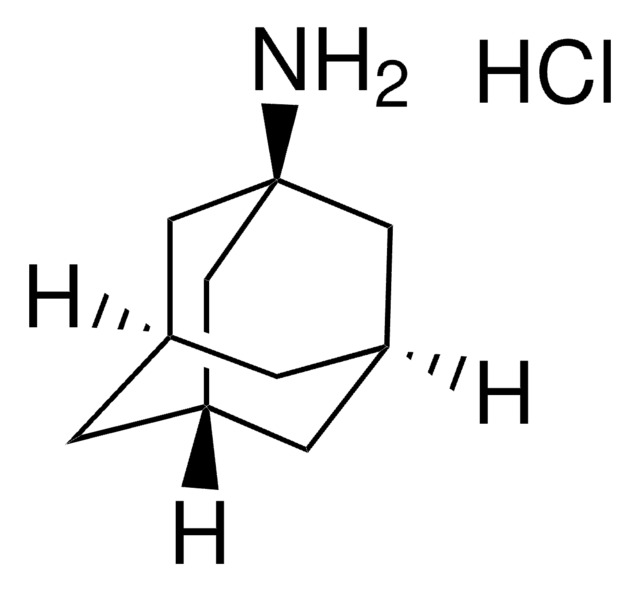
CAS Number665-66-7
SynonymsAmazolon; adamantanamine hydrochloride; Amantadine HCl; Lysovir; EINECS 211-560-2; MFCD00074723; virasol; 1-aminoadamantane hydrochloride; Virofral; 1-Adamantanaminehydrochloride; Mantadix; 1-adamantamine hydrochloride; Midantan; 1-Adamantanamine hydrochloride; Adekin; Mantadan; 1-adamantylamine hydrochloride; exp105-1; Amantadine hydrochloride; Amantadine (hydrochloride)
Molecular FormulaC10H18ClN
Molecular Weight187.71
Purity98.00%
Density1.067g/cm3
Boiling Point225.7ºC at 760 mmHg
Melting Point>300 °C(lit.)
Appearancepowder
EINECS211-560-2
| Chemical & Physical Properties | |
|---|---|
| CAS Number | 665-66-7 |
| Catalog No. | 2A-9024795 |
| Chinese Name | 盐酸金刚烷胺 |
| Synonyms | Amazolon; adamantanamine hydrochloride; Amantadine HCl; Lysovir; EINECS 211-560-2; MFCD00074723; virasol; 1-aminoadamantane hydrochloride; Virofral; 1-Adamantanaminehydrochloride; Mantadix; 1-adamantamine hydrochloride; Midantan; 1-Adamantanamine hydrochloride; Adekin; Mantadan; 1-adamantylamine hydrochloride; exp105-1; Amantadine hydrochloride; Amantadine (hydrochloride) |
| Molecular Formula | C10H18ClN |
| Molecular Weight | 187.71 |
| Purity | 98.00 |
| Density | 1.067g/cm3 |
| Boiling Point | 225.7ºC at 760 mmHg |
| Melting Point | >300 °C(lit.) |
| Appearance | powder |
| Water Solubility | soluble |
| Storage Condition | Store in an airtight container in a cool, dry plac |
| Application | Amantadine hydrochloride is an anti-influenza virus and anti-Parkinson's disease compound. |
| EINECS | 211-560-2 |
| HTC | 2921300090 |
| PubChem ID | 24277882 |
| MDL Number | MFCD00074723 |
| SMILES | Cl[H].[H][C@@]12C[C@@]3([H])C[C@@]([H])(C1)CC(N)(C2)C3 |
| InChI | 1S/C10H17N.ClH/c11-10-4-7-1-8(5-10)3-9(2-7)6-10;/h7-9H,1-6,11H2;1H/t7-,8+,9-,10-; |
| InChI Key | WOLHOYHSEKDWQH-SOVZANNPSA-N |
| Beilstein/REAXYS | 4198854 |
| NACRES Code | NA.77 |
| UNSPSC | 12352200 |
| MSDS | msds/24795_1_665_66_7.pdf |
| Bioactivity | Amantadine Hydrochloride is an antiviral and an antiparkinsonian drug.Target: Influenza VirusAmantadine is an antiviral that is used in the prophylactic or symptomatic treatment of influenza A. It is also used as an antiparkinsonian agent, to treat extrapyramidal reactions, and for postherpetic neuralgia. Amantadine binding of M2, based on studies of a peptide representing the M2 transmembrane segment in dodecylphosphocholine micelles. Amantadine competes with protons for binding to the deprotonated tetramer, thereby stabilizing the tetramer in a slightly altered conformation. This model accounts for the observed inhibition of proton flux by amantadine [1]. In contrast to most other described channel-blocking molecules, amantadine causes the channel gate of NMDA receptors to close more quickly. Amantadine binding inhibits current flow through NMDA receptor channels but show that its main inhibitory action at pharmaceutically relevant concentrations results from stabilization of closed states of the channel [2]. Related Catalog Signaling Pathways >> Anti-infection >> Influenza Virus Research Areas >> Infection References [1]. Salom, D., et al., pH-dependent tetramerization and amantadine binding of the transmembrane helix of M2 from the influenza A virus. Biochemistry, 2000. 39(46): p. 14160-70. [2]. Blanpied, T.A., R.J. Clarke, and J.W. Johnson, Amantadine inhibits NMDA receptors by accelerating channel closure during channel block. J Neurosci, 2005. 25(13): p. 3312-22. Chemical & Physical Properties Density 1.067g/cm3 Boiling Point 225.7ºC at 760 mmHg Melting Point >300 °C(lit.) Molecular Formula C10H18ClN Molecular Weight 187.710 Flash Point 96ºC Exact Mass 187.112778 PSA 26.02000 LogP 3.41620 Index of Refraction 1.558 InChIKey WOLHOYHSEKDWQH-UHFFFAOYSA-N SMILES Cl.NC12CC3CC(CC(C3)C1)C2 Water Solubility soluble |
| Use of | Amantadine Hydrochloride is an antiviral and an antiparkinsonian drug.Target: Influenza VirusAmantadine is an antiviral that is used in the prophylactic or symptomatic treatment of influenza A. It is also used as an antiparkinsonian agent, to treat extrapyramidal reactions, and for postherpetic neuralgia. Amantadine binding of M2, based on studies of a peptide representing the M2 transmembrane segment in dodecylphosphocholine micelles. Amantadine competes with protons for binding to the deprotonated tetramer, thereby stabilizing the tetramer in a slightly altered conformation. This model accounts for the observed inhibition of proton flux by amantadine [1]. In contrast to most other described channel-blocking molecules, amantadine causes the channel gate of NMDA receptors to close more quickly. Amantadine binding inhibits current flow through NMDA receptor channels but show that its main inhibitory action at pharmaceutically relevant concentrations results from stabilization of closed states of the channel [2]. Properties Articles47 Name amantadine hydrochloride Synonym More Synonyms 1-Adamantanamine hydrochloride Biological Activity Description Amantadine Hydrochloride is an antiviral and an antiparkinsonian drug.Target: Influenza VirusAmantadine is an antiviral that is used in the prophylactic or symptomatic treatment of influenza A. It is also used as an antiparkinsonian agent, to treat extrapyramidal reactions, and for postherpetic neuralgia. Amantadine binding of M2, based on studies of a peptide representing the M2 transmembrane segment in dodecylphosphocholine micelles. Amantadine competes with protons for binding to the deprotonated tetramer, thereby stabilizing the tetramer in a slightly altered conformation. This model accounts for the observed inhibition of proton flux by amantadine [1]. In contrast to most other described channel-blocking molecules, amantadine causes the channel gate of NMDA receptors to close more quickly. Amantadine binding inhibits current flow through NMDA receptor channels but show that its main inhibitory action at pharmaceutically relevant concentrations results from stabilization of closed states of the channel [2]. Related Catalog Signaling Pathways >> Anti-infection >> Influenza Virus Research Areas >> Infection References [1]. Salom, D., et al., pH-dependent tetramerization and amantadine binding of the transmembrane helix of M2 from the influenza A virus. Biochemistry, 2000. 39(46): p. 14160-70. [2]. Blanpied, T.A., R.J. Clarke, and J.W. Johnson, Amantadine inhibits NMDA receptors by accelerating channel closure during channel block. J Neurosci, 2005. 25(13): p. 3312-22. Chemical & Physical Properties Exact Mass 187.112778 PSA 26.02000 LogP 3.41620 Index of Refraction 1.558 InChIKey WOLHOYHSEKDWQH-UHFFFAOYSA-N Water Solubility soluble |
| Tax Rebate | 9.0% |
| Supervision | None MFN tariff: 6.5% Ordinary tariff: 30.0% |
| Transport Info | Product name: Purity: 99.0% |
| MSDS Transport Info | Module 14. Shipping information United Nations classification: inconsistent with United Nations classification standards UN number: not specified |
| Related Products in Specialty Chemicals | ||
|---|---|---|
| Diethylamine hydrochloride | 660-68-4 | 2A-9024789 |
| 5-Aminovaleric acid | 660-88-8 | 2A-9024790 |
| 1-Docosanol | 661-19-8 | 2A-9024791 |
| Hexamethylditin | 661-69-8 | 2A-9024792 |
| Tetraethylammonium fluoride dihydrate | 665-46-3 | 2A-9024794 |
| Pantothenyl ethyl ether | 667-83-4 | 2A-9024797 |
| DL-Pantothenyl ethyl ether | 667-84-5 | 2A-9024798 |
| N-Morpholino-1-cyclohexene | 670-80-4 | 2A-9024801 |
| 4-Chloro-3-iodobenzotrifluoride | 672-57-1 | 2A-9024811 |
| (1-Chloroethyl)benzene | 672-65-1 | 2A-9024813 |
| Browse all Specialty Chemicals products » | ||
Phone:
630-322-8886
630-322-8887
Email:
Office Locations:
Chicago, IL, USA
San Francisco, CA, USA


 EN
EN


 SDS
SDS