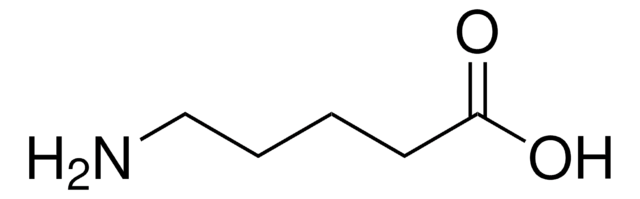
CAS Number660-88-8
Synonyms5-amino valeric acid; δ-Aminovaleric acid; EINECS 211-544-5; 5-Aminopentanoic acid; 5-Aminovaleric acid; MFCD00008232; H-5-Ava-OH
Molecular FormulaNH2(CH2)4CO2H
Molecular Weight117.15
Purity97%
Density1.1±0.1 g/cm3
Boiling Point247.5±23.0 °C at 760 mmHg
Melting Point158-161 °C (lit.)
Appearancesolid
EINECS211-544-5
Symbol
Signal WordWarning
| Chemical & Physical Properties | |
|---|---|
| CAS Number | 660-88-8 |
| Catalog No. | 2A-9024790 |
| Chinese Name | 5-氨基戊酸 |
| Synonyms | 5-amino valeric acid; δ-Aminovaleric acid; EINECS 211-544-5; 5-Aminopentanoic acid; 5-Aminovaleric acid; MFCD00008232; H-5-Ava-OH |
| Molecular Formula | NH2(CH2)4CO2H |
| Molecular Weight | 117.15 |
| Purity | 97 |
| Density | 1.1±0.1 g/cm3 |
| Boiling Point | 247.5±23.0 °C at 760 mmHg |
| Melting Point | 158-161 °C (lit.) |
| Appearance | solid |
| Storage Condition | This product should be kept sealed. |
| Application | 5-Aminovaleric acid is considered to be the methylene homologue of GABA and is a weak agonist of GABA. |
| EINECS | 211-544-5 |
| HTC | 2922499990 |
| PubChem ID | 24847525 |
| MDL Number | MFCD00008232 |
| SMILES | NCCCCC(O)=O |
| InChI | 1S/C5H11NO2/c6-4-2-1-3-5(7)8/h1-4,6H2,(H,7,8) |
| InChI Key | JJMDCOVWQOJGCB-UHFFFAOYSA-N |
| Beilstein/REAXYS | 906833 |
| NACRES Code | NA.22 |
| UNSPSC | 12352106 |
| Hazard Symbols | transportation |
| MSDS | msds/24790_1_660_88_8.pdf |
| Bioactivity | 5-Aminovaleric acid is believed to act as a methylene homologue of gamma-aminobutyric acid (GABA) and functions as a weak GABA agonist. Related Catalog Research Areas >> Metabolic Disease Research Areas >> Neurological Disease Natural Products >> Others Target Human Endogenous Metabolite In Vitro 5-Aminovaleric acid is a normal metabolite present in human saliva, with a tendency to elevated concentration in patients with chronic periodontitis[1]. 5-Aminovaleric acid is also believed to act as a methylene homologue of gamma-aminobutyric acid (GABA) and functions as a weak GABA agonist[2]. It is also known as an antifibrinolytic amino acid analog and so it functions as a weak inhibitor of the blood clotting pathway[3]. References [1]. Syrjänen S, et al. Free amino-acid content of wax-stimulated human whole saliva as related to periodontal disease. Arch Oral Biol. 1987;32(9):607-10. [2]. Callery PS, et al. 1-Piperideine as an in vivo precursor of the gamma-aminobutyric acid homologue 5-aminopentanoic acid. J Neurochem. 1985 Sep;45(3):946-8. [3]. Cole KR, et al. The binding of antifibrinolytic amino acids to kringle-4-containing fragments of plasminogen. Arch Biochem Biophys. 1984 Mar;229(2):568-75. Chemical & Physical Properties Density 1.1±0.1 g/cm3 Boiling Point 247.5±23.0 °C at 760 mmHg Melting Point 158-161 °C(lit.) Molecular Formula C5H11NO2 Molecular Weight 117.146 Flash Point 103.5±22.6 °C Exact Mass 117.078979 PSA 63.32000 LogP -0.34 Vapour Pressure 0.0±1.0 mmHg at 25°C Index of Refraction 1.466 Storage condition Store at 0-5°C |
| Use of | 5-Aminovaleric acid is believed to act as a methylene homologue of gamma-aminobutyric acid (GABA) and functions as a weak GABA agonist. Properties Articles40 Name 5-aminopentanoic acid Synonym More Synonyms 5-Aminovaleric acid Biological Activity Description 5-Aminovaleric acid is believed to act as a methylene homologue of gamma-aminobutyric acid (GABA) and functions as a weak GABA agonist. Related Catalog Research Areas >> Metabolic Disease Research Areas >> Neurological Disease Natural Products >> Others Human Endogenous Metabolite In Vitro 5-Aminovaleric acid is a normal metabolite present in human saliva, with a tendency to elevated concentration in patients with chronic periodontitis[1]. 5-Aminovaleric acid is also believed to act as a methylene homologue of gamma-aminobutyric acid (GABA) and functions as a weak GABA agonist[2]. It is also known as an antifibrinolytic amino acid analog and so it functions as a weak inhibitor of the blood clotting pathway[3]. References [1]. Syrjänen S, et al. Free amino-acid content of wax-stimulated human whole saliva as related to periodontal disease. Arch Oral Biol. 1987;32(9):607-10. [2]. Callery PS, et al. 1-Piperideine as an in vivo precursor of the gamma-aminobutyric acid homologue 5-aminopentanoic acid. J Neurochem. 1985 Sep;45(3):946-8. [3]. Cole KR, et al. The binding of antifibrinolytic amino acids to kringle-4-containing fragments of plasminogen. Arch Biochem Biophys. 1984 Mar;229(2):568-75. Chemical & Physical Properties Molecular Formula C5H11NO2 Exact Mass 117.078979 PSA 63.32000 LogP -0.34 Index of Refraction 1.466 |
| Tax Rebate | 9.0% |
| Supervision | A. Customs clearance form for inbound goods B. Customs clearance form for outbound goods |
| Inspection | P. Quarantine of entry animals, plants, and animal and plant products Q. Quarantine of exit animals, plants, and animal and plant products R. Hygiene supervision and inspection of imported food S. Hyg |
| Transport Info | Product name: Purity: 98.0% |
| MSDS Transport Info | Module 14. Shipping information 14.1 UN dangerous goods number European Land Transport Dangerous Regulations: -International Maritime Dangerous Regulations: -International Air Transport Dangerous Regulations: - 14.2 Names specified by the United Nations (UN) European Land Transport Dangerous Regulations: Non-dangerous goods IMDG Code: Non-dangerous goods International air transport dangerous goods regulations: non-dangerous goods 14.3 Transport hazard categories European Land Transport Dangerous Regulations: -International Maritime Dangerous Regulations: -International Air Transport Dangerous Regulations: - 14.4 Package group European Land Transport Dangerous Regulations: -International Maritime Dangerous Regulations: -International Air Transport Dangerous Regulations: - 14.5 Environmental hazards European Land Transport Dangerous Regulations: No International Maritime Transport Dangerous Regulations Maritime Pollutants: No International Air Transport Risk Regulations: No 14.6 Special reminder to users No data available |
| Related Products in Specialty Chemicals | ||
|---|---|---|
| Hexamidine diisethionate | 659-40-5 | 2A-9024785 |
| Isopentyl isopentanoate | 659-70-1 | 2A-9024786 |
| Diisopropylammonium dichloroacetate | 660-27-5 | 2A-9024787 |
| Cupric stearate | 660-60-6 | 2A-9024788 |
| Diethylamine hydrochloride | 660-68-4 | 2A-9024789 |
| 1-Docosanol | 661-19-8 | 2A-9024791 |
| Hexamethylditin | 661-69-8 | 2A-9024792 |
| Tetraethylammonium fluoride dihydrate | 665-46-3 | 2A-9024794 |
| 1-Adamantanamine hydrochloride | 665-66-7 | 2A-9024795 |
| Pantothenyl ethyl ether | 667-83-4 | 2A-9024797 |
| Browse all Specialty Chemicals products » | ||
Phone:
630-322-8886
630-322-8887
Email:
Office Locations:
Chicago, IL, USA
San Francisco, CA, USA


 EN
EN


 SDS
SDS