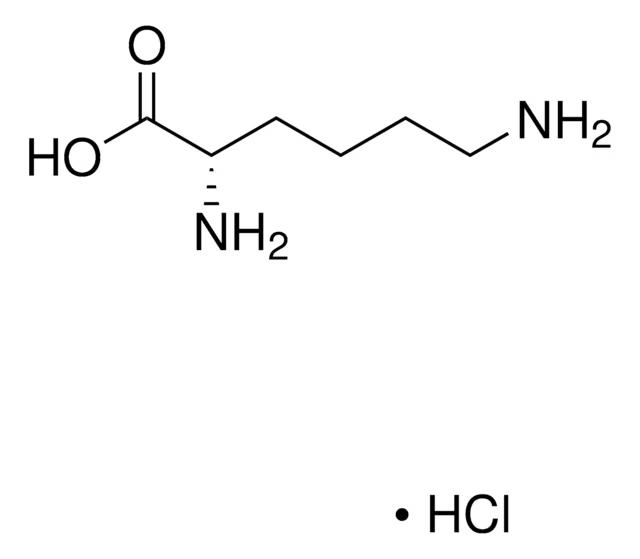
CAS Number657-27-2
SynonymsH-Lys-OH.HCl; MFCD00064564; L-Lysinehydrochloride; (2S)-2,6-Diaminohexanoic acid monohydrochloride; L-Lysine, monohydrochloride; L-LYS HCL; Lysine hydrochloride; L-Lysine HCl; LYSINE-L HCL; L-Lysine hydrochloride; LYS,HCL; anhydrous L-lysine monohydrochloride; EINECS 211-519-9; L-Lysine, hydrochloride (1:1); (S)-2,6-Diaminohexanoic acid monohydrochloride; H-Lys-OH hydrochloride; (S)-2,6-Diaminohexanoic acid hydrochloride; L-Lysine chlorhydrate; L-Lysine, hydrochloride; LYSINE HCL; (2S)-2,6-diaminohexanoic acid hydrochloride; L-Lysine hydrochloride (1:1)
Molecular FormulaH2N(CH2)4CH(NH2)CO2H·HCl
Molecular Weight182.65
Purity98.5-101.0%
Boiling Point311.5ºC at 760 mmHg
Melting Point263 °C (dec.) (lit.)
Appearancepowder
EINECS211-519-9
Symbol
Signal WordWarning
| Chemical & Physical Properties | |
|---|---|
| CAS Number | 657-27-2 |
| Catalog No. | 2A-9024771 |
| Chinese Name | L-赖氨酸盐酸盐 |
| Synonyms | H-Lys-OH.HCl; MFCD00064564; L-Lysinehydrochloride; (2S)-2,6-Diaminohexanoic acid monohydrochloride; L-Lysine, monohydrochloride; L-LYS HCL; Lysine hydrochloride; L-Lysine HCl; LYSINE-L HCL; L-Lysine hydrochloride; LYS,HCL; anhydrous L-lysine monohydrochloride; EINECS 211-519-9; L-Lysine, hydrochloride (1:1); (S)-2,6-Diaminohexanoic acid monohydrochloride; H-Lys-OH hydrochloride; (S)-2,6-Diaminohexanoic acid hydrochloride; L-Lysine chlorhydrate; L-Lysine, hydrochloride; LYSINE HCL; (2S)-2,6-diaminohexanoic acid hydrochloride; L-Lysine hydrochloride (1:1) |
| Molecular Formula | H2N(CH2)4CH(NH2)CO2H·HCl |
| Molecular Weight | 182.65 |
| Purity | 98.5-101.0 |
| Boiling Point | 311.5ºC at 760 mmHg |
| Melting Point | 263 °C (dec.) (lit.) |
| Appearance | powder |
| Water Solubility | 65 g/100 mL (20 ºC) |
| Storage Condition | Sealed packaging in brown glass bottles. Store in |
| Application | L-lysine hydrochloride is an essential amino acid for humans and has a variety of benefits, including treating herpes, increasing calcium absorption, reducing diabetes-related illness and improving gu |
| EINECS | 211-519-9 |
| HTC | 29224100 |
| PubChem ID | 24896502 |
| MDL Number | MFCD00064564 |
| SMILES | OC([C@@H](N)CCCCN)=O.[H]Cl |
| InChI | 1S/C6H14N2O2.ClH/c7-4-2-1-3-5(8)6(9)10;/h5H,1-4,7-8H2,(H,9,10);1H/t5-;/m0./s1 |
| InChI Key | BVHLGVCQOALMSV-JEDNCBNOSA-N |
| Beilstein/REAXYS | 3563889 |
| NACRES Code | NA.26 |
| UNSPSC | 12352209 |
| Hazard Symbols | transportation |
| MSDS | msds/24771_1_657_27_2.pdf |
| Bioactivity | L-lysine hydrochloride is an essential amino acid for humans with various benefits including treating herpes, increasing calcium absorption, reducing diabetes-related illnesses and improving gut health. Related Catalog Signaling Pathways >> Others >> Others Research Areas >> Endocrinology Natural Products >> Others Research Areas >> Cardiovascular Disease Research Areas >> Inflammation/Immunology Research Areas >> Infection In Vivo L-lysine treatment attenuates pancreatic tissue injury induced by L-arginine by inhibiting the release of the inflammatory cytokine IL-6 and enhances antioxidant activity. Pre- or post-treatment with L-lysine leads to significant decreases in the levels of malondialdehyde and nitric oxide, while significant enhancement is observed in the activities of antioxidant enzymes (superoxide dismutase, catalase, and glutathione peroxidase) and glutathione[1]. L-lysine supplementation almost completely ameliorates vascular calcification. Dietary L-lysine strongly suppresses plasma intact parathyroid hormone in adenine rats and supports a proper bone-vascular axis. The conserved orientation of the femoral apatite in group Lys also evidences the bone-protective effects of L-lysine. Dietary L-lysine elevates plasma alanine, proline, arginine, and homoarginine but not lysine[2]. The dose-dependent delay in gastric emptying observed in rats is confirmed in humans with an increase in halftime of gastric emptying of 4 min/g L-lysine. Moreover, a dose-dependent increase in intestinal fluid accumulation is observed (0.4 mL/min/g L-lysine)[3]. Animal Admin Rats: Nephrocalcinosis in 6-week-old male Wistar rats is induced by continuous injection of rat PTH 1-34 at a dosage of 40 μg/kg per day via an osmotic mini-pump for 50 hours. L-lysine HCl or glycine at a dose of 20 mmol/kg is administered via a gastric tube at 2 hours, 14 hours, 26 hours, and 38 hours after the implantation of the osmotic pump. At the indicated periods, Serum and urinary biochemical parameters, urea nitrogen, albumin, calcium, inorganic phosphate, and magnesium are determined by clinical diagnostic reagents[2]. Mice: Four groups of mice (10 in each group) are assessed. Group I is the control. Animals in groups II-IV are injected intraperitoneally with L-arginine hydrochloride (400 mg/kg body weight [bw]) for 3 days. Group III animals are orally pre-treated with L-lysine(10 mg/kg bw), whereas group IV animals are orally post-treated with L-lysine(10 mg/kg bw). Serum samples are subjected to amylase, lipase, transaminase, and interleukin-6 (IL-6) assays. The pancreas is excised to measure the levels of malondialdehyde, nitric oxide, catalase, superoxide dismutase, reduced glutathione, and glutathione peroxidase[1]. References [1]. Al-Malki AL, et al. Suppression of acute pancreatitis by L-lysinein mice. BMC Complement Altern Med. 2015 Jun 23;15:193. [2]. Shimomura A, et al. Dietary L-lysineprevents arterial calcification in adenine-induced uremic rats. J Am Soc Nephrol. 2014 Sep;25(9):1954-65. [3]. Baruffol C, et al. L-lysine dose dependently delays gastric emptying and increases intestinal fluid volume in humans and rats. Neurogastroenterol Motil. 2014 Jul;26(7):999-1009. Chemical & Physical Properties Boiling Point 311.5ºC at 760 mmHg Melting Point 263 °C (dec.)(lit.) Molecular Formula C6H15ClN2O2 Molecular Weight 182.648 Flash Point 142.2ºC Exact Mass 182.082199 PSA 89.34000 LogP 1.72990 Water Solubility 65 g/100 mL (20 ºC) |
| Use of | L-lysine hydrochloride is an essential amino acid for humans with various benefits including treating herpes, increasing calcium absorption, reducing diabetes-related illnesses and improving gut health. Properties Articles1280 Name L-lysine hydrochloride Synonym More Synonyms L-(+)-Lysine monohydrochloride Biological Activity Description L-lysine hydrochloride is an essential amino acid for humans with various benefits including treating herpes, increasing calcium absorption, reducing diabetes-related illnesses and improving gut health. Related Catalog Signaling Pathways >> Others >> Others Research Areas >> Endocrinology Natural Products >> Others Research Areas >> Cardiovascular Disease Research Areas >> Inflammation/Immunology Research Areas >> Infection References [1]. Al-Malki AL, et al. Suppression of acute pancreatitis by L-lysinein mice. BMC Complement Altern Med. 2015 Jun 23;15:193. [2]. Shimomura A, et al. Dietary L-lysineprevents arterial calcification in adenine-induced uremic rats. J Am Soc Nephrol. 2014 Sep;25(9):1954-65. [3]. Baruffol C, et al. L-lysine dose dependently delays gastric emptying and increases intestinal fluid volume in humans and rats. Neurogastroenterol Motil. 2014 Jul;26(7):999-1009. Chemical & Physical Properties Exact Mass 182.082199 PSA 89.34000 LogP 1.72990 |
| Tax Rebate | 9.0% |
| Supervision | A. Customs clearance form for inbound goods B. Customs clearance form for outbound goods |
| Inspection | P. Quarantine of entry animals, plants, and animal and plant products Q. Quarantine of exit animals, plants, and animal and plant products R. Hygiene supervision and inspection of imported food S. Hyg |
| Transport Info | Shipping Name: UN |
| MSDS Transport Info | Module 14. Shipping information 14.1 UN dangerous goods number European Land Transport Dangerous Regulations: -International Maritime Dangerous Regulations: -International Air Transport Dangerous Regulations: - 14.2 United Nations shipping name European Land Transport Dangerous Regulations: Non-dangerous goods IMDG Code: Non-dangerous goods International air transport dangerous goods regulations: non-dangerous goods 14.3 Transport hazard categories European Land Transport Dangerous Regulations: -International Maritime Dangerous Regulations: -International Air Transport Dangerous Regulations: - 14.4 Package group European Land Transport Dangerous Regulations: -International Maritime Dangerous Regulations: -International Air Transport Dangerous Regulations: - 14.5 Environmental hazards European Land Transport Danger Regulations: No International Maritime Danger Regulations International Air Transport Danger Regulations: No Marine pollutants (yes/no): No 14.6 Special reminder to users No data available |
| Related Products in Specialty Chemicals | ||
|---|---|---|
| 4'-Fluoro-2,2,2-trifluoroacetophenone | 655-32-3 | 2A-9024758 |
| Phenazine-2,3-diamine | 655-86-7 | 2A-9024759 |
| 2,2,5-Trifluoro-1,3-benzodioxole | 656-43-9 | 2A-9024762 |
| 4-Bromo-3-fluoroaniline | 656-65-5 | 2A-9024766 |
| L-Lysine dihydrochloride | 657-26-1 | 2A-9024770 |
| 1,1-Difluoroethylbenzene | 657-35-2 | 2A-9024772 |
| 2,6-Difluoro-4-nitrophenol | 658-07-1 | 2A-9024776 |
| 3-Fluorothioanisole | 658-28-6 | 2A-9024777 |
| DL-alpha-Methyltyrosine | 658-48-0 | 2A-9024778 |
| 3-Chloro-4-fluorophenylacetonitrile | 658-98-0 | 2A-9024782 |
| Browse all Specialty Chemicals products » | ||
Phone:
630-322-8886
630-322-8887
Email:
Office Locations:
Chicago, IL, USA
San Francisco, CA, USA


 EN
EN


 SDS
SDS