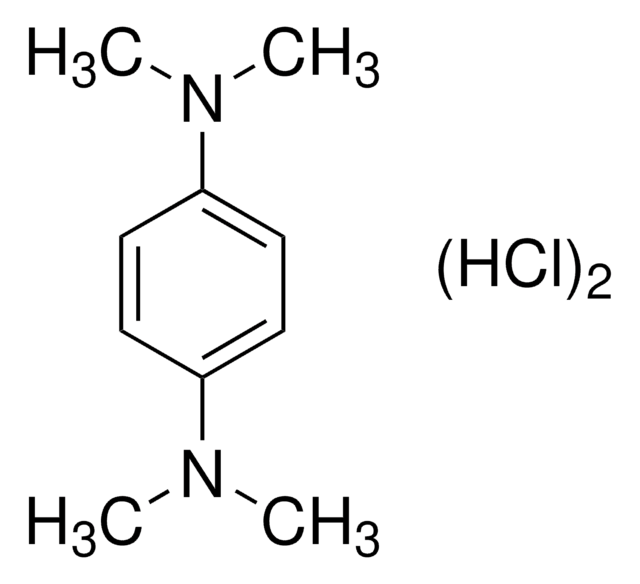
CAS Number637-01-4
Synonyms1-N,1-N,4-N,4-N-tetramethylbenzene-1,4-diamine,dihydrochloride; MFCD00012482; N,N,N',N'-Tetramethylbenzol-1,4-diamindihydrochlorid; 1,4-Benzenediamine, N,N,N,N-tetramethyl-, hydrochloride (1:2); Wurster's reagent dihydrochloride; N,N,N',N'-Tetramethyl-P-phenylenediaminedihydrochloride; 1,4-Benzenediamine, N,N,N',N'-tetramethyl-, dihydrochloride; N,N,N',N'-Tetramethylbenzene-1,4-diamine dihydrochloride; N,N,N',N'-Tetramethyl-1,4-benzenediamine dihydrochloride; EINECS 211-274-8
Molecular FormulaC6H4[N(CH3)2]2·2HCl
Molecular Weight237.17
Purity≥95%
Boiling Point260.6ºC at 760 mmHg
Melting Point222-224 °C (lit.)
Appearancepowder
EINECS211-274-8
Symbol
Signal WordWarning
| Chemical & Physical Properties | |
|---|---|
| CAS Number | 637-01-4 |
| Catalog No. | 2A-9024656 |
| Chinese Name | N,N,N',N'-四甲基对苯二胺 二盐酸盐 |
| Synonyms | 1-N,1-N,4-N,4-N-tetramethylbenzene-1,4-diamine,dihydrochloride; MFCD00012482; N,N,N',N'-Tetramethylbenzol-1,4-diamindihydrochlorid; 1,4-Benzenediamine, N,N,N,N-tetramethyl-, hydrochloride (1:2); Wurster's reagent dihydrochloride; N,N,N',N'-Tetramethyl-P-phenylenediaminedihydrochloride; 1,4-Benzenediamine, N,N,N',N'-tetramethyl-, dihydrochloride; N,N,N',N'-Tetramethylbenzene-1,4-diamine dihydrochloride; N,N,N',N'-Tetramethyl-1,4-benzenediamine dihydrochloride; EINECS 211-274-8 |
| Molecular Formula | C6H4[N(CH3)2]2·2HCl |
| Molecular Weight | 237.17 |
| Purity | ≥95 |
| Boiling Point | 260.6ºC at 760 mmHg |
| Melting Point | 222-224 °C (lit.) |
| Appearance | powder |
| Water Solubility | SOLUBLE |
| Storage Condition | Store in an airtight container in a cool, dry plac |
| Packaging | II |
| Application | TMPD dihydrochloride, a readily oxidizable compound, is an enzymatically converted redox-active substrate molecule. TMPD dihydrochloride is also an electron donor and serves as a reducing co-substrate |
| EINECS | 211-274-8 |
| HTC | 29215190 |
| PubChem ID | 24900109 |
| MDL Number | MFCD00012482 |
| SMILES | Cl[H].Cl[H].CN(C)c1ccc(cc1)N(C)C |
| InChI | 1S/C10H16N2.2ClH/c1-11(2)9-5-7-10(8-6-9)12(3)4;;/h5-8H,1-4H3;2*1H |
| InChI Key | FBHKTSXMTASXFJ-UHFFFAOYSA-N |
| Beilstein/REAXYS | 7442241 |
| NACRES Code | NA.47 |
| UNSPSC | 12171500 |
| Hazard Symbols | 6.1(a) |
| MSDS | msds/24656_1_637_01_4.pdf |
| Bioactivity | TMPD dihydrochloride, a readily oxidizable compound, is an enzymatically convert redox active substrate molecule. TMPD dihydrochloride is also an electron donor and serves as a reducing cosubstrate for heme peroxidases[1][2]. TMPD dihydrochloride is also a complex IV substrate[3]. Related Catalog Signaling Pathways >> Others >> Others Research Areas >> Metabolic Disease In Vitro TMPD (N,N,N′,N′-tetramethyl-para-phenylene-diamine) is used in cell culture and microbiology to differentiate organisms that exhibit cytochrome c oxidase activity and to distinguish between Gram-negative and Gram-positive pathogenic and non-pathogenic bacteria. The concept of TMPD oxidation by microorganisms is widely used and is known as a successful colorimetric indicator for bacterial oxidases, as the radical cation TMPD+˙, formed by oxidation, shows a characteristic deep blue colour. The electrochemical recognition of the TMPD oxidation by bacterial oxidases can be applied to a variety of pathogens[1]. References [1]. S Kuss, et al. Electrochemical recognition and quantification of cytochrome c expression in Bacillus subtilis and aerobe/anaerobe Escherichia coli using N, N, N', N'-tetramethyl- para-phenylene-diamine (TMPD). Chem Sci. 2017 Nov 1;8(11):7682-7688. [2]. Nenad Petrovic, et al. Using N,N,N',N'-tetramethyl-p-phenylenediamine (TMPD) to assay cyclooxygenase activity in vitro. Methods Mol Biol. 2010;594:129-40. [3]. Franco A Rossato, et al. Fatty acid synthase inhibitors induce apoptosis in non-tumorigenic melan-a cells associated with inhibition of mitochondrial respiration. PLoS One. 2014 Jun 25;9(6):e101060. Chemical & Physical Properties Boiling Point 260.6ºC at 760 mmHg Melting Point 222-224 °C(lit.) Molecular Formula C10H18Cl2N2 Molecular Weight 237.169 Flash Point 104.9ºC Exact Mass 236.084702 PSA 6.48000 LogP 3.42260 InChIKey FBHKTSXMTASXFJ-UHFFFAOYSA-N SMILES CN(C)c1ccc(N(C)C)cc1.Cl.Cl Storage condition Store at RT. Stability Stable. Incompatible with strong oxidizing agents, strong bases. Water Solubility SOLUBLE |
| Use of | TMPD dihydrochloride, a readily oxidizable compound, is an enzymatically convert redox active substrate molecule. TMPD dihydrochloride is also an electron donor and serves as a reducing cosubstrate for heme peroxidases[1][2]. TMPD dihydrochloride is also a complex IV substrate[3]. Properties Name N,N,N',N'-Tetramethyl-p-phenylenediamine dihydrochloride Synonym More Synonyms TMPD dihydrochloride Biological Activity Description TMPD dihydrochloride, a readily oxidizable compound, is an enzymatically convert redox active substrate molecule. TMPD dihydrochloride is also an electron donor and serves as a reducing cosubstrate for heme peroxidases[1][2]. TMPD dihydrochloride is also a complex IV substrate[3]. Related Catalog Signaling Pathways >> Others >> Others Research Areas >> Metabolic Disease In Vitro TMPD (N,N,N′,N′-tetramethyl-para-phenylene-diamine) is used in cell culture and microbiology to differentiate organisms that exhibit cytochrome c oxidase activity and to distinguish between Gram-negative and Gram-positive pathogenic and non-pathogenic bacteria. The concept of TMPD oxidation by microorganisms is widely used and is known as a successful colorimetric indicator for bacterial oxidases, as the radical cation TMPD+˙, formed by oxidation, shows a characteristic deep blue colour. The electrochemical recognition of the TMPD oxidation by bacterial oxidases can be applied to a variety of pathogens[1]. References [1]. S Kuss, et al. Electrochemical recognition and quantification of cytochrome c expression in Bacillus subtilis and aerobe/anaerobe Escherichia coli using N, N, N', N'-tetramethyl- para-phenylene-diamine (TMPD). Chem Sci. 2017 Nov 1;8(11):7682-7688. [2]. Nenad Petrovic, et al. Using N,N,N',N'-tetramethyl-p-phenylenediamine (TMPD) to assay cyclooxygenase activity in vitro. Methods Mol Biol. 2010;594:129-40. [3]. Franco A Rossato, et al. Fatty acid synthase inhibitors induce apoptosis in non-tumorigenic melan-a cells associated with inhibition of mitochondrial respiration. PLoS One. 2014 Jun 25;9(6):e101060. Chemical & Physical Properties Exact Mass 236.084702 PSA 6.48000 LogP 3.42260 InChIKey FBHKTSXMTASXFJ-UHFFFAOYSA-N Storage condition Store at RT. Stability Stable. Incompatible with strong oxidizing agents, strong bases. Water Solubility SOLUBLE |
| Tax Rebate | 17.0% |
| Supervision | None. MFN tariff: 6.5%. Ordinary tariff: 30.0% |
| Transport Info | Shipping Name: UN |
| MSDS Transport Info | Module 14. Shipping information 14.1 UN dangerous goods number European Land Transport Dangerous Regulations: -International Maritime Dangerous Regulations: -International Air Transport Dangerous Regulations: - 14.2 United Nations shipping name European Land Transport Dangerous Regulations: Non-dangerous goods IMDG Code: Non-dangerous goods International air transport dangerous goods regulations: non-dangerous goods 14.3 Transport hazard categories European Land Transport Dangerous Regulations: -International Maritime Dangerous Regulations: -International Air Transport Dangerous Regulations: - 14.4 Package group European Land Transport Dangerous Regulations: -International Maritime Dangerous Regulations: -International Air Transport Dangerous Regulations: - 14.5 Environmental hazards European Land Transport Danger Regulations: No International Maritime Danger Regulations International Air Transport Danger Regulations: No Marine pollutants (yes/no): No 14.6 Special reminder to users No data available |
| Related Products in Functional & Formulation | ||
|---|---|---|
| Isopropyl myristate | 110-27-0 | 2A-9018728 |
| Ethylparaben | 120-47-8 | 2A-9019086 |
| Dimethicone | 9006-65-9 | 2A-9019184 |
| Isopropyl palmitate | 142-91-6 | 2A-9020920 |
| Decamethylcyclopentasiloxane; Cyclopentasiloxane | 541-02-6 | 2A-9022739 |
| Lauryl betaine | 683-10-3 | 2A-9024848 |
| N-(1,3-Dimethylbutyl)-N'-phenyl-p-phenylenediamine | 793-24-8 | 2A-9025267 |
| 4-(N,N-Diethyl)-2-methyl-p-phenylenediamine monohydrochloride | 2051-79-8 | 2A-9027910 |
| 2-Pentafluorophenoxyethanol | 2192-55-4 | 2A-9028123 |
| Ammonium lauryl sulfate | 2235-54-3 | 2A-9028196 |
| Browse all Functional & Formulation products » | ||
Phone:
630-322-8886
630-322-8887
Email:
Office Locations:
Chicago, IL, USA
San Francisco, CA, USA


 EN
EN


 SDS
SDS