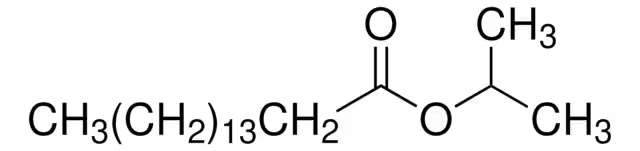
CAS Number142-91-6
SynonymsHexadecanoic acid 1-methylethyl ester; Isopropyl hexadecanoate; Hexadecanoic acid, 1-methylethyl ester; Isopropyl palmitate; Palmitic Acid Isopropyl Ester; propan-2-yl hexadecanoate; MFCD00008993; EINECS 205-571-1
Molecular FormulaCH3(CH2)14COOCH(CH3)2
Molecular Weight298.50
Purity98.00%
Density0.9±0.1 g/cm3
Boiling Point340.7±10.0 °C at 760 mmHg
Melting Point11-13 °C (lit.)
Appearanceliquid
Symbol
Signal WordWarning
| Chemical & Physical Properties | |
|---|---|
| CAS Number | 142-91-6 |
| Catalog No. | 2A-9020920 |
| Chinese Name | 棕榈酸异丙酯 |
| Synonyms | Hexadecanoic acid 1-methylethyl ester; Isopropyl hexadecanoate; Hexadecanoic acid, 1-methylethyl ester; Isopropyl palmitate; Palmitic Acid Isopropyl Ester; propan-2-yl hexadecanoate; MFCD00008993; EINECS 205-571-1 |
| Molecular Formula | CH3(CH2)14COOCH(CH3)2 |
| Molecular Weight | 298.50 |
| Purity | 98.00 |
| Density | 0.9±0.1 g/cm3 |
| Boiling Point | 340.7±10.0 °C at 760 mmHg |
| Melting Point | 11-13 °C (lit.) |
| Appearance | liquid |
| Storage Condition | Packed in plastic drums or galvanized iron drums. |
| Application | Isopropyl palmitate is a fatty acid ester. Isopropyl palmitate can be used in the design and characterization of bioactive bilayer membranes. The double-layer membrane not only has the ability to scav |
| HTC | 2915709000 |
| PubChem ID | 329750203 |
| MDL Number | MFCD00008993 |
| SMILES | CCCCCCCCCCCCCCCC(=O)OC(C)C |
| InChI | 1S/C19H38O2/c1-4-5-6-7-8-9-10-11-12-13-14-15-16-17-19(20)21-18(2)3/h18H,4-17H2,1-3H3 |
| InChI Key | XUGNVMKQXJXZCD-UHFFFAOYSA-N |
| Beilstein/REAXYS | 1786567 |
| NACRES Code | NA.24 |
| UNSPSC | 41116107 |
| Hazard Symbols | Transport |
| MSDS | msds/20920_1_142_91_6.pdf |
| Bioactivity | Isopropyl palmitate is an fatty acid ester. Isopropyl palmitate can be used for design and characterization of bioactive bilayer films. The bilayer membrane not only has the ability to scavenge free radicals and inhibit lipid peroxidation, but also can inhibit the growth of known foodborne pathogens. Isopropyl palmitate can be used as an excipient, such as lubricant, oily carrier, solvent, controlled-release transdermal film. Pharmaceutical excipients, or pharmaceutical auxiliaries, refer to other chemical substances used in the pharmaceutical process other than pharmaceutical ingredients. Pharmaceutical excipients generally refer to inactive ingredients in pharmaceutical preparations, which can improve the stability, solubility and processability of pharmaceutical preparations. Pharmaceutical excipients also affect the absorption, distribution, metabolism, and elimination (ADME) processes of co-administered drugs[1][2]. Related Catalog Research Areas >> Others References [1]. Luís Â, et al. Design and Characterization of Bioactive Bilayer Films: Release Kinetics of Isopropyl Palmitate. Antibiotics (Basel). 2020 Jul 24;9(8):443. [2]. Elder DP, et al. Pharmaceutical excipients - quality, regulatory and biopharmaceutical considerations. Eur J Pharm Sci. 2016 May 25;87:88-99. Chemical & Physical Properties Density 0.9±0.1 g/cm3 Boiling Point 340.7±10.0 °C at 760 mmHg Melting Point 11-13 °C(lit.) Molecular Formula C19H38O2 Molecular Weight 298.51 Flash Point 162.2±8.8 °C Exact Mass 298.287170 PSA 26.30000 LogP 8.49 Vapour Pressure 0.0±0.7 mmHg at 25°C Index of Refraction 1.443 InChIKey XUGNVMKQXJXZCD-UHFFFAOYSA-N SMILES CCCCCCCCCCCCCCCC(=O)OC(C)C Storage condition 2-8°C |
| Use of | Isopropyl palmitate is an fatty acid ester. Isopropyl palmitate can be used for design and characterization of bioactive bilayer films. The bilayer membrane not only has the ability to scavenge free radicals and inhibit lipid peroxidation, but also can inhibit the growth of known foodborne pathogens. Isopropyl palmitate can be used as an excipient, such as lubricant, oily carrier, solvent, controlled-release transdermal film. Pharmaceutical excipients, or pharmaceutical auxiliaries, refer to other chemical substances used in the pharmaceutical process other than pharmaceutical ingredients. Pharmaceutical excipients generally refer to inactive ingredients in pharmaceutical preparations, which can improve the stability, solubility and processability of pharmaceutical preparations. Pharmaceutical excipients also affect the absorption, distribution, metabolism, and elimination (ADME) processes of co-administered drugs[1][2]. Properties Articles27 Name isopropyl palmitate Synonym More Synonyms Isopropyl palmitate Biological Activity Description Isopropyl palmitate is an fatty acid ester. Isopropyl palmitate can be used for design and characterization of bioactive bilayer films. The bilayer membrane not only has the ability to scavenge free radicals and inhibit lipid peroxidation, but also can inhibit the growth of known foodborne pathogens. Isopropyl palmitate can be used as an excipient, such as lubricant, oily carrier, solvent, controlled-release transdermal film. Pharmaceutical excipients, or pharmaceutical auxiliaries, refer to other chemical substances used in the pharmaceutical process other than pharmaceutical ingredients. Pharmaceutical excipients generally refer to inactive ingredients in pharmaceutical preparations, which can improve the stability, solubility and processability of pharmaceutical preparations. Pharmaceutical excipients also affect the absorption, distribution, metabolism, and elimination (ADME) processes of co-administered drugs[1][2]. Related Catalog Research Areas >> Others References [1]. Luís Â, et al. Design and Characterization of Bioactive Bilayer Films: Release Kinetics of Isopropyl Palmitate. Antibiotics (Basel). 2020 Jul 24;9(8):443. [2]. Elder DP, et al. Pharmaceutical excipients - quality, regulatory and biopharmaceutical considerations. Eur J Pharm Sci. 2016 May 25;87:88-99. Chemical & Physical Properties Molecular Formula C19H38O2 Exact Mass 298.287170 PSA 26.30000 Index of Refraction 1.443 InChIKey XUGNVMKQXJXZCD-UHFFFAOYSA-N SMILES CCCCCCCCCCCCCCCC(=O)OC(C)C |
| Tax Rebate | 13.0% |
| Supervision | None. MFN tariff: 5.5%. Ordinary tariff: 30.0% |
| Transport Info | Shipping Name: UN |
| MSDS Transport Info | Module 14. Shipping information 14.1 UN dangerous goods number European Land Transport Dangerous Regulations: -International Maritime Dangerous Regulations: -International Air Transport Dangerous Regulations: - 14.2 United Nations shipping name European Land Transport Dangerous Regulations: Non-dangerous goods IMDG Code: Non-dangerous goods International air transport dangerous goods regulations: non-dangerous goods 14.3 Transport hazard categories European Land Transport Dangerous Regulations: -International Maritime Dangerous Regulations: -International Air Transport Dangerous Regulations: - 14.4 Package group European Land Transport Dangerous Regulations: -International Maritime Dangerous Regulations: -International Air Transport Dangerous Regulations: - 14.5 Environmental hazards European Land Transport Danger Regulations: No International Maritime Danger Regulations International Air Transport Danger Regulations: No Marine pollutants (yes/no): No 14.6 Special reminder to users No data available |
| Related Products in Functional & Formulation | ||
|---|---|---|
| Methylparaben | 99-76-3 | 2A-9018153 |
| N-Phenyl-p-phenylenediamine | 101-54-2 | 2A-9018257 |
| Isopropyl myristate | 110-27-0 | 2A-9018728 |
| Ethylparaben | 120-47-8 | 2A-9019086 |
| Dimethicone | 9006-65-9 | 2A-9019184 |
| Decamethylcyclopentasiloxane; Cyclopentasiloxane | 541-02-6 | 2A-9022739 |
| N,N,N',N'-Tetramethyl-p-phenylenediamine dihydrochloride | 637-01-4 | 2A-9024656 |
| Lauryl betaine | 683-10-3 | 2A-9024848 |
| N-(1,3-Dimethylbutyl)-N'-phenyl-p-phenylenediamine | 793-24-8 | 2A-9025267 |
| 4-(N,N-Diethyl)-2-methyl-p-phenylenediamine monohydrochloride | 2051-79-8 | 2A-9027910 |
| Browse all Functional & Formulation products » | ||
Phone:
630-322-8886
630-322-8887
Email:
Office Locations:
Chicago, IL, USA
San Francisco, CA, USA


 EN
EN


 SDS
SDS