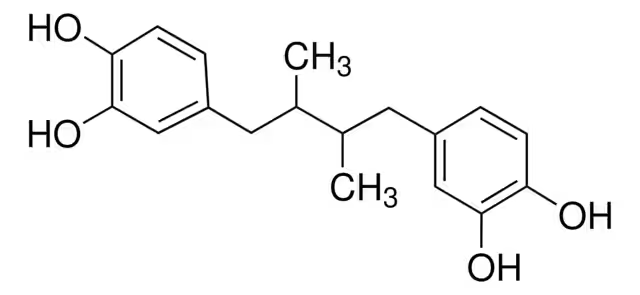
CAS Number500-38-9
Synonymsmeso-4,4'-(2,3-Dimethyltetramethylene)dipyrocatechol; MFCD00002206; 1,4-Bis(3,4-dihydroxyphenyl)-2,3-dimethylbutane; Nordihydroguaiaretic acid; Nordihydroguaiaretic acid (meso-form); MESO-NORDIHYDROGUAIARETIC ACID; Nordihydroguairaretic acid; 4,4'-(2,3-Dimethyltetramethylene)dipyrocatechol; Actinex; NDGA; 4-[(2R,3S)-4-(3,4-Dihydroxyphenyl)-2,3-dimethylbutyl]-1,2-benzenediol; b,g-Dimethyl-a,d-bis(3,4-dihydroxyphenyl)butane; Masoprocol; 4-[(2R,3S)-4-(3,4-Dihydroxyphenyl)-2,3-dimethylbutyl]benzene-1,2-diol; Nordihydro Guaiaretic Acid; EINECS 207-903-0
Molecular Formula[-CH(CH3)CH2C6H3-1,2-(OH)2]2
Molecular Weight302.36
Purity≥97.0 (HPLC)%
Density1.2±0.1 g/cm3
Boiling Point526.5±45.0 °C at 760 mmHg
Melting Point184-186 °C (lit.)
Appearancecrystals
EINECS207-903-0
Symbol
Signal WordWarning
| Chemical & Physical Properties | |
|---|---|
| CAS Number | 500-38-9 |
| Catalog No. | 2A-9022307 |
| Chinese Name | 去甲二氢愈创木酸 |
| Synonyms | meso-4,4'-(2,3-Dimethyltetramethylene)dipyrocatechol; MFCD00002206; 1,4-Bis(3,4-dihydroxyphenyl)-2,3-dimethylbutane; Nordihydroguaiaretic acid; Nordihydroguaiaretic acid (meso-form); MESO-NORDIHYDROGUAIARETIC ACID; Nordihydroguairaretic acid; 4,4'-(2,3-Dimethyltetramethylene)dipyrocatechol; Actinex; NDGA; 4-[(2R,3S)-4-(3,4-Dihydroxyphenyl)-2,3-dimethylbutyl]-1,2-benzenediol; b,g-Dimethyl-a,d-bis(3,4-dihydroxyphenyl)butane; Masoprocol; 4-[(2R,3S)-4-(3,4-Dihydroxyphenyl)-2,3-dimethylbutyl]benzene-1,2-diol; Nordihydro Guaiaretic Acid; EINECS 207-903-0 |
| Molecular Formula | [-CH(CH3)CH2C6H3-1,2-(OH)2]2 |
| Molecular Weight | 302.36 |
| Purity | ≥97.0 (HPLC) |
| Density | 1.2±0.1 g/cm3 |
| Boiling Point | 526.5±45.0 °C at 760 mmHg |
| Melting Point | 184-186 °C (lit.) |
| Appearance | crystals |
| Water Solubility | slightly soluble |
| Storage Condition | Sealed and stored at -20°C, placed in a ventilated |
| Application | Nordihydroguaiaretic acid is a 5-lipoxygenase (5LOX) (IC50=8±3 μM) and tyrosine kinase inhibitor. |
| EINECS | 207-903-0 |
| HTC | 2907299090 |
| PubChem ID | 57652455 |
| MDL Number | MFCD00002206 |
| SMILES | CC(Cc1ccc(O)c(O)c1)C(C)Cc2ccc(O)c(O)c2 |
| InChI | 1S/C18H22O4/c1-11(7-13-3-5-15(19)17(21)9-13)12(2)8-14-4-6-16(20)18(22)10-14/h3-6,9-12,19-22H,7-8H2,1-2H3 |
| InChI Key | HCZKYJDFEPMADG-UHFFFAOYSA-N |
| Beilstein/REAXYS | 2056826 |
| NACRES Code | NA.22 |
| UNSPSC | 12352100 |
| Hazard Symbols | Transport |
| MSDS | msds/22307_1_500_38_9.pdf |
| Bioactivity | Nordihydroguaiaretic acid is a 5-lipoxygenase (5LOX) (IC50=8±3 μM) and tyrosine kinase inhibitor. Related Catalog Signaling Pathways >> Metabolic Enzyme/Protease >> 5-Lipoxygenase Signaling Pathways >> Autophagy >> Autophagy Research Areas >> Cancer Research Areas >> Neurological Disease Natural Products >> Phenylpropanoids Target IC50: 8±3 μM (5LOX)[1] In Vitro The natural dicatechol Nordihydroguaiaretic acid (NDGA) is a selective 5LOX inhibitor from the creosote plant (Larrea tridentata: Zygophyllaceae). The 5LOX-inhibiting natural dicatechol Nordihydroguaiaretic acid is a very effective, non-toxic antagonist of TNFα-stimulated microglial activation. Nordihydroguaiaretic acid is approximately six times more potent than Minocycline in vitro, with an IC50 value of 8±3 μM and no toxicity at 100 μM. Significant NO2- suppression is observed at 800 nM Nordihydroguaiaretic acid. Similar efficacy is observed for natural and synthetic Nordihydroguaiaretic acid, as well as for the acetyl ester of Nordihydroguaiaretic acid. Nordihydroguaiaretic acid also suppresses TNFα-stimulated PGE2 production by EOC-20 cells with an IC50 of 841 nM[1].To test the proliferation effect of prostaglandin E1 and Nordihydroguaiaretic acid (NDGA) on cancer cell lines, HepG2 cell lines are treated with various doses of the two compounds and the positive compounds 8-anilino-1-naphtalene sulfonate (ANS), respectively, for 24 h and cell viability is examined by the MTT assay. ANS displays a dose-dependent inhibition (0, 10, 30, 50, 80, 100, 120, and 150 μM) with the estimated IC50 being 25.888 μM. The tested IC50 of prostaglandin E1 is 41.223 μM and Nordihydroguaiaretic acid is 45.646 μM, respectively, at different concentrations of 0, 30, 60, 80, 100, 120, and 140 μM[2]. In Vivo Compared with the control ob/ob chow diet group, there is a significant reduction of body weight starting from 9 wk treatment in the high-dose Nordihydroguaiaretic acid (NDGA) diet group, and from 12 wk in the low-dose group. Nordihydroguaiaretic acid treatment results in higher body (rectal) temperatures of ob/ob mice, especially with the high dose of Nordihydroguaiaretic acid[3]. Cell Assay MTT assay is used to measure cell growth-inhibitory activity of the selected most promising compounds in HepG2 cell lines. Cells are cultured in 96-well culture plate at 1×10⁴ cells/well. After 24 h cultured at 37 °C in the atmosphere of 5% CO2, cells are adhered and treated with different concentrations of the targeted compounds (e.g., Nordihydroguaiaretic acid, 0, 30, 60, 80, 100, 120, and 140 μM) and incubated for 24 h. Then, the supernatants are discarded and MTT (0.5 mg/mL) is added to each well and incubated at 37°C in 5% CO2 for an additional 4 h. Following, the MTT is removed and 150 μL of formazan in DMSO is added to terminate response and then plates are set to the table shaker for 5 min at low speed. Cell proliferation is evaluated by measuring the absorbance at 570 nm using ELISA Plate Reader. The IC50 values are calculated by SPSS statistics 17.0[2]. Animal Admin Mice[3] Seven-week-old male control C57BL/6J mice, male leptin-deficient (ob/ob) mice, and male Pparα-deficient mutant mice (B6.129S4-Pparatm1Gonz/J) are used. These mice are fed a standard chow diet for 1 wk to allow them to acclimatize to a controlled new environment (25±2°C, 55±5% relative humidity with a 12-h light-dark cycle). Subsequently, one group of ob/ob mice is switched to a chow diet supplemented with either low- (0.83 g/kg chow diet) or high-dose (2.5 g/kg chow diet) Nordihydroguaiaretic acid and maintained on this diet for 16 wk. The other groups of ob/ob mice and control mice continue to be fed a normal chow diet for 16 wk. In another set of studies, C57BL/6J mice and Pparα-deficient mutant mice are fed either a high-fat diet (~60% of total calories come from fat), or the same high-fat diet supplemented with a high dose of Nordihydroguaiaretic acid (2.5 g/kg diet). Food intake and body weights are measured once a week throughout the experiment. References [1]. West M, et al. The arachidonic acid 5-lipoxygenase inhibitor Nordihydroguaiaretic acid inhibits tumor necrosis factor alpha activation of microglia and extends survival of G93A-SOD1 transgenic mice. J Neurochem. 2004 Oct;91(1):133-43. [2]. Lu F, et al. Virtual Screening for Potential Allosteric Inhibitors of Cyclin-Dependent Kinase 2 from Traditional Chinese Medicine. Molecules. 2016 Sep 21;21(9). pii: E1259. [3]. Zhang H, et al. Nordihydroguaiaretic acid improves metabolic dysregulation and aberrant hepatic lipid metabolism in mice by both PPARα-dependent and -independent pathways. Am J Physiol Gastrointest Liver Physiol. 2013 Jan 1;304(1):G72-86. Chemical & Physical Properties Density 1.2±0.1 g/cm3 Boiling Point 526.5±45.0 °C at 760 mmHg Melting Point 184-189ºC Molecular Formula C18H22O4 Molecular Weight 302.365 Flash Point 247.8±23.3 °C Exact Mass 302.151794 PSA 80.92000 LogP 3.71 Vapour Pressure 0.0±1.4 mmHg at 25°C Index of Refraction 1.627 InChIKey HCZKYJDFEPMADG-UHFFFAOYSA-N SMILES CC(Cc1ccc(O)c(O)c1)C(C)Cc1ccc(O)c(O)c1 Storage condition Freezer (-20°C) Stability Stable. Incompatible with oxidizing agents. Water Solubility slightly soluble |
| Use of | Properties Articles114 Name nordihydroguaiaretic acid Synonym More Synonyms Nordihydroguaiaretic acid Biological Activity Related Catalog Signaling Pathways >> Metabolic Enzyme/Protease >> 5-Lipoxygenase Signaling Pathways >> Autophagy >> Autophagy Research Areas >> Cancer Research Areas >> Neurological Disease Natural Products >> Phenylpropanoids In Vivo Compared with the control ob/ob chow diet group, there is a significant reduction of body weight starting from 9 wk treatment in the high-dose Nordihydroguaiaretic acid (NDGA) diet group, and from 12 wk in the low-dose group. Nordihydroguaiaretic acid treatment results in higher body (rectal) temperatures of ob/ob mice, especially with the high dose of Nordihydroguaiaretic acid[3]. References [1]. West M, et al. The arachidonic acid 5-lipoxygenase inhibitor Nordihydroguaiaretic acid inhibits tumor necrosis factor alpha activation of microglia and extends survival of G93A-SOD1 transgenic mice. J Neurochem. 2004 Oct;91(1):133-43. [2]. Lu F, et al. Virtual Screening for Potential Allosteric Inhibitors of Cyclin-Dependent Kinase 2 from Traditional Chinese Medicine. Molecules. 2016 Sep 21;21(9). pii: E1259. [3]. Zhang H, et al. Nordihydroguaiaretic acid improves metabolic dysregulation and aberrant hepatic lipid metabolism in mice by both PPARα-dependent and -independent pathways. Am J Physiol Gastrointest Liver Physiol. 2013 Jan 1;304(1):G72-86. Chemical & Physical Properties Molecular Formula C18H22O4 Exact Mass 302.151794 PSA 80.92000 Index of Refraction 1.627 InChIKey HCZKYJDFEPMADG-UHFFFAOYSA-N Stability Stable. Incompatible with oxidizing agents. Water Solubility slightly soluble |
| Tax Rebate | 9.0% |
| Supervision | A. Customs clearance form for inbound goods B. Customs clearance form for outbound goods |
| Inspection | R. Imported food hygiene supervision and inspection S. Export food hygiene supervision and inspection M. Imported commodity inspection N. Exported commodity inspection |
| Transport Info | Shipping Name: UN |
| MSDS Transport Info | Module 14. Shipping information 14.1 UN dangerous goods number European Land Transport Dangerous Regulations: -International Maritime Dangerous Regulations: -International Air Transport Dangerous Regulations: - 14.2 United Nations shipping name European Land Transport Dangerous Regulations: Non-dangerous goods IMDG Code: Non-dangerous goods International air transport dangerous goods regulations: non-dangerous goods 14.3 Transport hazard categories European Land Transport Dangerous Regulations: -International Maritime Dangerous Regulations: -International Air Transport Dangerous Regulations: - 14.4 Package group European Land Transport Dangerous Regulations: -International Maritime Dangerous Regulations: -International Air Transport Dangerous Regulations: - 14.5 Environmental hazards European Land Transport Danger Regulations: No International Maritime Danger Regulations International Air Transport Danger Regulations: No Marine pollutants (yes/no): No 14.6 Special reminder to users No data available |
| Related Products in Specialty Chemicals | ||
|---|---|---|
| Mesaconic acid | 498-24-8 | 2A-9022287 |
| Scopine | 498-45-3 | 2A-9022288 |
| Dihydroterpineol | 498-81-7 | 2A-9022292 |
| Nipecotic acid | 498-95-3 | 2A-9022294 |
| 5-Isopropyl-2-methylphenol | 499-75-2 | 2A-9022300 |
| Yangonin | 500-62-9 | 2A-9022308 |
| Olivetol | 500-66-3 | 2A-9022310 |
| 5-Heptylresorcinol | 500-67-4 | 2A-9022311 |
| 3,5-Dimethoxyphenol | 500-99-2 | 2A-9022312 |
| Cidofovir hydrate | 149394-66-1 | 2A-9022315 |
| Browse all Specialty Chemicals products » | ||
Phone:
630-322-8886
630-322-8887
Email:
Office Locations:
Chicago, IL, USA
San Francisco, CA, USA


 EN
EN


 SDS
SDS