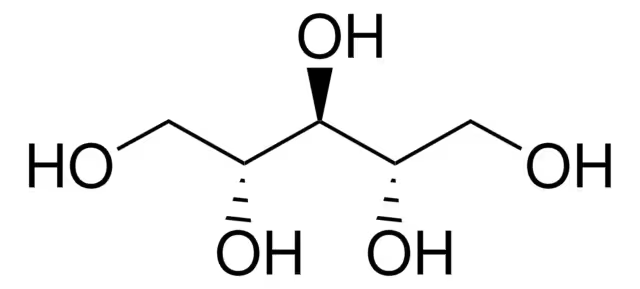
CAS Number488-81-3
Synonyms(2R,3s,4S)-1,2,3,4,5-Pentanpentol; adonitol; ADONIT; ADONITE; ADONITOL(RG); (2R,3s,4S)-pentane-1,2,3,4,5-pentol; RIBITO; Adonito; D-erythro-Pentitol; MFCD00064291; D-Ribitol; meso ribitol; Ribitol; (2R,3s,4S)-1,2,3,4,5-Pentanepentol; Adonite Ribitol; EINECS 207-685-7; Adonite,Ribitol; meso-ribitol; D-(+)-Arabitol; Adonitrol
Molecular FormulaC5H12O5
Molecular Weight152.15
Purity≥99%
Density1.5±0.1 g/cm3
Boiling Point494.5±40.0 °C at 760 mmHg
Melting Point104 °C ((219 °F ))
Appearancepowder
EINECS207-685-7
Symbol
Signal WordWarning
| Chemical & Physical Properties | |
|---|---|
| CAS Number | 488-81-3 |
| Catalog No. | 2A-0202346 |
| Chinese Name | 侧金盏花醇 |
| Synonyms | (2R,3s,4S)-1,2,3,4,5-Pentanpentol; adonitol; ADONIT; ADONITE; ADONITOL(RG); (2R,3s,4S)-pentane-1,2,3,4,5-pentol; RIBITO; Adonito; D-erythro-Pentitol; MFCD00064291; D-Ribitol; meso ribitol; Ribitol; (2R,3s,4S)-1,2,3,4,5-Pentanepentol; Adonite Ribitol; EINECS 207-685-7; Adonite,Ribitol; meso-ribitol; D-(+)-Arabitol; Adonitrol |
| Molecular Formula | C5H12O5 |
| Molecular Weight | 152.15 |
| Purity | ≥99 |
| Density | 1.5±0.1 g/cm3 |
| Boiling Point | 494.5±40.0 °C at 760 mmHg |
| Melting Point | 104 °C ((219 °F )) |
| Appearance | powder |
| Storage Condition | Store in a cool, dry place filled with argon gas. |
| Application | Ribitol is a pentitol formed by the reduction of ribose. Enhanced D-glucose to pentose phosphate pathway in Saccharomyces cerevisiae, which can be used to produce D-ribose and ribitol. |
| EINECS | 207-685-7 |
| PubChem ID | 57653860 |
| MDL Number | MFCD00064291 |
| SMILES | OCC(O)C(O)C(O)CO |
| InChI | 1S/C5H12O5/c6-1-3(8)5(10)4(9)2-7/h3-10H,1-2H2/t3-,4+,5- |
| InChI Key | HEBKCHPVOIAQTA-ZXFHETKHSA-N |
| Beilstein/REAXYS | 1720524 |
| NACRES Code | NA.25 |
| UNSPSC | 12352201 |
| Hazard Symbols | Transport |
| MSDS | msds/22212_1_488_81_3.pdf |
| Bioactivity | Ribitol is a crystalline pentose alcohol formed by the reduction of ribose. Enhancing the flux of D-glucose to the pentose phosphate pathway in Saccharomyces cerevisiae for the production of D-ribose and ribitol. Related Catalog Research Areas >> Others Natural Products >> Saccharides and Glycosides Target Human Endogenous Metabolite In Vitro Ribitol is a reduced sugar[1]. Phosphoglucose isomerase-deficient (pgi1) strains of Saccharomyces cerevisiae are studied for the production of D-ribose and Ribitol from D-glucose via the intermediates of the pentose phosphate pathway. Overexpression of the gene encoding sugar phosphate phosphatase (DOG1) of S. cerevisiae is needed for the production of D-ribose and Ribitol. The engineered strains are compared for their ability to produce the PPP-derived 5-carbon compounds Ribitol and D-ribose from D-glucose[2]. Kinase Assay The high-performance liquid chromatography (HPLC) analyses are carried out using a Fast Acid Column (100×7.8 mm) and a HPX-87H Ion Exclusion Column (300 mm×7.8 mm) in series with 2.5 mM H2SO4 in water as the mobile phase at a flow rate of 0.3 mL/min, at 55°C. This method enabled quantification of D-glucose, ethanol, glycerol, D-xylulose, Ribitol, and xylitol. D-ribose, D-ribulose, and D-arabitol coeluted on the Aminex HPX-87H column. The CarboPac MA-1 column of Dionex ICS-3000 is used to analyze representative culture supernatant samples for the presence of arabitol and xylitol. Samples are run at column temperature of 30°C with 480 mM NaOH at flow rate 0.4 mL/min. The CarboPac MA-1 column separated D-arabitol from D-ribose and D-ribulose, but the alkaline conditions degraded D-ribulose interfering with the quantification of D-ribose.Yeast cells are disrupted with glass beads in 100 mM sodium phosphate buffer pH 7.0 containing phenylmethylsulfonyl fluoride and pepstatin A in final concentrations of 0.17 mg/mL and 0.01 mg/mL, respectively.The activity of NAD+-dependent Gdh2p is measured in a reaction buffer of 0.5 M triethanol amine pH 7.7 and 2 mM NADH. After addition of the cell lysate, the reaction is started by adding a mixture of α-ketoglutarate (100 mM) and NH4Cl (200 mM) to a final concentration of 2.4 mM and 4.9 mM, respectively. The GapB activity is measured. Shortly, the reaction mixture is 500 mM triethanol amine pH 7.8, 1 mM ATP, 2 mM MgCl2, 200 μM NADPH, and 10 μg/mL of phosphoglycerate kinase. 3-phosphoglycerate is added to a final concentration of 5 mM to start the reaction. Activity measurements are performed with a Cobas Mira Plus automated analyzer[2]. References [1]. Praissman JL, et al. The functional O-mannose glycan on α-dystroglycan contains a phospho-Ribitol primed for matriglycan addition. Elife. 2016 Apr 29;5. pii: e14473. [2]. Toivari MH, et al. Enhancing the flux of D-glucose to the pentose phosphate pathway in Saccharomyces cerevisiae for the production of D-ribose and ribitol. Appl Microbiol Biotechnol. 2010 Jan;85(3):731-9. Chemical & Physical Properties Density 1.5±0.1 g/cm3 Boiling Point 494.5±40.0 °C at 760 mmHg Melting Point 101-104ºC Molecular Formula C5H12O5 Molecular Weight 152.146 Flash Point 261.9±21.9 °C Exact Mass 152.068466 PSA 101.15000 LogP -3.77 Vapour Pressure 0.0±2.9 mmHg at 25°C Index of Refraction 1.571 InChIKey HEBKCHPVOIAQTA-NGQZWQHPSA-N SMILES OCC(O)C(O)C(O)CO Storage condition Store at RT. Stability Stable. Combustible. Incompatible with strong oxidizing agents. |
| Use of | Ribitol is a crystalline pentose alcohol formed by the reduction of ribose. Enhancing the flux of D-glucose to the pentose phosphate pathway in Saccharomyces cerevisiae for the production of D-ribose and ribitol. Properties Articles100 Name D-ribitol Synonym More Synonyms Ribitol Biological Activity Description Ribitol is a crystalline pentose alcohol formed by the reduction of ribose. Enhancing the flux of D-glucose to the pentose phosphate pathway in Saccharomyces cerevisiae for the production of D-ribose and ribitol. Related Catalog Research Areas >> Others Natural Products >> Saccharides and Glycosides Human Endogenous Metabolite In Vitro Ribitol is a reduced sugar[1]. Phosphoglucose isomerase-deficient (pgi1) strains of Saccharomyces cerevisiae are studied for the production of D-ribose and Ribitol from D-glucose via the intermediates of the pentose phosphate pathway. Overexpression of the gene encoding sugar phosphate phosphatase (DOG1) of S. cerevisiae is needed for the production of D-ribose and Ribitol. The engineered strains are compared for their ability to produce the PPP-derived 5-carbon compounds Ribitol and D-ribose from D-glucose[2]. References [1]. Praissman JL, et al. The functional O-mannose glycan on α-dystroglycan contains a phospho-Ribitol primed for matriglycan addition. Elife. 2016 Apr 29;5. pii: e14473. [2]. Toivari MH, et al. Enhancing the flux of D-glucose to the pentose phosphate pathway in Saccharomyces cerevisiae for the production of D-ribose and ribitol. Appl Microbiol Biotechnol. 2010 Jan;85(3):731-9. Chemical & Physical Properties Molecular Formula C5H12O5 Exact Mass 152.068466 PSA 101.15000 LogP -3.77 Index of Refraction 1.571 InChIKey HEBKCHPVOIAQTA-NGQZWQHPSA-N SMILES OCC(O)C(O)C(O)CO Storage condition Store at RT. Stability Stable. Combustible. Incompatible with strong oxidizing agents. |
| Transport Info | Product name: Purity: 99.0% |
| MSDS Transport Info | Module 14. Shipping information 14.1 UN dangerous goods number European Land Transport Dangerous Regulations: -International Maritime Dangerous Regulations: -International Air Transport Dangerous Regulations: - 14.2 Names specified by the United Nations (UN) European Land Transport Dangerous Regulations: Non-dangerous goods IMDG Code: Non-dangerous goods International air transport dangerous goods regulations: non-dangerous goods 14.3 Transport hazard categories European Land Transport Dangerous Regulations: -International Maritime Dangerous Regulations: -International Air Transport Dangerous Regulations: - 14.4 Package group European Land Transport Dangerous Regulations: -International Maritime Dangerous Regulations: -International Air Transport Dangerous Regulations: - 14.5 Environmental hazards European Land Transport Dangerous Regulations: No International Maritime Transport Dangerous Regulations Maritime Pollutants: No International Air Transport Risk Regulations: No 14.6 Special reminder to users No data available |
| Related Products in Specialty Chemicals | ||
|---|---|---|
| Elemicin | 487-11-6 | 2A-9022199 |
| Lumazine | 487-21-8 | 2A-9022200 |
| Mucobromic acid | 488-11-9 | 2A-9022208 |
| 3-Methylcatechol | 488-17-5 | 2A-9022209 |
| 1,2,3,4-Tetramethylbenzene | 488-23-3 | 2A-9022210 |
| Croconic acid | 488-86-8 | 2A-9022213 |
| Guaiazulene | 489-84-9 | 2A-9022216 |
| 5,7-Dihydrox -4'-methoxyisoflavone | 491-80-5 | 2A-9022231 |
| Thioxanthen-9-one | 492-22-8 | 2A-9022232 |
| 2-C-Methyl-D-ribono-1,4-lactone | 492-30-8 | 2A-9022234 |
| Browse all Specialty Chemicals products » | ||
Phone:
630-322-8886
630-322-8887
Email:
Office Locations:
Chicago, IL, USA
San Francisco, CA, USA


 EN
EN


 SDS
SDS