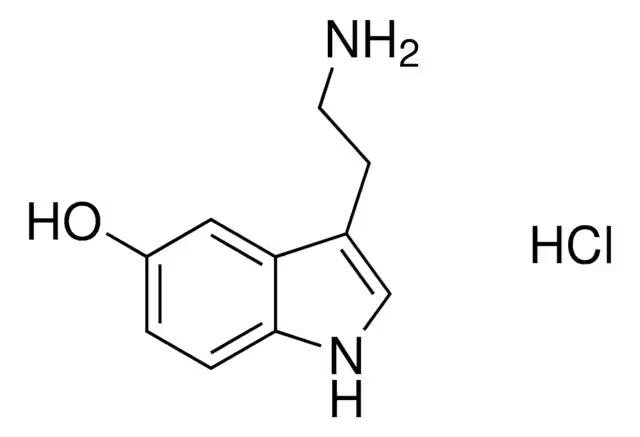
CAS Number153-98-0
Synonyms3-(2-aminoethyl)-1H-indol-5-ol,hydrochloride; 3-(2-Aminoethyl)-1H-indol-5-ol hydrochloride; 3-(2-Aminoethyl)-5-hydroxyindole hydrochloride,5-HT,5-Hydroxytryptamine hydrochloride; 5-hydroxytryptamine hydrochloride; Serotonin HCl; 1H-Indol-5-ol, 3-(2-aminoethyl)-, hydrochloride (1:1); 3-(2-Aminoethyl)-1H-indol-5-ol hydrochloride (1:1); EINECS 244-464-4; MFCD00012686; 5-Hydroxytryptamine HCl
Molecular FormulaC10H13ClN2O
Molecular Weight212.68
Purity≥98%
Boiling Point416.1ºC at 760 mmHg
Melting Point149-154 °C (lit.)
Appearancepowder
Symbol
Signal WordWarning
| Chemical & Physical Properties | |
|---|---|
| CAS Number | 153-98-0 |
| Catalog No. | 2A-9021033 |
| Chinese Name | 血清胺盐酸盐 |
| Synonyms | 3-(2-aminoethyl)-1H-indol-5-ol,hydrochloride; 3-(2-Aminoethyl)-1H-indol-5-ol hydrochloride; 3-(2-Aminoethyl)-5-hydroxyindole hydrochloride,5-HT,5-Hydroxytryptamine hydrochloride; 5-hydroxytryptamine hydrochloride; Serotonin HCl; 1H-Indol-5-ol, 3-(2-aminoethyl)-, hydrochloride (1:1); 3-(2-Aminoethyl)-1H-indol-5-ol hydrochloride (1:1); EINECS 244-464-4; MFCD00012686; 5-Hydroxytryptamine HCl |
| Molecular Formula | C10H13ClN2O |
| Molecular Weight | 212.68 |
| Purity | ≥98 |
| Boiling Point | 416.1ºC at 760 mmHg |
| Melting Point | 149-154 °C (lit.) |
| Appearance | powder |
| Water Solubility | soluble |
| Storage Condition | Store in a dry and cool place. |
| Packaging | III |
| Application | Serotonin hydrochloride is a monoamine neurotransmitter and endogenous 5-HT receptor agonist in the CNS. Serotonin hydrochloride is also an inhibitor of catechol O-methyltransferase (COMT) with a Ki o |
| HTC | 2933990090 |
| PubChem ID | 24278124 |
| MDL Number | MFCD00012686 |
| SMILES | Cl[H].NCCc1c[nH]c2ccc(O)cc12 |
| InChI | 1S/C10H12N2O.ClH/c11-4-3-7-6-12-10-2-1-8(13)5-9(7)10;/h1-2,5-6,12-13H,3-4,11H2;1H |
| InChI Key | MDIGAZPGKJFIAH-UHFFFAOYSA-N |
| Beilstein/REAXYS | 3570963 |
| NACRES Code | NA.77 |
| UNSPSC | 12352200 |
| Hazard Symbols | 6.1 |
| MSDS | msds/21033_1_153_98_0.pdf |
| Bioactivity | Serotonin hydrochloride is a monoamine neurotransmitter in the CNS and an endogenous 5-HT receptor agonist. Serotonin hydrochloride is also a catechol O-methyltransferase (COMT) inhibitor with a Ki of 44 μM. Related Catalog Signaling Pathways >> GPCR/G Protein >> 5-HT Receptor Signaling Pathways >> Neuronal Signaling >> 5-HT Receptor Signaling Pathways >> Metabolic Enzyme/Protease >> COMT Signaling Pathways >> Neuronal Signaling >> COMT Research Areas >> Neurological Disease Target 5-HT receptor[1] Ki: 44 μM (COMT)[1] In Vitro Serotonin hydrochloride is a monoamine neurotransmitter in the CNS and an endogenous 5-HT receptor agonist. Serotonin hydrochloride also inhibits catechol O-methyltransferase (COMT), an enzyme that contributes to modultion the perception of pain, via non-competitive binding to the site bound by catechol substrates with a binding affinity comparable to the binding affinity of catechol itself (Ki= 44 μM). Results show that addition of 100 μM of Serotonin hydrochloride decreases the reaction velocity of COMT[1]. In Vivo Serotonin hydrochloride produces robust hypersensitivity compare to saline-treated controls (p<0.001)[1]. A significant increase in colonic 5-HT content is observed in IL-13-/- mice receiving Serotonin hydrochloride compare to IL-13-/- receiving vehicle following induction of DSS colitis[2]. Cell Assay For macrophage culture, peritoneal cavity cells are collected from WT and IL-13-/- mice with or without dextran sodium sulfate (DSS) treatment and cultured. Cells are plated at a concentration of 3.0×10⁶ cells per millilitre, and treated with either lipopolysaccharides (LPS); (100 ng/mL) or Serotonin hydrochloride (10-10 M) for 24 hours. The culture supernatant are collected and stored in -80°C until determination of cytokine levels using protein array system[2]. Animal Admin Dextran sodium sulfate (DSS) colitis is induced by orally administering 5% DSS in drinking water for 5 days. In a separate experiment, IL-13-/- mice are injected subcutaneously with 100 mg/kg of Serotonin hydrochloride (5-HTP) twice daily for 8 days beginning 3 days prior to induction of DSS colitis; whereas, the control IL-13-/- mice receive saline as vehicle. Animals are anaesthetized prior to euthanization via cervical dislocation at the conclusion of each experiment or if they reach a predetermined end point (ie, loss of ≥20% body weight and/or significant deterioration of body condition)[2]. References [1]. Tsao D, et al. Serotonin-induced hypersensitivity via inhibition of catechol O-methyltransferase activity. Mol Pain. 2012 Apr 13;8:25. [2]. Shajib MS, et al. Interleukin 13 and serotonin: linking the immune and endocrine systems in murine models of intestinal inflammation. PLoS One. 2013 Aug 28;8(8):e72774. Chemical & Physical Properties Boiling Point 416.1ºC at 760 mmHg Melting Point 149-154 °C(lit.) Molecular Formula C10H13ClN2O Molecular Weight 212.676 Flash Point 205.4ºC Exact Mass 212.071640 PSA 62.04000 LogP 2.87700 Vapour Pressure 1.63E-07mmHg at 25°C InChIKey MDIGAZPGKJFIAH-UHFFFAOYSA-N SMILES Cl.NCCc1c[nH]c2ccc(O)cc12 Storage condition 2-8°C Stability Stable, but light sensitive and hygroscopic. Incompatible with strong oxidizing agents. Water Solubility soluble |
| Use of | Serotonin hydrochloride is a monoamine neurotransmitter in the CNS and an endogenous 5-HT receptor agonist. Serotonin hydrochloride is also a catechol O-methyltransferase (COMT) inhibitor with a Ki of 44 μM. Properties Articles41 Name Serotonin hydrochloride Synonym More Synonyms Serotonin hydrochloride Biological Activity Description Serotonin hydrochloride is a monoamine neurotransmitter in the CNS and an endogenous 5-HT receptor agonist. Serotonin hydrochloride is also a catechol O-methyltransferase (COMT) inhibitor with a Ki of 44 μM. Related Catalog Signaling Pathways >> GPCR/G Protein >> 5-HT Receptor Signaling Pathways >> Neuronal Signaling >> 5-HT Receptor Signaling Pathways >> Metabolic Enzyme/Protease >> COMT Signaling Pathways >> Neuronal Signaling >> COMT Research Areas >> Neurological Disease 5-HT receptor[1] Ki: 44 μM (COMT)[1] In Vitro Serotonin hydrochloride is a monoamine neurotransmitter in the CNS and an endogenous 5-HT receptor agonist. Serotonin hydrochloride also inhibits catechol O-methyltransferase (COMT), an enzyme that contributes to modultion the perception of pain, via non-competitive binding to the site bound by catechol substrates with a binding affinity comparable to the binding affinity of catechol itself (Ki= 44 μM). Results show that addition of 100 μM of Serotonin hydrochloride decreases the reaction velocity of COMT[1]. In Vivo Serotonin hydrochloride produces robust hypersensitivity compare to saline-treated controls (p<0.001)[1]. A significant increase in colonic 5-HT content is observed in IL-13-/- mice receiving Serotonin hydrochloride compare to IL-13-/- receiving vehicle following induction of DSS colitis[2]. References [1]. Tsao D, et al. Serotonin-induced hypersensitivity via inhibition of catechol O-methyltransferase activity. Mol Pain. 2012 Apr 13;8:25. [2]. Shajib MS, et al. Interleukin 13 and serotonin: linking the immune and endocrine systems in murine models of intestinal inflammation. PLoS One. 2013 Aug 28;8(8):e72774. Chemical & Physical Properties Exact Mass 212.071640 PSA 62.04000 LogP 2.87700 InChIKey MDIGAZPGKJFIAH-UHFFFAOYSA-N Stability Stable, but light sensitive and hygroscopic. Incompatible with strong oxidizing agents. Water Solubility soluble |
| Tax Rebate | 13.0% |
| Supervision | None. MFN tariff: 6.5%. Ordinary tariff: 20.0% |
| Transport Info | Shipping Name: UN |
| MSDS Transport Info | Module 14. Shipping information 14.1 UN dangerous goods number European Land Transport Dangerous Regulations: -International Maritime Dangerous Regulations: -International Air Transport Dangerous Regulations: - 14.2 United Nations shipping name European Land Transport Dangerous Regulations: Non-dangerous goods IMDG Code: Non-dangerous goods International air transport dangerous goods regulations: non-dangerous goods 14.3 Transport hazard categories European Land Transport Dangerous Regulations: -International Maritime Dangerous Regulations: -International Air Transport Dangerous Regulations: - 14.4 Package group European Land Transport Dangerous Regulations: -International Maritime Dangerous Regulations: -International Air Transport Dangerous Regulations: - 14.5 Environmental hazards European Land Transport Danger Regulations: No International Maritime Danger Regulations International Air Transport Danger Regulations: No Marine pollutants (yes/no): No 14.6 Special reminder to users No data available |
| Related Products in Specialty Chemicals | ||
|---|---|---|
| Dimethylbenzylcarbinyl acetate | 151-05-3 | 2A-9021013 |
| 3-Aminopropionitrile | 151-18-8 | 2A-9021015 |
| Acenocoumarol | 152-72-7 | 2A-9021024 |
| Cephalothin | 153-61-7 | 2A-9021029 |
| 7-Chlorotryptophan | 153-97-9 | 2A-9021032 |
| Cocarboxylase | 154-87-0 | 2A-9021040 |
| 2-Phenylethylamine hydrochloride | 156-28-5 | 2A-9021048 |
| 4-Hydroxyphenylpyruvic acid | 156-39-8 | 2A-9021050 |
| 4-Chlorophenethylamine | 156-41-2 | 2A-9021051 |
| Cysteamine hydrochloride | 156-57-0 | 2A-9021054 |
| Browse all Specialty Chemicals products » | ||
Phone:
630-322-8886
630-322-8887
Email:
Office Locations:
Chicago, IL, USA
San Francisco, CA, USA


 EN
EN


 SDS
SDS