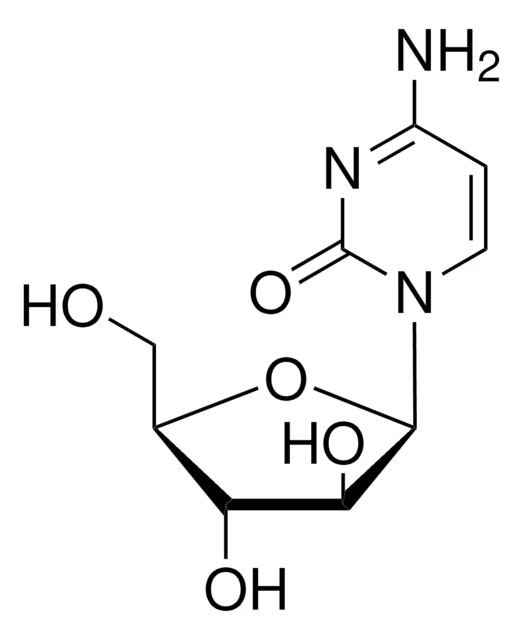
CAS Number147-94-4
SynonymsMFCD00066487; Cytosine β-D-Arabinofuranoside; Cytarabine; Arabinosylcytosine; 4-Amino-1-β-D-arabinofuranosyl-2(1H)-pyrimidinone; Arabinocytidine; 4-amino-1-[(2R,3S,4S,5R)-3,4-dihydroxy-5-(hydroxymethyl)oxolan-2-yl]pyrimidin-2-one; (β-D-Arabinofuranosyl)cytosine; EINECS 205-705-9; 4-Amino-1-((2R,3S,4S,5R)-3,4-dihydroxy-5-(hydroxymethyl)tetrahydrofuran-2-yl)pyrimidin-2(1H)-one; Arabinofuranosylcytosine
Molecular FormulaC9H13N3O5
Molecular Weight243.22
Purity≥90 (HPLC)%
Density1.9±0.1 g/cm3
Boiling Point529.7±60.0 °C at 760 mmHg
Melting Point214 °C
Appearancecrystalline
EINECS205-705-9
Symbol
Signal WordWarning
| Chemical & Physical Properties | |
|---|---|
| CAS Number | 147-94-4 |
| Catalog No. | 2A-9020978 |
| Chinese Name | 阿糖胞苷 |
| Synonyms | MFCD00066487; Cytosine β-D-Arabinofuranoside; Cytarabine; Arabinosylcytosine; 4-Amino-1-β-D-arabinofuranosyl-2(1H)-pyrimidinone; Arabinocytidine; 4-amino-1-[(2R,3S,4S,5R)-3,4-dihydroxy-5-(hydroxymethyl)oxolan-2-yl]pyrimidin-2-one; (β-D-Arabinofuranosyl)cytosine; EINECS 205-705-9; 4-Amino-1-((2R,3S,4S,5R)-3,4-dihydroxy-5-(hydroxymethyl)tetrahydrofuran-2-yl)pyrimidin-2(1H)-one; Arabinofuranosylcytosine |
| Molecular Formula | C9H13N3O5 |
| Molecular Weight | 243.22 |
| Purity | ≥90 (HPLC) |
| Density | 1.9±0.1 g/cm3 |
| Boiling Point | 529.7±60.0 °C at 760 mmHg |
| Melting Point | 214 °C |
| Appearance | crystalline |
| Water Solubility | H2O: 50 mg/mL, clear, colorless |
| Storage Condition | Store at 2-8ºC. |
| Application | Cytarabine is a chemotherapy drug used to treat acute myeloid leukemia. It inhibits DNA synthesis with an IC50 of 16 nM. |
| EINECS | 205-705-9 |
| HTC | 2934999090 |
| PubChem ID | 24892435 |
| MDL Number | MFCD00066487 |
| SMILES | NC1=NC(=O)N(C=C1)[C@@H]2O[C@H](CO)[C@@H](O)[C@@H]2O |
| InChI | 1S/C9H13N3O5/c10-5-1-2-12(9(16)11-5)8-7(15)6(14)4(3-13)17-8/h1-2,4,6-8,13-15H,3H2,(H2,10,11,16)/t4-,6-,7+,8-/m1/s1 |
| InChI Key | UHDGCWIWMRVCDJ-CCXZUQQUSA-N |
| Beilstein/REAXYS | 89175 |
| NACRES Code | NA.77 |
| UNSPSC | 12352200 |
| Hazard Symbols | Transport |
| MSDS | msds/20978_1_147_94_4.pdf |
| Bioactivity | Cytarabine is a chemotherapy drug used to treat acute myeloid leukaemia, acting by inhibiting DNA synthesis with an IC50 of 16 nM. Related Catalog Signaling Pathways >> Autophagy >> Autophagy Signaling Pathways >> Cell Cycle/DNA Damage >> Nucleoside Antimetabolite/Analog Research Areas >> Cancer Target IC50: 16 nM (DNA synthesis) In Vitro Cytarabine is phosphorylated into a triphosphate form (Ara-CTP) involving deoxycytidine kinase (dCK), which competes with dCTP for incorporation into DNA, and then blocks DNA synthesis by inhibiting the function of DNA and RNA polymerases. Cytarabine displays a higher growth inhibitory activity towards wild-type CCRF-CEM cells compared to other acute myelogenous leukemia (AML) cells with IC50 of 16 nM[1]. Cytarabine apparently induces apoptosis of rat sympathetic neurons at 10 μM, of which 100 μM shows the highest toxicity and kills over 80% of the neurons by 84 hours, involving the release of mitochondrial cytochrome-c and the activation of caspase-3, and the toxicity can be attenuated by p53 knockdown and delayed by bax deletion[2]. In Vivo Cytarabine (250 mg/kg) also causes placental growth retardation and increases placental trophoblastic cells apoptosis in the placental labyrinth zone of the pregnant Slc:Wistar rats, which increases from 3 hour after the treatment and peaks at 6 hour before returning to control levels at 48 hour, with remarkably enhanced p53 protein, p53 trancriptional target genes such as p21, cyclinG1 and fas and caspase-3 activity[3]. Cytarabine is highly effective against acute leukaemias, which causes the Cytarabine teristic G1/S blockage and synchronization, and increases the survival time for leukaemic Brown Norway rats in a weak dose-related fashion indicating that the use of higher dosages of Cytarabine does not contribute to its antileukaemic effectiveness in man[4]. Kinase Assay Stock solution of Cytarabine is prepared in absolute ethanol, and serial dilutions of Cytarabine are prepared. CCRF-CEM cells are suspended in RPMI medium supplemented with 10% FBS, 0.1% gentamicin, and 1% sodium pyruvate. The cells are suspended in their respective media to give 10 mL volumes of cell suspension at a final density of 3-6×10⁴ cells/mL. Appropriate volumes of Cytarabine solution are transferred to the cell suspensions, and incubation is continued for 72 hours. The cells are spun down and resuspended in fresh Cytarabine -free medium, and final cell counts are determined. The data are analyzed by sigmoidal curve fitting of the cell count versus Cytarabine concentration, and the results are expressed as the IC50 (Cytarabine concentration that inhibits cell growth to 50% of the control value). Animal Admin Pregnant rats are injected intraperitoneally (i.p.) with 250 mg/kg of Cytarabine on Day 13 of gestation (GD13). Under the conditions of this experiment, congenital anomalies and growth retardation are detected at a high rate in perinatal fetuses, although the incidence of fetal death is not markedly increased. At 1, 3, 6, 9, 12, 24, and 48 h after the treatment, six dams each are killed by heart puncture under ether anesthesia, and the placentas are collected. As controls, six pregnant rats are injected i.p. with an equivalent volume of PBS on GD13 and killed at the same time point as Cytarabine-treated groups. Of the six dams obtained at each time point, three are used for histopathological analyses and three for reverse transcription-polymerase chain reaction (RT-PCR) analysis. References [1]. Tobias, S.C. and R.F. Borch, Synthesis and biological evaluation of a cytarabine phosphoramidate prodrug. Mol Pharm, 2004. 1(2): p. 112-6. [2]. Besirli, C.G., et al. Cytosine arabinoside rapidly activates Bax-dependent apoptosis and a delayed Bax-independent death pathway in sympathetic neurons. Cell Death Differ, 2003. 10(9): p. 1045-58. [3]. Yamauchi, H., et al., Involvement of p53 in 1-beta-D-arabinofuranosylcytosine-induced trophoblastic cell apoptosis and impaired proliferation in rat placenta. Biol Reprod, 2004. 70(6): p. 1762-7. [4]. Richel, D.J., et al., Comparison of the antileukaemic activity of 5 aza-2-deoxycytidine and arabinofuranosyl-cytosine in rats with myelocytic leukaemia. Br J Cancer, 1988. 58(6): p. 730-3. Chemical & Physical Properties Density 1.9±0.1 g/cm3 Boiling Point 529.7±60.0 °C at 760 mmHg Melting Point 214 °C Molecular Formula C9H13N3O5 Molecular Weight 243.217 Flash Point 274.1±32.9 °C Exact Mass 243.085526 PSA 130.83000 LogP -1.78 Vapour Pressure 0.0±3.2 mmHg at 25°C Index of Refraction 1.756 InChIKey UHDGCWIWMRVCDJ-CCXZUQQUSA-N SMILES Nc1ccn(C2OC(CO)C(O)C2O)c(=O)n1 Storage condition 2-8°C Water Solubility H2O: 50 mg/mL, clear, colorless |
| Use of | Cytarabine is a chemotherapy drug used to treat acute myeloid leukaemia, acting by inhibiting DNA synthesis with an IC50 of 16 nM. Properties Articles281 Name cytarabine Synonym More Synonyms Cytarabine Biological Activity Description Cytarabine is a chemotherapy drug used to treat acute myeloid leukaemia, acting by inhibiting DNA synthesis with an IC50 of 16 nM. Related Catalog Signaling Pathways >> Autophagy >> Autophagy Signaling Pathways >> Cell Cycle/DNA Damage >> Nucleoside Antimetabolite/Analog Research Areas >> Cancer IC50: 16 nM (DNA synthesis) In Vitro Cytarabine is phosphorylated into a triphosphate form (Ara-CTP) involving deoxycytidine kinase (dCK), which competes with dCTP for incorporation into DNA, and then blocks DNA synthesis by inhibiting the function of DNA and RNA polymerases. Cytarabine displays a higher growth inhibitory activity towards wild-type CCRF-CEM cells compared to other acute myelogenous leukemia (AML) cells with IC50 of 16 nM[1]. Cytarabine apparently induces apoptosis of rat sympathetic neurons at 10 μM, of which 100 μM shows the highest toxicity and kills over 80% of the neurons by 84 hours, involving the release of mitochondrial cytochrome-c and the activation of caspase-3, and the toxicity can be attenuated by p53 knockdown and delayed by bax deletion[2]. References [1]. Tobias, S.C. and R.F. Borch, Synthesis and biological evaluation of a cytarabine phosphoramidate prodrug. Mol Pharm, 2004. 1(2): p. 112-6. [2]. Besirli, C.G., et al. Cytosine arabinoside rapidly activates Bax-dependent apoptosis and a delayed Bax-independent death pathway in sympathetic neurons. Cell Death Differ, 2003. 10(9): p. 1045-58. [3]. Yamauchi, H., et al., Involvement of p53 in 1-beta-D-arabinofuranosylcytosine-induced trophoblastic cell apoptosis and impaired proliferation in rat placenta. Biol Reprod, 2004. 70(6): p. 1762-7. [4]. Richel, D.J., et al., Comparison of the antileukaemic activity of 5 aza-2-deoxycytidine and arabinofuranosyl-cytosine in rats with myelocytic leukaemia. Br J Cancer, 1988. 58(6): p. 730-3. Chemical & Physical Properties Molecular Formula C9H13N3O5 Exact Mass 243.085526 PSA 130.83000 LogP -1.78 Index of Refraction 1.756 InChIKey UHDGCWIWMRVCDJ-CCXZUQQUSA-N |
| Tax Rebate | 13.0% |
| Supervision | None. MFN tariff: 6.5%. Ordinary tariff: 20.0% |
| Transport Info | Shipping Name: UN |
| MSDS Transport Info | Module 14. Shipping information 14.1 UN dangerous goods number European Land Transport Dangerous Regulations: -International Maritime Dangerous Regulations: -International Air Transport Dangerous Regulations: - 14.2 United Nations shipping name European Land Transport Dangerous Regulations: Non-dangerous goods IMDG Code: Non-dangerous goods International air transport dangerous goods regulations: non-dangerous goods 14.3 Transport hazard categories European Land Transport Dangerous Regulations: -International Maritime Dangerous Regulations: -International Air Transport Dangerous Regulations: - 14.4 Package group European Land Transport Dangerous Regulations: -International Maritime Dangerous Regulations: -International Air Transport Dangerous Regulations: - 14.5 Environmental hazards European Land Transport Danger Regulations: No International Maritime Danger Regulations International Air Transport Danger Regulations: No Marine pollutants (yes/no): No 14.6 Special reminder to users No data available |
| Related Products in Specialty Chemicals | ||
|---|---|---|
| D-Tartaric acid | 147-71-7 | 2A-9020973 |
| DL-Arabinose | 147-81-9 | 2A-9020974 |
| 2,4,6-Tribromoaniline | 147-82-0 | 2A-9020975 |
| L-Proline | 147-85-3 | 2A-9020976 |
| Thiosalicylic acid | 147-93-3 | 2A-9020977 |
| Sodium diethyldithiocarbamate | 148-18-5 | 2A-9020980 |
| 1,8-Dihydroxynaphthylene-3,6-disulfonic acid | 148-25-4 | 2A-9020982 |
| 3-Hydroxynaphthalene-2,7-disulphonic acid | 148-75-4 | 2A-9020987 |
| Thiabendazole | 148-79-8 | 2A-9020988 |
| Tiron | 149-45-1 | 2A-9020995 |
| Browse all Specialty Chemicals products » | ||
Phone:
630-322-8886
630-322-8887
Email:
Office Locations:
Chicago, IL, USA
San Francisco, CA, USA


 EN
EN


 SDS
SDS