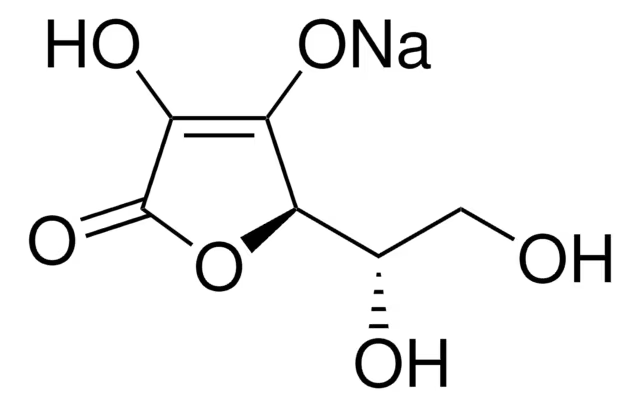
CAS Number134-03-2
SynonymsEINECS 205-126-1; Sodium ascorbate; L-Ascorbic Acid Sodium Salt; Vitamine C sodium salt,Vitamin C sodium salt; (+)-Sodium L-ascorbate (L(+)-Ascorbic acid sodium salt; SodiuM L-Ascorbate; L(+)-Ascorbic acid sodium salt,Vitamin C sodium salt; MFCD00082340; Vitamin C Sodium Salt; L(+)-Ascorbic acid sodium salt,E301
Molecular FormulaC6H7NaO6
Molecular Weight198.11
Purity≥98%
Density1.799 g/cm3
Boiling Point552.7ºC at 760 mmHg
Melting Point220 °C (dec.) (lit.)
Appearancecrystalline
EINECS205-126-1
Symbol
Signal WordWarning
| Chemical & Physical Properties | |
|---|---|
| CAS Number | 134-03-2 |
| Catalog No. | 2A-9020718 |
| Chinese Name | 维生素C钠 |
| Synonyms | EINECS 205-126-1; Sodium ascorbate; L-Ascorbic Acid Sodium Salt; Vitamine C sodium salt,Vitamin C sodium salt; (+)-Sodium L-ascorbate (L(+)-Ascorbic acid sodium salt; SodiuM L-Ascorbate; L(+)-Ascorbic acid sodium salt,Vitamin C sodium salt; MFCD00082340; Vitamin C Sodium Salt; L(+)-Ascorbic acid sodium salt,E301 |
| Molecular Formula | C6H7NaO6 |
| Molecular Weight | 198.11 |
| Purity | ≥98 |
| Density | 1.799 g/cm3 |
| Boiling Point | 552.7ºC at 760 mmHg |
| Melting Point | 220 °C (dec.) (lit.) |
| Appearance | crystalline |
| Water Solubility | 620 g/L (20 ºC) |
| Storage Condition | Store sealed and away from light. |
| Application | L-Ascorbic acid sodium is the more available form of vitamin C and has antioxidant effects. |
| EINECS | 205-126-1 |
| PubChem ID | 24891261 |
| MDL Number | MFCD00082340 |
| SMILES | [Na+].OC[C@H](O)[C@H]1OC(=O)C(O)=C1[O-] |
| InChI | 1S/C6H8O6.Na/c7-1-2(8)5-3(9)4(10)6(11)12-5;/h2,5,7-10H,1H2;/q;+1/p-1/t2-,5+;/m0./s1 |
| InChI Key | PPASLZSBLFJQEF-RXSVEWSESA-M |
| Beilstein/REAXYS | 3767246 |
| NACRES Code | NA.79 |
| eCl@ss | 34058010 |
| UNSPSC | 12352205 |
| Hazard Symbols | Transport |
| MSDS | msds/20718_1_134_03_2.pdf |
| Bioactivity | L-Ascorbic acid (sodium) is a more bioavailable form of vitamin C that is an antioxidant agent. Related Catalog Signaling Pathways >> Others >> Others Research Areas >> Cancer Natural Products >> Others In Vitro Vitamin C (L-ascorbic acid), a known enhancer of collagen deposition, has also been identified as an inhibitor of elastogenesis[1]. The conditioned medium for B16F10 cells significantly inhibits cell apoptosis induced by sodium L-ascorbate (10 mM), and the effective ingredients in the medium show a relative molecular mass below 5,000[2]. In Vivo Tg rats treated with sodium L-ascorbate show a higher incidence of carcinoma (29.6%), compared to those without sodium L-ascorbate (15.4%). Independent of the sodium L-ascorbate treatment, transgenic rats exhibit various kinds of malignant tumors in various organs[3]. After 12 weeks of PEITC-treatment, both simple hyperplasia and papillary or nodular (PN) hyperplasia have developed in all animals, but the majority of these lesions have disappeared at week 48, irrespective of the sodium L-ascorbate-treatment. The same lesions after 24 weeks of PEITC-treatment have progressed to dysplasia and carcinoma, in a small number of cases by week 48, but enhancement by the sodium L-ascorbate-treatment is evident only with simple hyperplasias and PN hyperplasias in rats[4]. Animal Admin A total of 40 7-week-old male Tg rats are divided into 2 groups. Twenty-seven (group 1) and 13 (group 2) rats are given a powdered MF diet with or without 5% sodium L-ascorbate, respectively. Similarly, a total of 42 7-week-old male Non-tg rats are divided into 2 groups, and 30 (group 3) and 12 (group 4) animals are given a diet with or without 5% sodium L-ascorbate, respectively. References [1]. Hinek A, et al. Sodium L-ascorbate enhances elastic fibers deposition by fibroblasts from normal and pathologic human skin. J Dermatol Sci. 2014 Sep;75(3):173-82. [2]. Yang X, et al. Mouse melanoma cell line B16F10-derived conditioned medium inhibits sodium L-ascorbate-induced B16F10 cell apoptosis. Nan Fang Yi Ke Da Xue Xue Bao. 2012 Feb;32(2):146-50. [3]. Morimura K, et al. Lack of urinary bladder carcinogenicity of sodium L-ascorbate in human c-Ha-ras proto-oncogene transgenic rats. Toxicol Pathol. 2005;33(7):764-7. [4]. Takagi H, et al. Limited tumor-initiating activity of phenylethyl isothiocyanate by promotion with sodium L-ascorbate in a rat two-stage urinary bladder carcinogenesis model. Cancer Lett. 2005 Mar 10;219(2):147-53. Chemical & Physical Properties Density 1.799 g/cm3 Boiling Point 552.7ºC at 760 mmHg Melting Point 220 °C (dec.)(lit.) Molecular Formula C6H7NaO6 Molecular Weight 198.106 Flash Point 238.2ºC Exact Mass 198.014038 PSA 110.05000 Vapour Pressure 1.62E-14mmHg at 25°C Index of Refraction 105.5 ° (C=10, H2O) InChIKey PPASLZSBLFJQEF-RXSVEWSESA-M SMILES O=C1OC(C(O)CO)C([O-])=C1O.[Na+] Water Solubility 620 g/L (20 ºC) |
| Use of | L-Ascorbic acid (sodium) is a more bioavailable form of vitamin C that is an antioxidant agent. Properties Articles170 Name Sodium L-Ascorbate Synonym More Synonyms sodium ascorbate Biological Activity Description L-Ascorbic acid (sodium) is a more bioavailable form of vitamin C that is an antioxidant agent. Related Catalog Signaling Pathways >> Others >> Others Research Areas >> Cancer Natural Products >> Others In Vivo Tg rats treated with sodium L-ascorbate show a higher incidence of carcinoma (29.6%), compared to those without sodium L-ascorbate (15.4%). Independent of the sodium L-ascorbate treatment, transgenic rats exhibit various kinds of malignant tumors in various organs[3]. After 12 weeks of PEITC-treatment, both simple hyperplasia and papillary or nodular (PN) hyperplasia have developed in all animals, but the majority of these lesions have disappeared at week 48, irrespective of the sodium L-ascorbate-treatment. The same lesions after 24 weeks of PEITC-treatment have progressed to dysplasia and carcinoma, in a small number of cases by week 48, but enhancement by the sodium L-ascorbate-treatment is evident only with simple hyperplasias and PN hyperplasias in rats[4]. References [1]. Hinek A, et al. Sodium L-ascorbate enhances elastic fibers deposition by fibroblasts from normal and pathologic human skin. J Dermatol Sci. 2014 Sep;75(3):173-82. [3]. Morimura K, et al. Lack of urinary bladder carcinogenicity of sodium L-ascorbate in human c-Ha-ras proto-oncogene transgenic rats. Toxicol Pathol. 2005;33(7):764-7. [4]. Takagi H, et al. Limited tumor-initiating activity of phenylethyl isothiocyanate by promotion with sodium L-ascorbate in a rat two-stage urinary bladder carcinogenesis model. Cancer Lett. 2005 Mar 10;219(2):147-53. Chemical & Physical Properties Molecular Formula C6H7NaO6 Exact Mass 198.014038 PSA 110.05000 InChIKey PPASLZSBLFJQEF-RXSVEWSESA-M SMILES O=C1OC(C(O)CO)C([O-])=C1O.[Na+] |
| Transport Info | Shipping Name: UN |
| MSDS Transport Info | Module 14. Shipping information 14.1 UN dangerous goods number European Land Transport Dangerous Regulations: -International Maritime Dangerous Regulations: -International Air Transport Dangerous Regulations: - 14.2 United Nations shipping name European Land Transport Dangerous Regulations: Non-dangerous goods IMDG Code: Non-dangerous goods International air transport dangerous goods regulations: non-dangerous goods 14.3 Transport hazard categories European Land Transport Dangerous Regulations: -International Maritime Dangerous Regulations: -International Air Transport Dangerous Regulations: - 14.4 Package group European Land Transport Dangerous Regulations: -International Maritime Dangerous Regulations: -International Air Transport Dangerous Regulations: - 14.5 Environmental hazards European Land Transport Danger Regulations: No International Maritime Danger Regulations International Air Transport Danger Regulations: No Marine pollutants (yes/no): No 14.6 Special reminder to users No data available |
| Related Products in Specialty Chemicals | ||
|---|---|---|
| Dimethyl dihydroxyfumarate | 133-47-1 | 2A-9020708 |
| Pentachlorothiophenol | 133-49-3 | 2A-9020709 |
| 5-Chloroorthanilic acid | 133-74-4 | 2A-9020714 |
| 3,5-Diiodosalicylic acid | 133-91-5 | 2A-9020716 |
| D-(+)-Cellobiose | 133-99-3 | 2A-9020717 |
| Menthyl anthranilate | 134-09-8 | 2A-9020719 |
| 2-Ethoxybenzoic acid | 134-11-2 | 2A-9020720 |
| Methyl anthranilate | 134-20-3 | 2A-9020721 |
| Citroxin | 134-30-5 | 2A-9020722 |
| 1-Aminonaphthalene | 134-32-7 | 2A-9020724 |
| Browse all Specialty Chemicals products » | ||
Phone:
630-322-8886
630-322-8887
Email:
Office Locations:
Chicago, IL, USA
San Francisco, CA, USA


 EN
EN


 SDS
SDS