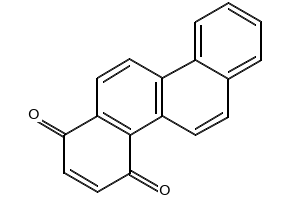
| Chemical & Physical Properties | |
|---|---|
| CAS Number | 100900-16-1 |
| Catalog No. | 2A-1197898 |
| Chinese Name | 1,4-屈醌 |
| Synonyms | 1,4-CHRYSENEQUINONE; Chrysene-1,4-dione; Chrysene-1,4-quinone; 1,4-Chrysenedione |
| Molecular Formula | C18H10O2 |
| Molecular Weight | 258.28 |
| Density | 1.4±0.1 g/cm3 |
| Boiling Point | 499.5±45.0 °C at 760 mmHg |
| Melting Point | 210-212ºC(lit.) |
| Storage Condition | room temperature |
| Application | 1,4-Chrysenequinone is a polycyclic aromatic hydrocarbon that functions as an activator of the aryl hydrocarbon receptor (AhR). |
| HTC | 2914399090 |
| MDL Number | MFCD00009941 |
| SMILES | O=C1C=CC(=O)c2c1ccc1c2ccc2ccccc21 |
| InChI | InChI=1S/C18H10O2/c19-16-9-10-17(20)18-14-6-5-11-3-1-2-4-12(11)13(14)7-8-15(16)18/h1-10H |
| InChI Key | UORKIKBNUWJNJF-UHFFFAOYSA-N |
| MSDS | msds/199761_1_100900_16_1.pdf |
| Bioactivity | 1,4-Chrysenequinone, a polycyclic aromatic quinone, acts as an activator of aryl hydrocarbon receptor (AhR). Related Catalog Signaling Pathways >> Immunology/Inflammation >> Aryl Hydrocarbon Receptor Research Areas >> Cancer Target AhR[1] In Vitro 1,4-Chrysenequinone shows significant AhR ligand activity, with ECTCDD25s (concentration equivalent with 25% of TCDD max) of 9.7 nM and 1.9 μM in yeast and mouse hepatoma cell systems, respectively[1]. Cell Assay Mouse hepatoma (H1L1.1c2) cells (1.5 × 10⁵ cells/well) are cultured in 96-well culture plates, and samples (1,4-Chrysenequinone) dissolved in dimethyl sulfoxide are added to the medium to achieve a final solvent concentration of 1%. After the plates are incubated at 37°C in 5% CO2 for 24 h, the cell viability is confirmed under a microscope. Subsequently, the medium is removed, and the cells are lysed. Adding luciferin as the substrate, the luciferase activity is determined under a luminometer and reported as relative light units. The concentrations producing luciferase activity equal to 25% of the maximal response to TCDD are calculated and also referred to as the ECTCDD25. The ratios of the ECTCDD25 of B[a]P to the ECTCDD25 of each of the compounds are calculated and referred to as IEFs[1]. References [1]. Misaki K, et al. Aryl hydrocarbon receptor ligand activity of polycyclic aromatic ketones and polycyclic aromatic quinones. Environ Toxicol Chem. 2007 Jul;26(7):1370-9. Chemical & Physical Properties Density 1.4±0.1 g/cm3 Boiling Point 499.5±45.0 °C at 760 mmHg Melting Point 210-212ºC(lit.) Molecular Formula C18H10O2 Molecular Weight 258.271 Flash Point 184.7±25.7 °C Exact Mass 258.068085 PSA 34.14000 LogP 4.25 Vapour Pressure 0.0±1.3 mmHg at 25°C Index of Refraction 1.761 InChIKey UORKIKBNUWJNJF-UHFFFAOYSA-N SMILES O=C1C=CC(=O)c2c1ccc1c2ccc2ccccc21 |
| Use of | 1,4-Chrysenequinone, a polycyclic aromatic quinone, acts as an activator of aryl hydrocarbon receptor (AhR). Properties Name 1,4-Chrysenequinone Synonym More Synonyms 1,4-Chrysenequinone Biological Activity Description 1,4-Chrysenequinone, a polycyclic aromatic quinone, acts as an activator of aryl hydrocarbon receptor (AhR). Related Catalog Signaling Pathways >> Immunology/Inflammation >> Aryl Hydrocarbon Receptor Research Areas >> Cancer In Vitro 1,4-Chrysenequinone shows significant AhR ligand activity, with ECTCDD25s (concentration equivalent with 25% of TCDD max) of 9.7 nM and 1.9 μM in yeast and mouse hepatoma cell systems, respectively[1]. References [1]. Misaki K, et al. Aryl hydrocarbon receptor ligand activity of polycyclic aromatic ketones and polycyclic aromatic quinones. Environ Toxicol Chem. 2007 Jul;26(7):1370-9. Chemical & Physical Properties Molecular Formula C18H10O2 Exact Mass 258.068085 PSA 34.14000 Index of Refraction 1.761 InChIKey UORKIKBNUWJNJF-UHFFFAOYSA-N |
| Tax Rebate | 13.0% |
| Supervision | None. MFN tariff: 5.5%. Ordinary tariff: 30.0% |
| Transport Info | Product name: Purity: 93.0% |
| MSDS Transport Info | Module 14. Shipping information United Nations classification: inconsistent with United Nations classification standards UN number: not specified |
| Related Products in Specialty Chemicals | ||
|---|---|---|
| 1,5-DIMETHOXYPENTANE | 111-89-7 | 2A-1197885 |
| N-(2-CHLOROBENZYLIDENE)-4-FLUOROANILINE | 75020-01-8 | 2A-1197888 |
| 1-BROMO-2-(METHOXYMETHOXY)ETHANE | 112496-94-3 | 2A-1197889 |
| N N-DI-N-HEXYLANILINE | 4430-09-5 | 2A-1197892 |
| 3-DIBUTYLAMINO-1-PROPYNE | 6336-58-9 | 2A-1197894 |
| Ethylene bis(2-bromoisobutyrate) | 248603-11-4 | 2A-1197901 |
| Benzoic acid (trifluoromethanesulfonic acid)anhydride | 36967-85-8 | 2A-1197902 |
| AMYL METHYL SULFIDE | 1741-83-9 | 2A-1197903 |
| 4-CYANO-TEMPO | 38078-71-6 | 2A-1197904 |
| IS 741 | 141283-87-6 | 2A-1197905 |
| Browse all Specialty Chemicals products » | ||
Phone:
630-322-8886
630-322-8887
Email:
Office Locations:
Chicago, IL, USA
San Francisco, CA, USA


 EN
EN


 SDS
SDS