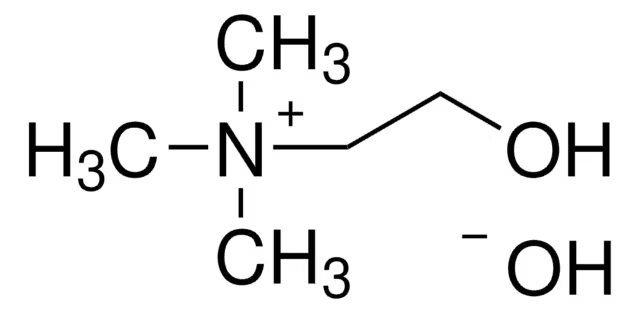
CAS Number123-41-1
SynonymsEthanaminium, 2-hydroxy-N,N,N-trimethyl-, hydroxide (1:1); Bursine; Gossypine; Sincaline; VIDINE; MFCD00002831; EINECS 204-625-1; 2-Hydroxy-N,N,N-trimethylethanaminium hydroxide; Luridine; Fagine; Choline hydroxide; UNII:7THJ3EG9SY
Molecular FormulaHOCH2CH2N(CH3)3OH
Molecular Weight121.18
Purity30-35%
Density1.09 g/mL at 20 °C
Appearanceliquid
Symbol
Signal WordWarning
| Chemical & Physical Properties | |
|---|---|
| CAS Number | 123-41-1 |
| Catalog No. | 2A-9019513 |
| Chinese Name | 胆碱 |
| Synonyms | Ethanaminium, 2-hydroxy-N,N,N-trimethyl-, hydroxide (1:1); Bursine; Gossypine; Sincaline; VIDINE; MFCD00002831; EINECS 204-625-1; 2-Hydroxy-N,N,N-trimethylethanaminium hydroxide; Luridine; Fagine; Choline hydroxide; UNII:7THJ3EG9SY |
| Molecular Formula | HOCH2CH2N(CH3)3OH |
| Molecular Weight | 121.18 |
| Purity | 30-35 |
| Density | 1.09 g/mL at 20 °C |
| Appearance | liquid |
| Water Solubility | miscible |
| Storage Condition | 2-8°C |
| Packaging | II |
| Application | Choline hydroxide is a choline hydroxide derivative and a strong organic base that can be used as a standard base to adjust the pH value of the medium. Choline is an orally active nutrient and an impo |
| HTC | 2923900090 |
| PubChem ID | 24857572 |
| MDL Number | MFCD00002831 |
| SMILES | [OH-].C[N+](C)(C)CCO |
| InChI | 1S/C5H14NO.H2O/c1-6(2,3)4-5-7;/h7H,4-5H2,1-3H3;1H2/q+1;/p-1 |
| InChI Key | KIZQNNOULOCVDM-UHFFFAOYSA-M |
| NACRES Code | NA.22 |
| UNSPSC | 12352000 |
| Hazard Symbols | 8 |
| MSDS | msds/19513_1_123_41_1.pdf |
| Bioactivity | Choline hydroxide is a Choline hydrogen oxidized derivative and a strong organic base, can be used as the standard alkaline to adjust the pH of the medium. Choline is an orally active nutrient, serves as an important component of lecithin and sphingomyelin, promotes fat metabolism [1][2][3]. Related Catalog Research Areas >> Others Signaling Pathways >> Others >> Others In Vitro Choline hydroxide can be used as the standard alkaline, and (0.5 M) results pHo shifts rapidly to 7.59 in a sucrose medium (pH at 7.08)[1]. Choline hydroxide (0.1-0.5 g/mL), together with organic carboxylic acids, makes preparation of ionic liquids, which is used for prepare a ionic liquid-reverse micelle drug-carrying delivery system and involves in epidermal desensitization research[2]. References [1]. Mitchell P, et al. Estimation of membrane potential and pH difference across the cristae membrane of rat liver mitochondria. Eur J Biochem. 1969 Feb;7(4):471-84. [2]. Ding Y, et al. An ionic liquid-reverse micelle drug delivery system for epidermal desensitization therapy and its preparation method and application: China, CN113975224. 2022-01-28. [3]. Wang F, et al. Short communication: Effects of dietary deoiled soy lecithin supplementation on circulating choline and choline metabolites, and the plasma phospholipid profile in Holstein cows fed palm fat. J Dairy Sci. 2021 Feb;104(2):1838-1845. Chemical & Physical Properties Density 1.09 g/mL at 20 °C Molecular Formula C5H15NO2 Molecular Weight 121.178 Flash Point 92 °F Exact Mass 121.110275 PSA 43.29000 Index of Refraction n20/D 1.4304 InChIKey KIZQNNOULOCVDM-UHFFFAOYSA-M SMILES C[N+](C)(C)CCO.[OH-] Storage condition 2-8°C Stability Stable. Combustible. Incompatible with strong oxidizing agents. Water Solubility miscible |
| Use of | Choline hydroxide is a Choline hydrogen oxidized derivative and a strong organic base, can be used as the standard alkaline to adjust the pH of the medium. Choline is an orally active nutrient, serves as an important component of lecithin and sphingomyelin, promotes fat metabolism [1][2][3]. Properties Name 2-Hydroxyethyltrimethylammonium Hydroxide Synonym More Synonyms Choline Hydroxide Biological Activity Description Choline hydroxide is a Choline hydrogen oxidized derivative and a strong organic base, can be used as the standard alkaline to adjust the pH of the medium. Choline is an orally active nutrient, serves as an important component of lecithin and sphingomyelin, promotes fat metabolism [1][2][3]. Related Catalog Research Areas >> Others Signaling Pathways >> Others >> Others References [1]. Mitchell P, et al. Estimation of membrane potential and pH difference across the cristae membrane of rat liver mitochondria. Eur J Biochem. 1969 Feb;7(4):471-84. [2]. Ding Y, et al. An ionic liquid-reverse micelle drug delivery system for epidermal desensitization therapy and its preparation method and application: China, CN113975224. 2022-01-28. [3]. Wang F, et al. Short communication: Effects of dietary deoiled soy lecithin supplementation on circulating choline and choline metabolites, and the plasma phospholipid profile in Holstein cows fed palm fat. J Dairy Sci. 2021 Feb;104(2):1838-1845. Chemical & Physical Properties Molecular Formula C5H15NO2 Exact Mass 121.110275 PSA 43.29000 InChIKey KIZQNNOULOCVDM-UHFFFAOYSA-M SMILES C[N+](C)(C)CCO.[OH-] Stability Stable. Combustible. Incompatible with strong oxidizing agents. Water Solubility miscible |
| Tax Rebate | 9.0% |
| Supervision | none |
| Transport Info | Shipping Name: UN |
| MSDS Transport Info | Module 14. Shipping information 14.1 United Nations number European Land Transport Danger Regulations: 3267 International Maritime Danger Regulations: 3267 International Air Transport Danger Regulations: 3267 14.2 United Nations shipping name European Land Transport Dangerous Regulations: CORROSIVE LIQUID, BASIC, ORGANIC, N.O.S. (Choline hydroxide) IMDG Code: CORROSIVE LIQUID, BASIC, ORGANIC, N.O.S. (Choline hydroxide) International air transport hazard regulations: Corrosive liquid, basic, organic, n.o.s. (Choline hydroxide) 14.3 Transport hazard categories European Dangerous Regulations for land transport: 8 International Dangerous Regulations for sea transport: 8 International Dangerous Regulations for air transport: 8 14.4 Package group European Dangerous Regulations for land transport: II International Dangerous Regulations for sea transport: II International Dangerous Regulations for air transport: II 14.5 Environmental hazards European Land Transport Danger Regulations: No International Maritime Danger Regulations International Air Transport Danger Regulations: No Marine pollutants (yes/no): No 14.6 Special precautions No data available H314 causes severe skin burns and eye damage. Skin Corr.Skin corrosion further information The above information is believed to be correct, but is not all-inclusive and should be used as a guide only. The information in this document is based on our current knowledge and is Correct safety instructions apply to this product. This information does not represent a warranty as to the properties of this product. See reverse side of invoice or packing slip. |
| Related Products in Specialty Chemicals | ||
|---|---|---|
| Ethoxymethylenemalononitrile | 123-06-8 | 2A-9019496 |
| 4-Ethylphenol | 123-07-9 | 2A-9019497 |
| 4-Chlorothioanisole | 123-09-1 | 2A-9019499 |
| Dilauryl thiodipropionate | 123-28-4 | 2A-9019504 |
| Ethyl nonanoate | 123-29-5 | 2A-9019505 |
| Girard's Reagent T | 123-46-6 | 2A-9019515 |
| Succinimide | 123-56-8 | 2A-9019519 |
| Propionic anhydride | 123-62-6 | 2A-9019520 |
| N,N'-Dimethyl-N,N'-bis(3-methylaminopropyl)trimethylenediamine | 123-67-1 | 2A-9019523 |
| Allyl hexanoate | 123-68-2 | 2A-9019524 |
| Browse all Specialty Chemicals products » | ||
Phone:
630-322-8886
630-322-8887
Email:
Office Locations:
Chicago, IL, USA
San Francisco, CA, USA


 EN
EN


 SDS
SDS