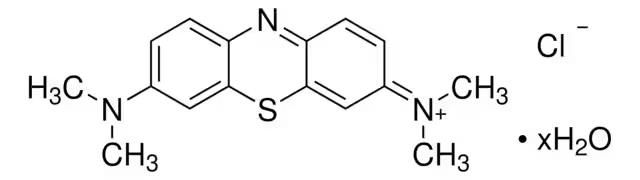
CAS Number122965-43-9
SynonymsMFCD00150006; Methylene Blue; MethyleneblueHydrat; Methylene Blue hydrate; Methylthioninium chloride; EINECS 200-515-2; Methylene Blue hydrate,Methylthionini chloridum
Molecular FormulaC16H20ClN3OS
Molecular Weight319.85 (anhydrous basis)
Density0.6600g/ml
Melting Point190ºC
AppearanceFine Crystalline Powder | Green
Symbol
Signal WordWarning
| Chemical & Physical Properties | |
|---|---|
| CAS Number | 122965-43-9 |
| Catalog No. | 2A-1191229 |
| Chinese Name | 亚甲基蓝 |
| Synonyms | MFCD00150006; Methylene Blue; MethyleneblueHydrat; Methylene Blue hydrate; Methylthioninium chloride; EINECS 200-515-2; Methylene Blue hydrate,Methylthionini chloridum |
| Molecular Formula | C16H20ClN3OS |
| Molecular Weight | 319.85 (anhydrous basis) |
| Density | 0.6600g/ml |
| Melting Point | 190ºC |
| Appearance | Fine Crystalline Powder | Green |
| Water Solubility | H2O: soluble4mg/4ml | Soluble in water, alcohol, a |
| Storage Condition | Keep the container sealed and stored in a cool, dr |
| Application | Methylene blue (basic blue 9) hydrate is an inhibitor of guanosyl cyclase (sGC), monoamine oxidase a (MAO-a), and nitric oxide synthase (NOS). Methylene blue is a vasopressor commonly used as a dye in |
| PubChem ID | 24897317 |
| InChI | InChI=1S/C16H18N3S.ClH.H2O/c1-18(2)11-5-7-13-15(9-11)20-16-10-12(19(3)4)6-8-14(16)17-13;;/h5-10H,1-4H3;1H;1H2/q+1;;/p-1 |
| InChI Key | WQVSELLRAGBDLX-UHFFFAOYSA-M |
| Hazard Symbols | transportation |
| Bioactivity | Methylene blue (Basic Blue 9) hydrate is a guanylyl cyclase (sGC), monoamine oxidase A (MAO-A) and NO synthase (NOS) inhibitor. Methylene blue is a vasopressor and is often used as a dye in several medical procedures. Methylene blue hydrate through the nitric oxide syntase/guanylate cyclase signalling pathway to reduce prepulse inhibition. Methylene blue hydrate is a REDOX cycling compound and able to cross the blood-brain barrier. Methylene blue hydrate is a Tau aggregation inhibitor. Methylene blue hydrate reduces cerebral edema, attenuated microglial activation and reduced neuroinflammation[1][2][3]. Related Catalog Research Areas >> Cancer Research Areas >> Infection Signaling Pathways >> Cell Cycle/DNA Damage >> Microtubule/Tubulin Signaling Pathways >> Immunology/Inflammation >> NO Synthase Signaling Pathways >> Neuronal Signaling >> Monoamine Oxidase Research Areas >> Inflammation/Immunology Signaling Pathways >> Cytoskeleton >> Microtubule/Tubulin Signaling Pathways >> GPCR/G Protein >> Guanylate Cyclase In Vitro Methylene blue (Basic Blue 9) hydrate (4.5 μM; BV2 microglia) alters the immune profile of LPS-activated BV2 microglia and decreased the level of CD14, IL-1β, TNF-α, and CCL2 mRNA[3]. In Vivo Methylene blue (Basic Blue 9) hydrate (50 and 100 mg/kg; i.p.; once, for 25 min; male NMRI mice) reduces absent prepulse inhibition[1]. Methylene blue (Basic Blue 9) hydrate (20 and 40 mg/kg; p.o.; daily, for 6 months; CaMKIIα-tTA transactivator mice) preserves cognition in mice expressing full-length pro-aggregant human Tau[2]. Methylene blue (Basic Blue 9) hydrate (2 mg/kg; i.v.; once, for 1 d; TBI-treated male BALB/c mice) reduces TBI-induced edema and neuroinflammation and reduces acute depression-like behavior[3]. Methylene blue (Basic Blue 9) hydrate (2 mg/kg; i.v.; once, for 1 d; TBI-treated male BALB/c mice) reduces the percentage of inflammatory factor[3]. Animal Model: Male NMRI mice[1] Dosage: 50 and 100 mg/kg Administration: Intraperitoneal injection; once, for 25 minutes Result: Reduced the prepulse inhibition and reduced the increase in locomotor activity caused by phencyclidine (PCP). Animal Model: CaMKIIα-tTA transactivator mice[2] Dosage: 20 and 40 mg/kg Administration: Oral administration; daily, for 6 months Result: Inhibited Tau aggregation in CaMKIIα-tTA transactivator mice. Animal Model: TBI-treated male BALB/c mice[3] Dosage: 2 mg/kg Administration: Intravenous injection; once, for 1 day Result: Decreased the level of CD14, IL-1β, TNF-α, and CCL2 mRNA. Animal Model: TBI-treated male BALB/c mice[3] Dosage: 2 mg/kg Administration: Intravenous injection; once, for 1 day Result: Reduced the percentage of myeloid (CD11b+/GR1+) cells, reduced IL-1β and enhanced IL-10 expression in microglia. References [1]. Klamer D, et, al. Phencyclidine-induced behaviour in mice prevented by methylene blue. Basic Clin Pharmacol Toxicol. 2004 Feb;94(2):65-72. [2]. Hochgräfe K, et, al. Preventive methylene blue treatment preserves cognition in mice expressing full-length pro-aggregant human Tau. Acta Neuropathol Commun. 2015 May 10;3:25. [3]. Fenn AM, et, al. Methylene blue attenuates traumatic brain injury-associated neuroinflammation and acute depressive-like behavior in mice. J Neurotrauma. 2015 Jan 15;32(2):127-38. Chemical & Physical Properties Density 0.6600g/ml Melting Point 190ºC Molecular Formula C16H20ClN3OS Molecular Weight 337.86800 Exact Mass 337.10200 PSA 56.61000 Appearance of Characters Fine Crystalline Powder | Green Storage condition room temp Water Solubility H2O: soluble4mg/4ml | Soluble in water, alcohol, acetic acid, glycerol and chloroform. Insoluble in ether. |
| Use of | Methylene blue (Basic Blue 9) hydrate is a guanylyl cyclase (sGC), monoamine oxidase A (MAO-A) and NO synthase (NOS) inhibitor. Methylene blue is a vasopressor and is often used as a dye in several medical procedures. Methylene blue hydrate through the nitric oxide syntase/guanylate cyclase signalling pathway to reduce prepulse inhibition. Methylene blue hydrate is a REDOX cycling compound and able to cross the blood-brain barrier. Methylene blue hydrate is a Tau aggregation inhibitor. Methylene blue hydrate reduces cerebral edema, attenuated microglial activation and reduced neuroinflammation[1][2][3]. Properties Name methylene blue Synonym More Synonyms METHYLENE BLUE Biological Activity Description Methylene blue (Basic Blue 9) hydrate is a guanylyl cyclase (sGC), monoamine oxidase A (MAO-A) and NO synthase (NOS) inhibitor. Methylene blue is a vasopressor and is often used as a dye in several medical procedures. Methylene blue hydrate through the nitric oxide syntase/guanylate cyclase signalling pathway to reduce prepulse inhibition. Methylene blue hydrate is a REDOX cycling compound and able to cross the blood-brain barrier. Methylene blue hydrate is a Tau aggregation inhibitor. Methylene blue hydrate reduces cerebral edema, attenuated microglial activation and reduced neuroinflammation[1][2][3]. Related Catalog Research Areas >> Cancer Research Areas >> Infection Signaling Pathways >> Cell Cycle/DNA Damage >> Microtubule/Tubulin Signaling Pathways >> Immunology/Inflammation >> NO Synthase Signaling Pathways >> Neuronal Signaling >> Monoamine Oxidase Research Areas >> Inflammation/Immunology Signaling Pathways >> Cytoskeleton >> Microtubule/Tubulin Signaling Pathways >> GPCR/G Protein >> Guanylate Cyclase References [1]. Klamer D, et, al. Phencyclidine-induced behaviour in mice prevented by methylene blue. Basic Clin Pharmacol Toxicol. 2004 Feb;94(2):65-72. [2]. Hochgräfe K, et, al. Preventive methylene blue treatment preserves cognition in mice expressing full-length pro-aggregant human Tau. Acta Neuropathol Commun. 2015 May 10;3:25. [3]. Fenn AM, et, al. Methylene blue attenuates traumatic brain injury-associated neuroinflammation and acute depressive-like behavior in mice. J Neurotrauma. 2015 Jan 15;32(2):127-38. Chemical & Physical Properties Exact Mass 337.10200 PSA 56.61000 Appearance of Characters Fine Crystalline Powder | Green Storage condition room temp |
| Transport Info | Shipping Name: UN |
| MSDS Transport Info | Module 14. Shipping information 14.1 UN dangerous goods number European Land Transport Dangerous Regulations: -International Maritime Dangerous Regulations: -International Air Transport Dangerous Regulations: - 14.2 United Nations shipping name European Land Transport Dangerous Regulations: Non-dangerous goods IMDG Code: Non-dangerous goods International air transport dangerous goods regulations: non-dangerous goods 14.3 Transport hazard categories European Land Transport Dangerous Regulations: -International Maritime Dangerous Regulations: -International Air Transport Dangerous Regulations: - 14.4 Package group European Land Transport Dangerous Regulations: -International Maritime Dangerous Regulations: -International Air Transport Dangerous Regulations: - 14.5 Environmental hazards European Land Transport Danger Regulations: No International Maritime Danger Regulations International Air Transport Danger Regulations: No Marine pollutants (yes/no): No 14.6 Special reminder to users No data available The above information is believed to be correct, but is not all-inclusive and should be used as a guide only. The information in this document is based on our current knowledge and is Correct safety instructions apply to this product. This information does not represent a warranty as to the properties of this product. See reverse side of invoice or packing slip. |
| Related Products in Pigments & Additives | ||
|---|---|---|
| DISPERSE BLUE 106 | 12223-01-7 | 2A-2187821 |
| 2,5-Di(HD)-3,6-di(5-broMothiophen)diketopyrrolopyrrole | 1000623-98-2 | 2A-1190022 |
| DISPERSE YELLOW 9 | 6373-73-5 | 2A-1190888 |
| Disperse Blue 124 | 15141-18-1 | 2A-1190889 |
| DISPERSE BLUE 26 | 3860-63-7 | 2A-1190890 |
| Pigment Yellow 176 | 90268-24-9 | 2A-1191465 |
| Disperse Yellow 114 | 61968-66-9 | 2A-1191480 |
| Disperse Blue 354 | 104137-27-1 | 2A-1191481 |
| N-hydroxy Rhodamine B amide | 1115867-62-3 | 2A-1192885 |
| Pigment Fast Scarlet 2BP | 2A-2193834 | 2A-2193834 |
| Browse all Pigments & Additives products » | ||
Phone:
630-322-8886
630-322-8887
Email:
Office Locations:
Chicago, IL, USA
San Francisco, CA, USA


 EN
EN


 SDS
SDS