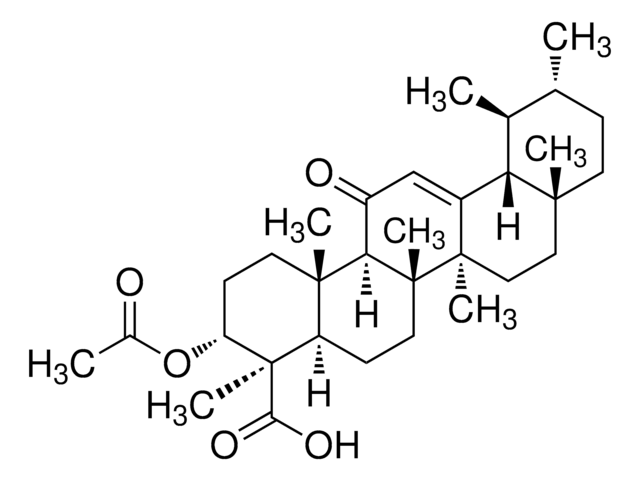
CAS Number67416-61-9
Synonyms3-O-Acetyl-11-keto-β-boswellic acid; (3α)-3-Acetoxy-11-oxours-12-en-24-oic acid; (3α)-3-(acetyloxy)-11-oxours-12-en-24-oic acid; 3-Acetyl-11-keto-β-boswellic Acid; AKBA
Molecular FormulaC32H48O5
Molecular Weight512.72
Density1.1±0.1 g/cm3
Boiling Point600.3±55.0 °C at 760 mmHg
Symbol
Signal WordWarning
| Chemical & Physical Properties | |
|---|---|
| CAS Number | 67416-61-9 |
| Catalog No. | 2A-1190535 |
| Chinese Name | 3-O-乙酰基-11-氧代-β-乳香酸 |
| Synonyms | 3-O-Acetyl-11-keto-β-boswellic acid; (3α)-3-Acetoxy-11-oxours-12-en-24-oic acid; (3α)-3-(acetyloxy)-11-oxours-12-en-24-oic acid; 3-Acetyl-11-keto-β-boswellic Acid; AKBA |
| Molecular Formula | C32H48O5 |
| Molecular Weight | 512.72 |
| Density | 1.1±0.1 g/cm3 |
| Boiling Point | 600.3±55.0 °C at 760 mmHg |
| Storage Condition | −20°C |
| Application | Acetyl-11-Keto-_beta_-Boswellic Acid (AKBA) is an active compound extracted from frankincense and was found to be a novel Nrf2 activator. |
| PubChem ID | 329749127 |
| SMILES | CC(=O)OC1CCC2(C)C(CCC3(C)C2C(=O)C=C2C4C(C)C(C)CCC4(C)CCC23C)C1(C)C(=O)O |
| InChI | InChI=1S/C32H48O5/c1-18-9-12-28(4)15-16-30(6)21(25(28)19(18)2)17-22(34)26-29(5)13-11-24(37-20(3)33)32(8,27(35)36)23(29)10-14-31(26,30)7/h17-19,23-26H,9-16H2,1-8H3,(H,35,36)/t18-,19+,23-,24-,25+,26-,28-,29+,30-,31-,32-/m1/s1 |
| InChI Key | HMMGKOVEOFBCAU-BCDBGHSCSA-N |
| Hazard Symbols | transportation |
| Bioactivity | Acetyl-11-Keto-β-Boswellic Acid (AKBA) is an active triterpenoid compound from the extract of Boswellia serrate; a novel Nrf2 activator.IC50 value:Target: Nrf2 activatorin vitro: AKBA significantly reduced infarct volumes and apoptotic cells, and also increased neurologic scores by elevating the Nrf2 and HO-1 expression in brain tissues in middle cerebral artery occlusion (MCAO) rats at 48 hours post reperfusion. In primary cultured neurons, AKBA increased the Nrf2 and HO-1 expression, which provided protection against OGD-induced oxidative insult. Additionally, AKBA treatment increased Nrf2 binding activity to antioxidant-response elements (ARE) [1]. AKBA significantly inhibited human colon adenocarcinoma growth, showing arrest of the cell cycle in G1-phase and induction of apoptosis[3]. AKBA triggered significant lipolysis in 3T3-L1 adipocytes as shown by reduced neutral lipids in cytosol and increased free fatty acids in culture medium. Increased lipolysis by AKBA was accompanied by up-regulation of lipolytic enzymes, adipocyte triglyceride lipase (ATGL) and hormone sensitive lipase (HSL), and a decreased expression of lipid droplet stability regulator perilipin. In addition, AKBA treatment reduced phenotypic markers of mature adipocyte aP2, adiponectin and glut-4 in mature adipocytes [5].in vivo: AKBA significantly prevented the formation of intestinal adenomatous polyps without toxicity to mice. AKBA's activity both in the prevention of small intestinal and colonic polyps was more potently than aspirin. Histopathologic examination revealed that AKBA's effect, that is the reduction of polyp size and degree of dysplasia, was more prominent in larger sized polyps, especially those originating in colon [2]. AKBA administration in mice effectively delayed the growth of HT-29 xenografts without signs of toxicity. The activity of AKBA was more potent than that of aspirin [3]. AKBA exhibited anti-cancer activity in vitro and in vivo. With oral application in mice, AKBA significantly inhibited SGC-7901 and MKN-45 xenografts without toxicity [4]. Related Catalog Signaling Pathways >> Metabolic Enzyme/Protease >> HIF/HIF Prolyl-Hydroxylase Research Areas >> Cancer Natural Products >> Terpenoids and Glycosides Chemical & Physical Properties Density 1.1±0.1 g/cm3 Boiling Point 600.3±55.0 °C at 760 mmHg Molecular Formula C32H48O5 Molecular Weight 512.721 Flash Point 184.4±25.0 °C Exact Mass 512.350159 PSA 80.67000 LogP 8.00 Vapour Pressure 0.0±3.7 mmHg at 25°C Index of Refraction 1.549 InChIKey HMMGKOVEOFBCAU-BCDBGHSCSA-N SMILES CC(=O)OC1CCC2(C)C(CCC3(C)C2C(=O)C=C2C4C(C)C(C)CCC4(C)CCC23C)C1(C)C(=O)O Storage condition −20°C |
| Use of | Acetyl-11-Keto-β-Boswellic Acid (AKBA) is an active triterpenoid compound from the extract of Boswellia serrate; a novel Nrf2 activator.IC50 value:Target: Nrf2 activatorin vitro: AKBA significantly reduced infarct volumes and apoptotic cells, and also increased neurologic scores by elevating the Nrf2 and HO-1 expression in brain tissues in middle cerebral artery occlusion (MCAO) rats at 48 hours post reperfusion. In primary cultured neurons, AKBA increased the Nrf2 and HO-1 expression, which provided protection against OGD-induced oxidative insult. Additionally, AKBA treatment increased Nrf2 binding activity to antioxidant-response elements (ARE) [1]. AKBA significantly inhibited human colon adenocarcinoma growth, showing arrest of the cell cycle in G1-phase and induction of apoptosis[3]. AKBA triggered significant lipolysis in 3T3-L1 adipocytes as shown by reduced neutral lipids in cytosol and increased free fatty acids in culture medium. Increased lipolysis by AKBA was accompanied by up-regulation of lipolytic enzymes, adipocyte triglyceride lipase (ATGL) and hormone sensitive lipase (HSL), and a decreased expression of lipid droplet stability regulator perilipin. In addition, AKBA treatment reduced phenotypic markers of mature adipocyte aP2, adiponectin and glut-4 in mature adipocytes [5].in vivo: AKBA significantly prevented the formation of intestinal adenomatous polyps without toxicity to mice. AKBA's activity both in the prevention of small intestinal and colonic polyps was more potently than aspirin. Histopathologic examination revealed that AKBA's effect, that is the reduction of polyp size and degree of dysplasia, was more prominent in larger sized polyps, especially those originating in colon [2]. AKBA administration in mice effectively delayed the growth of HT-29 xenografts without signs of toxicity. The activity of AKBA was more potent than that of aspirin [3]. AKBA exhibited anti-cancer activity in vitro and in vivo. With oral application in mice, AKBA significantly inhibited SGC-7901 and MKN-45 xenografts without toxicity [4]. Properties Name Acetyl-11-keto-b-boswellic acid Synonym More Synonyms 3-O-Acetyl-11-keto-beta-boswellic acid Biological Activity Description Acetyl-11-Keto-β-Boswellic Acid (AKBA) is an active triterpenoid compound from the extract of Boswellia serrate; a novel Nrf2 activator.IC50 value:Target: Nrf2 activatorin vitro: AKBA significantly reduced infarct volumes and apoptotic cells, and also increased neurologic scores by elevating the Nrf2 and HO-1 expression in brain tissues in middle cerebral artery occlusion (MCAO) rats at 48 hours post reperfusion. In primary cultured neurons, AKBA increased the Nrf2 and HO-1 expression, which provided protection against OGD-induced oxidative insult. Additionally, AKBA treatment increased Nrf2 binding activity to antioxidant-response elements (ARE) [1]. AKBA significantly inhibited human colon adenocarcinoma growth, showing arrest of the cell cycle in G1-phase and induction of apoptosis[3]. AKBA triggered significant lipolysis in 3T3-L1 adipocytes as shown by reduced neutral lipids in cytosol and increased free fatty acids in culture medium. Increased lipolysis by AKBA was accompanied by up-regulation of lipolytic enzymes, adipocyte triglyceride lipase (ATGL) and hormone sensitive lipase (HSL), and a decreased expression of lipid droplet stability regulator perilipin. In addition, AKBA treatment reduced phenotypic markers of mature adipocyte aP2, adiponectin and glut-4 in mature adipocytes [5].in vivo: AKBA significantly prevented the formation of intestinal adenomatous polyps without toxicity to mice. AKBA's activity both in the prevention of small intestinal and colonic polyps was more potently than aspirin. Histopathologic examination revealed that AKBA's effect, that is the reduction of polyp size and degree of dysplasia, was more prominent in larger sized polyps, especially those originating in colon [2]. AKBA administration in mice effectively delayed the growth of HT-29 xenografts without signs of toxicity. The activity of AKBA was more potent than that of aspirin [3]. AKBA exhibited anti-cancer activity in vitro and in vivo. With oral application in mice, AKBA significantly inhibited SGC-7901 and MKN-45 xenografts without toxicity [4]. Related Catalog Signaling Pathways >> Metabolic Enzyme/Protease >> HIF/HIF Prolyl-Hydroxylase Research Areas >> Cancer Natural Products >> Terpenoids and Glycosides Chemical & Physical Properties Molecular Formula C32H48O5 Exact Mass 512.350159 PSA 80.67000 Index of Refraction 1.549 InChIKey HMMGKOVEOFBCAU-BCDBGHSCSA-N |
| Transport Info | Product name: Purity: 98.0% |
| MSDS Transport Info | Module 14. Shipping information 14.1 UN dangerous goods number European Land Transport Dangerous Regulations: -International Maritime Dangerous Regulations: -International Air Transport Dangerous Regulations: - 14.2 Names specified by the United Nations (UN) European Land Transport Dangerous Regulations: Non-dangerous goods IMDG Code: Non-dangerous goods International air transport dangerous goods regulations: non-dangerous goods 14.3 Transport hazard categories European Land Transport Dangerous Regulations: -International Maritime Dangerous Regulations: -International Air Transport Dangerous Regulations: - 14.4 Package group European Land Transport Dangerous Regulations: -International Maritime Dangerous Regulations: -International Air Transport Dangerous Regulations: - 14.5 Environmental hazards European Land Transport Dangerous Regulations: No International Maritime Transport Dangerous Regulations Maritime Pollutants: No International Air Transport Risk Regulations: No 14.6 Special reminder to users No data available |
| Related Products in Botanical Reference Standards | ||
|---|---|---|
| 2,3,4,6-TETRA-O-BENZOYL-D-GALACTOPYRANOSIDE | 627466-84-6 | 2A-1189917 |
| 4-HYDROXYCHALCONE | 20426-12-4 | 2A-1189952 |
| Allyl 4,6-di-O-benzylidene-α-D-galactopyranoside | 100759-10-2 | 2A-1190500 |
| Valproic acyl D glucuronide | 60113-83-9 | 2A-1190507 |
| 8-Allyloxypsoralen | 62188-89-0 | 2A-1190515 |
| 2-Hydroxy-3-methoxychalcone | 7146-86-3 | 2A-1190542 |
| 2'-Hydroxy-,2,5,6'-trimethoxychalcone | 154469-46-2 | 2A-1190543 |
| 4'-Methoxychalcone | 22966-19-4 | 2A-1190545 |
| 4'-Chloro-4-methoxychalcone | 6552-63-2 | 2A-1190546 |
| 2',2-Dihydroxychalcone | 15131-80-3 | 2A-1190547 |
| Browse all Botanical Reference Standards products » | ||
Phone:
630-322-8886
630-322-8887
Email:
Office Locations:
Chicago, IL, USA
San Francisco, CA, USA


 EN
EN


 SDS
SDS