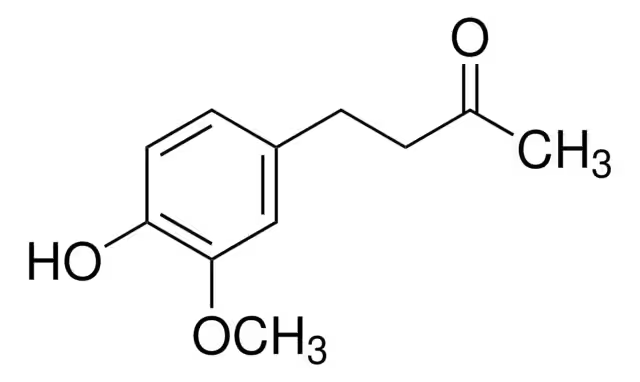
CAS Number122-48-5
SynonymsVanillyl acetone; 4-(4-Hydroxy-3-methoxyphenyl)-2-butanone; 4-(4-hydroxy-3-methoxyphenyl)butan-2-one; Zingiberone; EINECS 204-548-3; Vanillylacetone; MFCD00048232; 3-Methoxy-4-hydroxybenzylacetone; Zingberone; zingerone
Molecular Formula4-(HO)C6H3-3-(OCH3)CH2CH2COCH3
Molecular Weight194.23
Purity≥98.0 (GC)%
Density1.1±0.1 g/cm3
Boiling Point141 °C/0.5 mmHg (lit.)
Melting Point40-41 °C (lit.)
AppearanceTransparent slightly yellow liquid
EINECS204-548-3
Symbol
Signal WordWarning
| Chemical & Physical Properties | |
|---|---|
| CAS Number | 122-48-5 |
| Catalog No. | 2A-9019169 |
| Chinese Name | 姜酮; 4-(4-羟基-3-甲氧基苯基)-2-丁酮 |
| Synonyms | Vanillyl acetone; 4-(4-Hydroxy-3-methoxyphenyl)-2-butanone; 4-(4-hydroxy-3-methoxyphenyl)butan-2-one; Zingiberone; EINECS 204-548-3; Vanillylacetone; MFCD00048232; 3-Methoxy-4-hydroxybenzylacetone; Zingberone; zingerone |
| Molecular Formula | 4-(HO)C6H3-3-(OCH3)CH2CH2COCH3 |
| Molecular Weight | 194.23 |
| Purity | ≥98.0 (GC) |
| Density | 1.1±0.1 g/cm3 |
| Boiling Point | 141 °C/0.5 mmHg (lit.) |
| Melting Point | 40-41 °C (lit.) |
| Appearance | Transparent slightly yellow liquid |
| Water Solubility | Soluble in: methanol |
| Storage Condition | 2-8°C |
| Packaging | II; III |
| Application | Zingerone (Vanillylacetone) is a non-toxic methoxyphenol obtained from ginger and has anti-inflammatory, anti-diabetic, anti-lipid allergy, anti-diarrhea, anti-spasmodic and anti-tumor activities [1]. |
| EINECS | 204-548-3 |
| HTC | 29333999 |
| PubChem ID | 329769669 |
| MDL Number | MFCD00048232 |
| SMILES | COc1cc(CCC(C)=O)ccc1O |
| InChI | 1S/C11H14O3/c1-8(12)3-4-9-5-6-10(13)11(7-9)14-2/h5-7,13H,3-4H2,1-2H3 |
| InChI Key | OJYLAHXKWMRDGS-UHFFFAOYSA-N |
| NACRES Code | NA.24 |
| UNSPSC | 12164502 |
| Hazard Symbols | 4.1 |
| MSDS | msds/19169_1_122_48_5.pdf |
| Bioactivity | Zingerone (Vanillylacetone) is a nontoxic methoxyphenol isolated from Zingiber officinale, with potent anti-inflammatory, antidiabetic, antilipolytic, antidiarrhoeic, antispasmodic and anti-tumor[3] properties[1]. Zingerone alleviates oxidative stress and inflammation, down-regulates NF-κB mediated signaling pathways[2]. Zingerone acts as an anti-mitotic agent, and inhibits the growth of neuroblastoma cells[3]. Related Catalog Research Areas >> Cancer Research Areas >> Inflammation/Immunology Research Areas >> Metabolic Disease Natural Products >> Phenols Target NF-κB[3] In Vitro Zingerone is a nontoxic methoxyphenol with potent anti-inflammatory, antidiabetic, antilipolytic, antidiarrhoeic, antispasmodic properties[1]. Zingerone (0-2 mM) decreases neruoblastoma cell survival[3]. Zingerone (0-2 mM) reduces cyclin D1 expression, increases cleavage of caspase-3 and PARP-1 in BE(2)-M17 cells[3]. In Vivo Zingerone (50, 100 mg/kg, p.o. daily for 21 days) protects against alloxan-induced diabetes via alleviation of oxidative stress and inflammation in rat[2]. Zingerone (10 mg/kg, i.p.) inhibits tumor progression through mitotic arrest, failure of cell division, and stimulation of apoptosis[3]. References [1]. Ahmad B, et al. A Review on Pharmacological Properties of Zingerone (4-(4-Hydroxy-3-methoxyphenyl)-2-butanone). ScientificWorldJournal. 2015;2015:816364. [2]. Ahmad B, et al. Zingerone (4-(4-hydroxy-3-methylphenyl) butan-2-one) protects against alloxan-induced diabetes via alleviation of oxidative stress and inflammation: Probable role of NF-kB activation. Saudi Pharm J. 2018 Dec;26(8):1137-1145. [3]. Choi JS, et al. Zingerone Suppresses Tumor Development through Decreasing Cyclin D1 Expression and Inducing Mitotic Arrest. Int J Mol Sci. 2018 Sep 19;19(9). Chemical & Physical Properties Density 1.1±0.1 g/cm3 Boiling Point 323.0±27.0 °C at 760 mmHg Melting Point 40-41 °C(lit.) Molecular Formula C11H14O3 Molecular Weight 194.227 Flash Point 123.7±17.2 °C Exact Mass 194.094299 PSA 46.53000 LogP 0.64 Vapour Pressure 0.0±0.7 mmHg at 25°C Index of Refraction 1.526 InChIKey OJYLAHXKWMRDGS-UHFFFAOYSA-N SMILES COc1cc(CCC(C)=O)ccc1O Storage condition 2-8°C |
| Use of | Zingerone (Vanillylacetone) is a nontoxic methoxyphenol isolated from Zingiber officinale, with potent anti-inflammatory, antidiabetic, antilipolytic, antidiarrhoeic, antispasmodic and anti-tumor[3] properties[1]. Zingerone alleviates oxidative stress and inflammation, down-regulates NF-κB mediated signaling pathways[2]. Zingerone acts as an anti-mitotic agent, and inhibits the growth of neuroblastoma cells[3]. Properties Articles26 Name zingerone Synonym More Synonyms zingerone Biological Activity Description Zingerone (Vanillylacetone) is a nontoxic methoxyphenol isolated from Zingiber officinale, with potent anti-inflammatory, antidiabetic, antilipolytic, antidiarrhoeic, antispasmodic and anti-tumor[3] properties[1]. Zingerone alleviates oxidative stress and inflammation, down-regulates NF-κB mediated signaling pathways[2]. Zingerone acts as an anti-mitotic agent, and inhibits the growth of neuroblastoma cells[3]. Related Catalog Research Areas >> Cancer Research Areas >> Inflammation/Immunology Research Areas >> Metabolic Disease Natural Products >> Phenols References [1]. Ahmad B, et al. A Review on Pharmacological Properties of Zingerone (4-(4-Hydroxy-3-methoxyphenyl)-2-butanone). ScientificWorldJournal. 2015;2015:816364. [2]. Ahmad B, et al. Zingerone (4-(4-hydroxy-3-methylphenyl) butan-2-one) protects against alloxan-induced diabetes via alleviation of oxidative stress and inflammation: Probable role of NF-kB activation. Saudi Pharm J. 2018 Dec;26(8):1137-1145. [3]. Choi JS, et al. Zingerone Suppresses Tumor Development through Decreasing Cyclin D1 Expression and Inducing Mitotic Arrest. Int J Mol Sci. 2018 Sep 19;19(9). Chemical & Physical Properties Molecular Formula C11H14O3 Exact Mass 194.094299 PSA 46.53000 Index of Refraction 1.526 InChIKey OJYLAHXKWMRDGS-UHFFFAOYSA-N |
| Tax Rebate | 9.0% |
| Supervision | None MFN tariff: 5.5% Ordinary tariff: 30.0% |
| Transport Info | Shipping Name: UN |
| MSDS Transport Info | Module 14. Shipping information 14.1 UN dangerous goods number European Land Transport Dangerous Regulations: -International Maritime Dangerous Regulations: -International Air Transport Dangerous Regulations: - 14.2 United Nations shipping name European Land Transport Dangerous Regulations: Non-dangerous goods IMDG Code: Non-dangerous goods International air transport dangerous goods regulations: non-dangerous goods 14.3 Transport hazard categories European Land Transport Dangerous Regulations: -International Maritime Dangerous Regulations: -International Air Transport Dangerous Regulations: - 14.4 Package group European Land Transport Dangerous Regulations: -International Maritime Dangerous Regulations: -International Air Transport Dangerous Regulations: - 14.5 Environmental hazards European Land Transport Danger Regulations: No International Maritime Danger Regulations International Air Transport Danger Regulations: No Marine pollutants (yes/no): No 14.6 Special reminder to users No data available |
| Related Products in Industrial Applications | ||
|---|---|---|
| Trichloroethanol | 115-20-8 | 2A-9018920 |
| Hydroxyacetone | 116-09-6 | 2A-9018944 |
| Hexachloroacetone | 116-16-5 | 2A-9018948 |
| 2,6-Dichlorotoluene | 118-69-4 | 2A-9019010 |
| 2-Chloro-4-nitrotoluene | 121-86-8 | 2A-9019142 |
| Benzalacetone | 122-57-6 | 2A-9019172 |
| 2-Anilinoethanol | 122-98-5 | 2A-9019491 |
| N,N'-Dicinnamylidene-1,6-hexanediamine | 140-73-8 | 2A-9020851 |
| 2-Hydroxyhexanedial | 141-31-1 | 2A-9020871 |
| Triethanolamine borate | 283-56-7 | 2A-9021107 |
| Browse all Industrial Applications products » | ||
Phone:
630-322-8886
630-322-8887
Email:
Office Locations:
Chicago, IL, USA
San Francisco, CA, USA


 EN
EN


 SDS
SDS