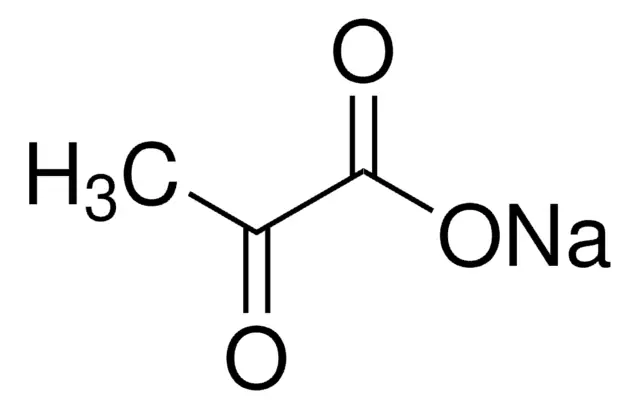
CAS Number113-24-6
SynonymsPYRUVATE; PYR NA; Pyruvic acid,sodium salt; sodium 2-oxopropanoate; Sodium pyroracemate; Sodium pyruate; SodiuM Pyruvate; Pyruvic acid sodium salt; pyruvic acid sodium; 2-oxopropanoic acid sodium salt; sodium salt of pyruvic acid; EINECS 204-024-4; SodiuM pyrovaceMate; MFCD00002586
Molecular FormulaCH3COCOONa
Molecular Weight110.04
Purity≥99%
Density1.267g/cm3
Boiling Point165ºC at 760 mmHg
Melting Point>300 °C (lit.)
Appearancepowder
EINECS204-024-4
Symbol
Signal WordWarning
| Chemical & Physical Properties | |
|---|---|
| CAS Number | 113-24-6 |
| Catalog No. | 2A-9018897 |
| Chinese Name | 丙酮酸钠 |
| Synonyms | PYRUVATE; PYR NA; Pyruvic acid,sodium salt; sodium 2-oxopropanoate; Sodium pyroracemate; Sodium pyruate; SodiuM Pyruvate; Pyruvic acid sodium salt; pyruvic acid sodium; 2-oxopropanoic acid sodium salt; sodium salt of pyruvic acid; EINECS 204-024-4; SodiuM pyrovaceMate; MFCD00002586 |
| Molecular Formula | CH3COCOONa |
| Molecular Weight | 110.04 |
| Purity | ≥99 |
| Density | 1.267g/cm3 |
| Boiling Point | 165ºC at 760 mmHg |
| Melting Point | >300 °C (lit.) |
| Appearance | powder |
| Water Solubility | H2O: 100 mg/mL |
| Storage Condition | 1. Store in a cool, ventilated warehouse. Keep awa |
| Application | Sodium 2-oxopropionate (sodium pyruvate) is a three-carbon metabolite of glucose and a compound produced in the glycolysis pathway. Sodium 2-oxopropionate is a free radical scavenger that can scavenge |
| EINECS | 204-024-4 |
| HTC | 29183000 |
| PubChem ID | 24898615 |
| MDL Number | MFCD00002586 |
| SMILES | [Na+].CC(=O)C([O-])=O |
| InChI | 1S/C3H4O3.Na/c1-2(4)3(5)6;/h1H3,(H,5,6);/q;+1/p-1 |
| InChI Key | DAEPDZWVDSPTHF-UHFFFAOYSA-M |
| Beilstein/REAXYS | 3568341 |
| NACRES Code | NA.71 |
| UNSPSC | 12352207 |
| Hazard Symbols | Transport |
| MSDS | msds/18897_1_113_24_6.pdf |
| Bioactivity | Sodium 2-oxopropanoate (Sodium pyruvate), a three-carbon metabolite of Glucose, is a compound produced in the glycolytic pathway. Sodium 2-oxopropanoate is a free radical scavenger that can scavenge ROS[1][2]. Related Catalog Research Areas >> Metabolic Disease Target Microbial Metabolite In Vitro In the process of scavenging hydrogen peroxide, Sodium 2-oxopropanoate (Sodium pyruvate) is decarboxylated to lactate and hence diverted away from aerobic metabolism and further ROS generation. Under conditions in which pyruvate stimulated JNK1 activity, both mitochondrial and cytosolic ROS levels rose. An increase in JNK1 activity in a variety of different cell types over a range of pyruvate concentrations are observed[1]. Sodium 2-oxopropanoate (Sodium pyruvate) is an effective scavenger of H2O2 as well as of O2▪-, thereby protecting the lens against oxidative stress and consequent cataract formation, under in vitro as well as in vivo conditions, Sodium 2-oxopropanoate has also been shown to protect the lens proteins against glycation by competitively inhibiting the initial reaction between the sugar carbonyl and the protein -NH2[2]. In Vivo Neonatal rats are given a bolus of Sodium 2-oxopropanoate (Sodium pyruvate; 0.1-10 g/kg), and 1 h later, levels of JNK1 activity were determined in liver extracts. Sodium 2-oxopropanoate (Sodium pyruvate) addition resulted in a significant increase in JNK1 activity. Analysis of serum levels of Sodium 2-oxopropanoate in neonatal rats revealed that baseline levels of pyruvate are 0.30 mM. At the time of sacrifice, following the largest dose of Sodium 2-oxopropanoate, serum levels rose approximately sixfold to 1.84 mM[1]. References [1]. S Nemoto, et al. Role for mitochondrial oxidants as regulators of cellular metabolism. Mol Cell Biol. 2000 Oct;20(19):7311-8. [2]. W Zhao, et al. Fructose induced deactivation of antioxidant enzymes: preventive effect of pyruvate. Free Radic Res. 2000 Jul;33(1):23-30. Chemical & Physical Properties Density 1.267g/cm3 Boiling Point 165ºC at 760 mmHg Melting Point >300 °C(lit.) Molecular Formula C3H3NaO3 Molecular Weight 110.04 Flash Point 54.3ºC Exact Mass 109.997986 PSA 57.20000 Vapour Pressure 0.968mmHg at 25°C Index of Refraction 1.426-1.43 InChIKey DAEPDZWVDSPTHF-UHFFFAOYSA-M SMILES CC(=O)C(=O)[O-].[Na+] Storage condition 2-8°C Stability Stable. Incompatible with strong oxidizing agents. Water Solubility H2O: 100 mg/mL |
| Use of | Sodium 2-oxopropanoate (Sodium pyruvate), a three-carbon metabolite of Glucose, is a compound produced in the glycolytic pathway. Sodium 2-oxopropanoate is a free radical scavenger that can scavenge ROS[1][2]. Properties Articles1784 Name sodium pyruvate Synonym More Synonyms Sodium 2-oxopropanoate Biological Activity Description Sodium 2-oxopropanoate (Sodium pyruvate), a three-carbon metabolite of Glucose, is a compound produced in the glycolytic pathway. Sodium 2-oxopropanoate is a free radical scavenger that can scavenge ROS[1][2]. Related Catalog Research Areas >> Metabolic Disease Microbial Metabolite In Vitro In the process of scavenging hydrogen peroxide, Sodium 2-oxopropanoate (Sodium pyruvate) is decarboxylated to lactate and hence diverted away from aerobic metabolism and further ROS generation. Under conditions in which pyruvate stimulated JNK1 activity, both mitochondrial and cytosolic ROS levels rose. An increase in JNK1 activity in a variety of different cell types over a range of pyruvate concentrations are observed[1]. Sodium 2-oxopropanoate (Sodium pyruvate) is an effective scavenger of H2O2 as well as of O2▪-, thereby protecting the lens against oxidative stress and consequent cataract formation, under in vitro as well as in vivo conditions, Sodium 2-oxopropanoate has also been shown to protect the lens proteins against glycation by competitively inhibiting the initial reaction between the sugar carbonyl and the protein -NH2[2]. References [1]. S Nemoto, et al. Role for mitochondrial oxidants as regulators of cellular metabolism. Mol Cell Biol. 2000 Oct;20(19):7311-8. [2]. W Zhao, et al. Fructose induced deactivation of antioxidant enzymes: preventive effect of pyruvate. Free Radic Res. 2000 Jul;33(1):23-30. Chemical & Physical Properties Molecular Formula C3H3NaO3 Exact Mass 109.997986 PSA 57.20000 Index of Refraction 1.426-1.43 InChIKey DAEPDZWVDSPTHF-UHFFFAOYSA-M SMILES CC(=O)C(=O)[O-].[Na+] Stability Stable. Incompatible with strong oxidizing agents. |
| Tax Rebate | 9.0% |
| Supervision | None MFN tariff: 6.5% Ordinary tariff: 30.0% |
| Transport Info | Shipping Name: UN |
| MSDS Transport Info | Module 14. Shipping information 14.1 UN dangerous goods number European Land Transport Dangerous Regulations: -International Maritime Dangerous Regulations: -International Air Transport Dangerous Regulations: - 14.2 United Nations shipping name European Land Transport Dangerous Regulations: Non-dangerous goods IMDG Code: Non-dangerous goods International air transport dangerous goods regulations: non-dangerous goods 14.3 Transport hazard categories European Land Transport Dangerous Regulations: -International Maritime Dangerous Regulations: -International Air Transport Dangerous Regulations: - 14.4 Package group European Land Transport Dangerous Regulations: -International Maritime Dangerous Regulations: -International Air Transport Dangerous Regulations: - 14.5 Environmental hazards European Land Transport Danger Regulations: No International Maritime Danger Regulations International Air Transport Danger Regulations: No Marine pollutants (yes/no): No 14.6 Special reminder to users No data available |
| Related Products in Specialty Chemicals | ||
|---|---|---|
| N,N-Dimethyltetradecylamine | 112-75-4 | 2A-9018886 |
| Erucylamide | 112-84-5 | 2A-9018890 |
| Docosanoic acid | 112-85-6 | 2A-9018891 |
| Oleylamine | 112-90-3 | 2A-9018894 |
| Octadecanol | 112-92-5 | 2A-9018895 |
| Chlorprothixene | 113-59-7 | 2A-9018900 |
| N-Methylnicotinamide | 114-33-0 | 2A-9018906 |
| Sodium 4-hydroxybenzoate | 114-63-6 | 2A-9018908 |
| Sodium phenylacetate | 114-70-5 | 2A-9018909 |
| Sodium phenylpyruvate | 114-76-1 | 2A-9018910 |
| Browse all Specialty Chemicals products » | ||
Phone:
630-322-8886
630-322-8887
Email:
Office Locations:
Chicago, IL, USA
San Francisco, CA, USA


 EN
EN


 SDS
SDS