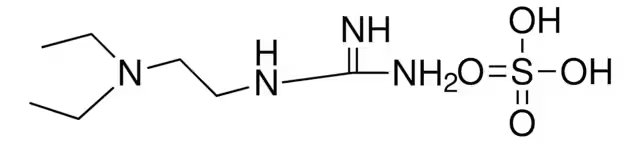
CAS Number3979-00-8
Synonyms2-(2-Sulfanylethyl)guanidine sulfate (2:1); 2-(2-sulfanylethyl)guanidine,sulfuric acid; Guanidine, N''-(2-mercaptoethyl)-, sulfate (2:1); MEG hemisulfate salt
Molecular FormulaC7H20N4O4S
Molecular Weight256.326
Purity98.00%
Boiling Point645.7ºC at 760 mmHg
Symbol
Signal WordWarning
| Chemical & Physical Properties | |
|---|---|
| CAS Number | 3979-00-8 |
| Catalog No. | 2A-1186394 |
| Chinese Name | MEG hemisulfate |
| Synonyms | 2-(2-Sulfanylethyl)guanidine sulfate (2:1); 2-(2-sulfanylethyl)guanidine,sulfuric acid; Guanidine, N''-(2-mercaptoethyl)-, sulfate (2:1); MEG hemisulfate salt |
| Molecular Formula | C7H20N4O4S |
| Molecular Weight | 256.326 |
| Purity | 98.00 |
| Boiling Point | 645.7ºC at 760 mmHg |
| Storage Condition | 2-8°C, dry, sealed |
| Application | MEG (Mercaptoethylguanidine) hemisulfate is a potent and selective inhibitor of inducible NO synthase (iNOS), with EC50 values of 11.5, 110 and 60 μM for iNOS, ecNOS and bNOS inhibition in tissue ho |
| PubChem ID | 24897374 |
| MDL Number | MFCD00185882 |
| SMILES | NC(N)=NCCS.NC(N)=NCCS.O=S(=O)(O)O |
| InChI | InChI=1S/2C3H9N3S.H2O4S/c2*4-3(5)6-1-2-7;1-5(2,3)4/h2*7H,1-2H2,(H4,4,5,6);(H2,1,2,3,4) |
| InChI Key | XJKZAAUVINNNNC-UHFFFAOYSA-N |
| Hazard Symbols | transportation |
| Bioactivity | MEG (Mercaptoethylguanidine) hemisulfate is a potent and selective inhibitor of the inducible NO synthase (iNOS), with EC50s of 11.5, 110, and 60 μM for iNOS, ecNOS, and bNOS respectively in tissue homogenates. MEG hemisulfate is also a potent scavenger of peroxynitrite and inhibits peroxynitrite-induced oxidative processes. MEG hemisulfate has a protective effect in many experimental models of inflammation, including ischemia/reperfusion injury, periodontitis, hemorrhagic shock, inflammatory bowel disease, and endotoxic and septic shock[1][2][3][4]. Related Catalog Signaling Pathways >> Immunology/Inflammation >> NO Synthase Research Areas >> Inflammation/Immunology Target IC50: 11.5 μM (iNOS), 110 μM (ecNOS), 60 μM (bNOS)[1] In Vitro MEG (0.1-1000 μM; 18 h) reduces nitrite accumulation in the supernatant of cultured J774.2 macrophages activated with LPS (10 μg/mL) and INF (50 μg/mL). MEG inhibits iNOS activity in homogenates of lungs taken from LPS-treated rats[1]. MEG (1 μM-3 mM; 3 min) dose-dependently inhibits the peroxynitrite-induced oxidation of cytochrome c2+ and hydroxylation of benzoate[2]. MEG (1-300 μM) inhibits the suppression of mitochondrial respiration and DNA single strand breakage in response to peroxynitrite in J774 cells[2]. MEG (300 μM; 30 min) inhibits the suppression of vascular contractility in response to peroxynitrite in thoracic aortic rings[2]. In Vivo MEG (10 mg/kg; i.p. for 5 d) attenuates the degree of lipid peroxidation, protein oxidation, and peroxynitrites level and ameliorated the decrease of antioxidant enzymes activities in the esophagus of rats subjected to caustic burn injury[3]. MEG (30-60 mg/kg; a single i.p.) decreases mean arterial blood pressure (MAP) of normal rats[1]. MEG (10 mg/kg; a single i.p.) improves the renal dysfunction and tissue injury induced by ischemia/reperfusion (I/R) of rat kidney[4]. Animal Model: Sprague-Dawley rats (200-250 g) were injured the esophagus[3] Dosage: 10 mg/kg Administration: I.p. for 5 days Result: Reduced the stenosis index (SI) and the histopathologic damage score. Decreased the malondialdehyde and protein carbonyl content and increased the activities of superoxide dismutase and glutathione peroxidase. Regulated the nitrate and nitrite level. References [1]. Southan GJ, et, al. Spontaneous rearrangement of aminoalkylisothioureas into mercaptoalkylguanidines, a novel class of nitric oxide synthase inhibitors with selectivity towards the inducible isoform. Br J Pharmacol. 1996 Feb;117(4):619-32. [2]. Szabó C, et, al. Mercaptoethylguanidine and guanidine inhibitors of nitric-oxide synthase react with peroxynitrite and protect against peroxynitrite-induced oxidative damage. J Biol Chem. 1997 Apr 4;272(14):9030-6. [3]. Guven A, et, al. Mercaptoethylguanidine attenuates caustic esophageal injury in rats: a role for scavenging of peroxynitrite. J Pediatr Surg. 2011 Sep;46(9):1746-52. [4]. Guven A, et, al. Scavenging of peroxynitrite reduces renal ischemia/reperfusion injury. Ren Fail. 2008;30(7):747-54. Chemical & Physical Properties Boiling Point 645.7ºC at 760 mmHg Molecular Formula C6H20N6O4S3 Molecular Weight 336.456 Flash Point 344.3ºC Exact Mass 336.070801 PSA 284.38000 LogP 1.60840 InChIKey XJKZAAUVINNNNC-UHFFFAOYSA-N SMILES NC(N)=NCCS.NC(N)=NCCS.O=S(=O)(O)O |
| Use of | MEG (Mercaptoethylguanidine) hemisulfate is a potent and selective inhibitor of the inducible NO synthase (iNOS), with EC50s of 11.5, 110, and 60 μM for iNOS, ecNOS, and bNOS respectively in tissue homogenates. MEG hemisulfate is also a potent scavenger of peroxynitrite and inhibits peroxynitrite-induced oxidative processes. MEG hemisulfate has a protective effect in many experimental models of inflammation, including ischemia/reperfusion injury, periodontitis, hemorrhagic shock, inflammatory bowel disease, and endotoxic and septic shock[1][2][3][4]. Properties Articles24 Name Mercaptoethylguanidine hemisulfate salt Synonym More Synonyms MEG hemisulfate Biological Activity Description MEG (Mercaptoethylguanidine) hemisulfate is a potent and selective inhibitor of the inducible NO synthase (iNOS), with EC50s of 11.5, 110, and 60 μM for iNOS, ecNOS, and bNOS respectively in tissue homogenates. MEG hemisulfate is also a potent scavenger of peroxynitrite and inhibits peroxynitrite-induced oxidative processes. MEG hemisulfate has a protective effect in many experimental models of inflammation, including ischemia/reperfusion injury, periodontitis, hemorrhagic shock, inflammatory bowel disease, and endotoxic and septic shock[1][2][3][4]. Related Catalog Signaling Pathways >> Immunology/Inflammation >> NO Synthase Research Areas >> Inflammation/Immunology IC50: 11.5 μM (iNOS), 110 μM (ecNOS), 60 μM (bNOS)[1] References [1]. Southan GJ, et, al. Spontaneous rearrangement of aminoalkylisothioureas into mercaptoalkylguanidines, a novel class of nitric oxide synthase inhibitors with selectivity towards the inducible isoform. Br J Pharmacol. 1996 Feb;117(4):619-32. [2]. Szabó C, et, al. Mercaptoethylguanidine and guanidine inhibitors of nitric-oxide synthase react with peroxynitrite and protect against peroxynitrite-induced oxidative damage. J Biol Chem. 1997 Apr 4;272(14):9030-6. [3]. Guven A, et, al. Mercaptoethylguanidine attenuates caustic esophageal injury in rats: a role for scavenging of peroxynitrite. J Pediatr Surg. 2011 Sep;46(9):1746-52. [4]. Guven A, et, al. Scavenging of peroxynitrite reduces renal ischemia/reperfusion injury. Ren Fail. 2008;30(7):747-54. Chemical & Physical Properties Molecular Formula C6H20N6O4S3 Exact Mass 336.070801 PSA 284.38000 LogP 1.60840 InChIKey XJKZAAUVINNNNC-UHFFFAOYSA-N SMILES NC(N)=NCCS.NC(N)=NCCS.O=S(=O)(O)O |
| Transport Info | Product name: Purity: 98.0% |
| MSDS Transport Info | Module 14. Shipping information 14.1 UN dangerous goods number European Land Transport Dangerous Regulations: -International Maritime Dangerous Regulations: -International Air Transport Dangerous Regulations: - 14.2 Names specified by the United Nations (UN) European Land Transport Dangerous Regulations: Non-dangerous goods IMDG Code: Non-dangerous goods International air transport dangerous goods regulations: non-dangerous goods 14.3 Transport hazard categories European Land Transport Dangerous Regulations: -International Maritime Dangerous Regulations: -International Air Transport Dangerous Regulations: - 14.4 Package group European Land Transport Dangerous Regulations: -International Maritime Dangerous Regulations: -International Air Transport Dangerous Regulations: - 14.5 Environmental hazards European Land Transport Dangerous Regulations: No International Maritime Transport Dangerous Regulations Maritime Pollutants: No International Air Transport Risk Regulations: No 14.6 Special reminder to users No data available |
| Related Products in Specialty Chemicals | ||
|---|---|---|
| Tricyclo[3.3.1.13,7]decane-1-acetonitrile,.alpha.S)- | 361441-95-4 | 2A-3186388 |
| (alphaS)-alpha-[[(1R)-2-Hydroxy-1-phenylethyl]aMino]-tricyclo[3.3.1.1(3,7)]decane-1-acetic acid hydrochloride | 361441-96-5 | 2A-3186389 |
| CARBOXYMETHYLCELLULOSE CALCIUM (1.5 G) (AS) | 9050-04-8 | 2A-1186391 |
| UMBELLIFERYL ARACHIDONATE | 161180-11-6 | 2A-1186391 |
| SR 144528 | 192703-06-3 | 2A-1186393 |
| SM 5887 | 110311-30-3 | 2A-1186395 |
| amrubicinol | 186353-53-7 | 2A-1186396 |
| 2-ethoxy-4-nitrophenol | 40130-25-4 | 2A-3186397 |
| Diethyl malonyldicarbamate | 49754-15-6 | 2A-3186398 |
| Cerdulatinib HCl salt | 1369761-01-2 | 2A-3186399 |
| Browse all Specialty Chemicals products » | ||
Phone:
630-322-8886
630-322-8887
Email:
Office Locations:
Chicago, IL, USA
San Francisco, CA, USA


 EN
EN


 SDS
SDS