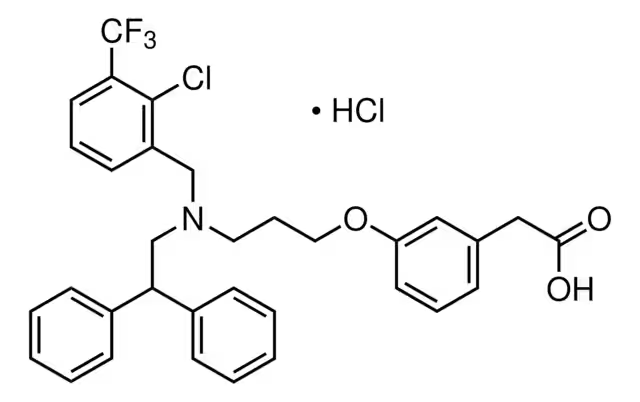
| Chemical & Physical Properties | |
|---|---|
| CAS Number | 405911-17-3 |
| Catalog No. | 2A-3186216 |
| Chinese Name | GW3965盐酸盐 |
| Synonyms | GW-3965 hydrochloride; GW3965 HCl; GW3965 (hydrochloride) |
| Molecular Formula | C33H32Cl2F3NO3 |
| Molecular Weight | 618.51 |
| Appearance | powder |
| Storage Condition | -20℃ |
| Application | GW3965 hydrochloride is an agonist of LXR and inhibits hLXRα and hLXRβ with EC50s of 190 and 30 nM respectively. |
| PubChem ID | 24724494 |
| MDL Number | MFCD08276920 |
| SMILES | Cl.O=C(O)Cc1cccc(OCCCN(Cc2cccc(C(F)(F)F)c2Cl)CC(c2ccccc2)c2ccccc2)c1 |
| InChI | InChI=1S/C33H31ClF3NO3.ClH/c34-32-27(15-8-17-30(32)33(35,36)37)22-38(18-9-19-41-28-16-7-10-24(20-28)21-31(39)40)23-29(25-11-3-1-4-12-25)26-13-5-2-6-14-26;/h1-8,10-17,20,29H,9,18-19,21-23H2,(H,39,40);1H |
| InChI Key | NMPUWJFHNOUNQU-UHFFFAOYSA-N |
| NACRES Code | NA.77 |
| UNSPSC | 12352200 |
| Hazard Symbols | transportation |
| Bioactivity | GW3965 hydrochloride is a potent and selective LXR agonist with EC50s of 190 and 30 nM for hLXRα and hLXRβ , respectively. Related Catalog Signaling Pathways >> Metabolic Enzyme/Protease >> LXR Research Areas >> Cardiovascular Disease Target EC50: 190 nM (hLXRα), 30 nM (hLXRβ)[4] In Vitro GW3965 hydrochloride promotes GBM cell death in vitro with enhanced efficacy in EGFRvIII-expressing tumor cells. GW3965 hydrochloride up-regulates expression of the cholesterol transporter gene ABCA1 and the E3 ubiquitin ligase IDOL and reduces LDLR levels[2]. LXR ligands inhibits platelet aggregation and calcium mobilization stimulated by collagen or CRP. GW3965 hydrochloride (1 or 5 μM) displays a minor inhibitory effect on fibrinogen binding and P-selectin exposure, when platelets are stimulated with 1 μg/mL CRP. But using higher concentrations of GW3965 hydrochloride (10 μM) or T0901317 (40 μM), the levels of fibrinogen and P-selectin on the platelet surface are reduced[3]. In Vivo GW3965 hydrochloride induces an increase of neuroactive steroids in the spinal cord, the cerebellum and the cerebral cortex of STZ-rats, but not in the CNS of non-pathological animals. GW3965 hydrochloride treatment induces an increase of dihydroprogesterone in the spinal cord of diabetic animals in association with an increase of myelin basic protein expression[1]. GW3965 hydrochloride (40 mg/kg, p.o.) strongly induces ABCA1 expression and reduces LDLR expression, and this is accompanied by 59% inhibition of tumor growth, and a 25-fold increase in GBM cell apoptosis in vivo[2]. GW3965 hydrochloride (2 mg/kg, i.v.) increases bleeding time and modulated platelet thrombus formation in vivo[3]. Cell Assay Cells are seeded in 96 wells and are treated after 24 hours with different drugs indicated in each experiment in medium containing 1% FBS or lipoprotein deficient serum. Relative proliferation is determined using Cell Proliferation Assay Kit. Cells are incubated 1.5 hrs after adding tetrazolium salt WST-1 [2-(4-iodophenyl)-3- (4-nitrophenyl)-5-(2, 4-disulfo-phenyl)-2H-tetrazolium, monosodium salt] at 5% CO2, 37ºC and the absorbance of the treated and untreated cells are measured using a microplate reader at 420 to 480 nm. Cells seeded in 12 well plates are counted using a hemocytometer, and dead cells are assessed using trypan blue exclusion assays. Animal Admin Diabetes is induced in two-month-old male rats by a single i.p. injection of freshly prepared STZ (65 mg/kg) in 0.09 M citrate buffer, pH 4.8. Control animals are injected with 0.09 mol/L citrate buffer at pH 4.8. Hyperglycemia is confirmed 48 h after streptozotocin injection by measuring tail vein blood glucose levels using a glucometer OneTouch Ultra2. Only animals with mean plasma glucose levels over 300 mg/mL are classified as diabetic. Glycemia is also assessed before treatment with Ro5-4864 or GW3965 hydrochloride and before death. Two months after STZ injection, diabetic animals are treated once a week with Ro5-4864 (3 mg/kg) or GW3965 hydrochloride (50 mg/kg). Thus, they receive four subcutaneous injections in a month. Control diabetic rats receive 200 μL of vehicle (sesame oil). Four-month-old non-diabetic male rats are injected, following the same experimental schedule, with Ro5-4864, GW3965 hydrochloride or vehicle. Rats are killed 24 h after the last treatment. References [1]. Mitro, Nico., et al. LXR and TSPO as new therapeutic targets to increase the levels of neuroactive steroids in the central nervous system of diabetic animals. Neurochemistry International (2012), 60(6), 616-621. [2]. Guo, Deliang., et al. An LXR Agonist Promotes Glioblastoma Cell Death through Inhibition of an EGFR/AKT/SREBP-1/LDLR-Dependent Pathway. Cancer Discovery (2011), 1(5), 442-456. [3]. Spyridon, Michael., et al. LXR as a novel antithrombotic target. Blood (2011), 117(21), 5751-5761. [4]. Collins JL, et al. Identification of a nonsteroidal liver X receptor agonist through parallel array synthesis of tertiary amines. J Med Chem. 2002 May 9;45(10):1963-6. Chemical & Physical Properties Molecular Formula C33H32Cl2F3NO3 Molecular Weight 618.513 Exact Mass 617.171143 PSA 49.77000 LogP 8.89110 InChIKey NMPUWJFHNOUNQU-UHFFFAOYSA-N SMILES Cl.O=C(O)Cc1cccc(OCCCN(Cc2cccc(C(F)(F)F)c2Cl)CC(c2ccccc2)c2ccccc2)c1 Storage condition -20℃ |
| Use of | GW3965 hydrochloride is a potent and selective LXR agonist with EC50s of 190 and 30 nM for hLXRα and hLXRβ , respectively. Properties Name GW3965 hydrochloride Synonym More Synonyms GW3965 HCl Biological Activity Description GW3965 hydrochloride is a potent and selective LXR agonist with EC50s of 190 and 30 nM for hLXRα and hLXRβ , respectively. Related Catalog Signaling Pathways >> Metabolic Enzyme/Protease >> LXR Research Areas >> Cardiovascular Disease EC50: 190 nM (hLXRα), 30 nM (hLXRβ)[4] In Vitro GW3965 hydrochloride promotes GBM cell death in vitro with enhanced efficacy in EGFRvIII-expressing tumor cells. GW3965 hydrochloride up-regulates expression of the cholesterol transporter gene ABCA1 and the E3 ubiquitin ligase IDOL and reduces LDLR levels[2]. LXR ligands inhibits platelet aggregation and calcium mobilization stimulated by collagen or CRP. GW3965 hydrochloride (1 or 5 μM) displays a minor inhibitory effect on fibrinogen binding and P-selectin exposure, when platelets are stimulated with 1 μg/mL CRP. But using higher concentrations of GW3965 hydrochloride (10 μM) or T0901317 (40 μM), the levels of fibrinogen and P-selectin on the platelet surface are reduced[3]. Cell Assay Cells are seeded in 96 wells and are treated after 24 hours with different drugs indicated in each experiment in medium containing 1% FBS or lipoprotein deficient serum. Relative proliferation is determined using Cell Proliferation Assay Kit. Cells are incubated 1.5 hrs after adding tetrazolium salt WST-1 [2-(4-iodophenyl)-3- (4-nitrophenyl)-5-(2, 4-disulfo-phenyl)-2H-tetrazolium, monosodium salt] at 5% CO2, 37ºC and the absorbance of the treated and untreated cells are measured using a microplate reader at 420 to 480 nm. Cells seeded in 12 well plates are counted using a hemocytometer, and dead cells are assessed using trypan blue exclusion assays. References [1]. Mitro, Nico., et al. LXR and TSPO as new therapeutic targets to increase the levels of neuroactive steroids in the central nervous system of diabetic animals. Neurochemistry International (2012), 60(6), 616-621. [3]. Spyridon, Michael., et al. LXR as a novel antithrombotic target. Blood (2011), 117(21), 5751-5761. [4]. Collins JL, et al. Identification of a nonsteroidal liver X receptor agonist through parallel array synthesis of tertiary amines. J Med Chem. 2002 May 9;45(10):1963-6. Chemical & Physical Properties Exact Mass 617.171143 PSA 49.77000 LogP 8.89110 InChIKey NMPUWJFHNOUNQU-UHFFFAOYSA-N Storage condition -20℃ |
| Transport Info | Shipping Name: UN |
| MSDS Transport Info | Module 14. Shipping information 14.1 UN dangerous goods number European Land Transport Dangerous Regulations: -International Maritime Dangerous Regulations: -International Air Transport Dangerous Regulations: - 14.2 United Nations shipping name European Land Transport Dangerous Regulations: Non-dangerous goods IMDG Code: Non-dangerous goods International air transport dangerous goods regulations: non-dangerous goods 14.3 Transport hazard categories European Land Transport Dangerous Regulations: -International Maritime Dangerous Regulations: -International Air Transport Dangerous Regulations: - 14.4 Package group European Land Transport Dangerous Regulations: -International Maritime Dangerous Regulations: -International Air Transport Dangerous Regulations: - 14.5 Environmental hazards European Land Transport Danger Regulations: No International Maritime Danger Regulations International Air Transport Danger Regulations: No Marine pollutants (yes/no): No 14.6 Special reminder to users No data available |
| Related Products in Specialty Chemicals | ||
|---|---|---|
| 4-Methoxynaphthalen-1-aMine | 16430-99-2 | 2A-3186203 |
| 3-hydroxypyrrolidin-2-one | 15116-68-4 | 2A-3186204 |
| 1H-Imidazol-4-ylmethylamine dihydrochloride | 72631-80-2 | 2A-3186207 |
| KN-62 | 127191-97-3 | 2A-3186211 |
| L-694,247 | 137403-12-4 | 2A-3186214 |
| RS 102895 | 300815-41-2 | 2A-3186217 |
| MDA 19 | 1048973-47-2 | 2A-3186218 |
| PD158780 | 171179-06-9 | 2A-3186219 |
| 3,3'-Dibromobenzophenone | 25032-74-0 | 2A-3186222 |
| METHOXY-BIS(DIMETHYLAMINO)METHANE | 1186-70-5 | 2A-1186199 |
| Browse all Specialty Chemicals products » | ||
Phone:
630-322-8886
630-322-8887
Email:
Office Locations:
Chicago, IL, USA
San Francisco, CA, USA


 EN
EN


 SDS
SDS