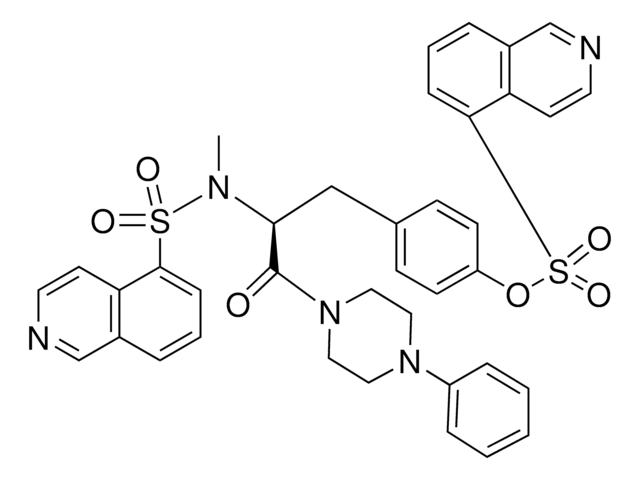
CAS Number127191-97-3
Synonymskn-62; 1-(N,O-bis(5-isoquinolinesulfonyl)-N-methyl-L-tyrosyl)-4-phenylpiperazine; MFCD00083180
Molecular FormulaC38H35N5O6S2
Molecular Weight721.84
Density1.4±0.1 g/cm3
Boiling Point964.7±75.0 °C at 760 mmHg
Melting Point92-94°C
Appearancewhite solid
Symbol
Signal WordWarning
| Chemical & Physical Properties | |
|---|---|
| CAS Number | 127191-97-3 |
| Catalog No. | 2A-3186211 |
| Chinese Name | 1-[N,O-二(5-异喹啉磺酰基)-N-甲基-L-型酪氨酸]-4-苯基哌嗪 |
| Synonyms | kn-62; 1-(N,O-bis(5-isoquinolinesulfonyl)-N-methyl-L-tyrosyl)-4-phenylpiperazine; MFCD00083180 |
| Molecular Formula | C38H35N5O6S2 |
| Molecular Weight | 721.84 |
| Density | 1.4±0.1 g/cm3 |
| Boiling Point | 964.7±75.0 °C at 760 mmHg |
| Melting Point | 92-94°C |
| Appearance | white solid |
| Water Solubility | 45% (w/v) aq 2-hydroxypropyl-β-cyclodextrin: 0.93 |
| Storage Condition | Seal and store at -20ºC |
| Application | KN-62 is a potent and selective calmodulin-dependent protein kinase II (CaMK-II) inhibitor with an IC50 of 0.9 μM. In HEK293 cells, KN-62 also antagonizes the P2X7 receptor non-competitively with an I |
| PubChem ID | 24895961 |
| MDL Number | MFCD00083180 |
| SMILES | CN(C(Cc1ccc(OS(=O)(=O)c2cccc3cnccc23)cc1)C(=O)N1CCN(c2ccccc2)CC1)S(=O)(=O)c1cccc2cnccc12 |
| InChI | InChI=1S/C38H35N5O6S2/c1-41(50(45,46)36-11-5-7-29-26-39-19-17-33(29)36)35(38(44)43-23-21-42(22-24-43)31-9-3-2-4-10-31)25-28-13-15-32(16-14-28)49-51(47,48)37-12-6-8-30-27-40-20-18-34(30)37/h2-20,26-27,35H,21-25H2,1H3 |
| InChI Key | RJVLFQBBRSMWHX-DHUJRADRSA-N |
| NACRES Code | NA.77 |
| UNSPSC | 12352200 |
| Hazard Symbols | transportation |
| Bioactivity | KN-62 is a selective and potent inhibitor of calmodulin-dependent protein kinase II (CaMK-II) with IC50 of 0.9 μM, KN-62 also displays noncompetitive antagonism at P2X7 receptors in HEK293 cells, with an IC50 value of approximately 15 nM. Related Catalog Signaling Pathways >> Neuronal Signaling >> CaMK Signaling Pathways >> Membrane Transporter/Ion Channel >> P2X Receptor Research Areas >> Metabolic Disease Target IC50: 0.9 μM (CaMK II)[1], 15 nM (P2X7 receptor, in HEK293 cells)[2] In Vitro KN-62 is a selective antagonist of Ca2+/calmodulin-dependent protein kinase II (CaMKII). KN-62 potently antagonizes ATP-stimulated Ba2+ influx into fura-2 loaded human lymphocytes with an IC50 of 12.7±1.5 nM (n=3) and complete inhibition of the flux at a concentration of 500 nM. Similarly, KN-62 inhibits ATP-stimulated ethidium+ uptake, measured by time resolved flow cytometry, with an IC50 of 13.1±2.6 nM (n=4) and complete inhibition of the flux at 500 nM[1]. KN-62 is found to be a potent antagonist in a functional assay, inhibition of ATP-induced K+efflux in HEK293 cells expressing recombinant human P2X7 receptors. In human leukemic B lymphocytes, KN-62 reduces the rate of permeability increase to larger permeant cations, like ethidium, induced by Bz-ATP with an IC50 of 13.1 nM. KN-62 at a concentration of 3 µM has no effect on ATP-induced ethidium influx through the rat P2X7 receptor, while the IC50 at the human P2X7 receptor is 0.1 µM. KN-62 has considerable selectivity for P2X7 receptors within the P2 family[2]. In Vivo The antidepressant-like behavior of ZnCl2 (10 mg/kg, p.o.) (p<0.01) is prevented by CAMKII inhibitor KN-62 (1 μg/site, i.c.v.). The two-way ANOVA reveals a significantly main effect of KN-62 treatment [F(1,28)=27.47, p<0.01], no main effect of ZnCl2 treatment [F(1,28)=0.84, p>0.05] and a significant effect of KN-62×ZnCl2 treatment interaction [F(1,28)=22.57, p<0.01] to immobility time. As revealed by the post-hoc analysis, the anti-immobility effect of ZnCl2 is completely prevented by treatment of animals with KN-62. No effect in locomotor activity in the open-field test is observed: (KN-62 treatment [F(1,24)=1.97, p>0.05], ZnCl2 treatment [F(1,24)=3.99, p>0.05] and KN-62×ZnCl2 treatment interaction [F(1,24)=0.61, p>0.05])[3]. Kinase Assay Lymphocytes (1×10⁷/mL) are cultured with [3H]-oleic acid (2-5 μCi/mL, specific activity 10 Ci/mmol) for 20-24 h in RPMI-1640 medium supplemented with Gentamicin (40 μg/mL), 10% heat inactivated foetal calf serum (FCS) at 37°C to label membrane phospholipids. Labelled cells are washed twice in HEPES buffered saline followed by a final wash in either HEPES buffered saline or 150 mM KCl medium containing HEPES 10 mM, pH 7.4, bovine serum albumin (BSA) 1 g/L and D-glucose 5 mM and CaCl2 1 mM. Three mL aliquots containing 1.1×10< sup>7/mL lymphocytes are warmed to 37°C and incubated with or without KN-62 or KN-04 (1 nM-500 nM) for 5 min, then 900 mL aliquots are added to 100 uL butanol (final concentration 30 mM) for a further 5 min, and stimulated with 1 mM ATP for 15 min with gentle mixing in the continued presence of inhibitor or diluent. The phospholipase D reaction is terminated by addition of 1 mL of 20 mM MgCl2 followed by centrifugation and addition of 1 mL ice cold methanol. Membrane lipids are extracted into chloroform/HCl at 4°C under N2, and separated by silica gel thin layer chromatography (t.l.c.) with the solvent system, ethyl acetate/iso-octane/acetic acid/water (13:2:3:10, v/v) under saturating conditions. Sample spots are located by autoradiography and [3H]-phosphatidylbutanol ([3H]-PBut) spots identified by an authentic standard. [3H]-PBut and [3H]-phospholipid spots are scraped into scintillant fluid (PPO in toluene, 4 g/L) and counted in a liquid scintillation counter. The quantity of [3H]-PBut is presented as a percentage of total 3H labelled-cellular phospholipids. Phospholipase D assays are performed in triplicate[1]. Cell Assay All experiments are performed using adherent HEK293 cells stably transfected with cDNA encoding the human P2X7 receptor. Adherent cells on 12-well polylysine-coated plates are incubated at 37°C in 1 mL physiological salt solution (125 mM NaCl, 5 mM KCl, 1 mM MgCl2, 1.5 mM CaCl2, 25 mM NaHEPES (pH 7.5), 10 mM D-glucose, 1 mg/mL BSA). Antagonists(e.g., KN-62) are added from 1,000× stock solutions dissolved in DMSO. Cells are preincubated with antagonists (e.g., KN-62) for 15 min prior to stimulation for 10 min with 3 mM ATP (final concentration). Reactions are terminated by rapid aspiration of the extracellular medium in each well. The adherent cells in each well are then extracted overnight with 1 mL 10% HNO3. K+ content in these nitric acid extracts is assayed by atomic absorbance spectrophotometry. Duplicate or triplicate wells are run for all test conditions in each separate experiment[2]. Animal Admin Mice[3] Female Swiss mice (45-55 days old, weighing 30-45 g) are used. The following drugs are used: ZnCl2 (1 or 10 mg/kg), H-89 (1 μg/site, PKA inhibitor), KN-62 (1 μg/site, CAMKII inhibitor), chelerythrine (1 μg/site, PKC inhibitor), PD98059 (5 μg/site, MAPKK/MEK 1/2 inhibitor), U0126 (5 μg/site, MEK1/2 inhibitor), LY294002 (10 nmol/site, PI3K inhibitor), AR-A014418 (0.001 μg/site, selective GSK-3β inhibitor). ZnCl2 is dissolved in distilled water and administered orally (p.o.). H-89, KN-62, chelerythrine, PD98059, U0126, LY294002, AR-A014418 are dissolved in saline (0.9% NaCl) at a final concentration of 1% dimethyl sulfoxide (DMSO) and administered by intracerebroventricular (i.c.v.) route. The drugs are freshly prepared before treatment and administered in a volume of 10 mL/kg body weight (p.o. route) or 5 μL/site (i.c.v. route). Control animals receive the appropriate vehicle. References [1]. Gargett CE, et al. The isoquinoline derivative KN-62 a potent antagonist of the P2Z-receptor of human lymphocytes. Br J Pharmacol. 1997 Apr;120(8):1483-90. [2]. Ravi RG, et al. Potent P2X7 Receptor Antagonists: Tyrosyl Derivatives Synthesized Using a Sequential Parallel Synthetic Approach. Drug Dev Res. 2001 Oct;54(2):75-87. [3]. Manosso LM, et al. Antidepressant-like effect of zinc is dependent on signaling pathways implicated in BDNF modulation. Prog Neuropsychopharmacol Biol Psychiatry. 2015 Jun 3;59:59-67. Chemical & Physical Properties Density 1.4±0.1 g/cm3 Boiling Point 964.7±75.0 °C at 760 mmHg Melting Point 92-94°C Molecular Formula C38H35N5O6S2 Molecular Weight 721.844 Flash Point 537.3±37.1 °C Exact Mass 721.202881 PSA 146.84000 LogP 5.23 Vapour Pressure 0.0±0.3 mmHg at 25°C Index of Refraction 1.686 InChIKey RJVLFQBBRSMWHX-DHUJRADRSA-N SMILES CN(C(Cc1ccc(OS(=O)(=O)c2cccc3cnccc23)cc1)C(=O)N1CCN(c2ccccc2)CC1)S(=O)(=O)c1cccc2cnccc12 Storage condition −20°C Water Solubility 45% (w/v) aq 2-hydroxypropyl-β-cyclodextrin: 0.93 mg/mL |
| Use of | Properties Articles54 Name 4-[(2S)-2-[(5-isoquinolinylsulfonyl)methylamino]-3-oxo-3-(4-phenyl-1-piperazinyl)propyl]phenylisoquinolinesulfonicacidester Synonym More Synonyms KN-62 Biological Activity Related Catalog Signaling Pathways >> Neuronal Signaling >> CaMK Signaling Pathways >> Membrane Transporter/Ion Channel >> P2X Receptor Research Areas >> Metabolic Disease References [1]. Gargett CE, et al. The isoquinoline derivative KN-62 a potent antagonist of the P2Z-receptor of human lymphocytes. Br J Pharmacol. 1997 Apr;120(8):1483-90. [2]. Ravi RG, et al. Potent P2X7 Receptor Antagonists: Tyrosyl Derivatives Synthesized Using a Sequential Parallel Synthetic Approach. Drug Dev Res. 2001 Oct;54(2):75-87. [3]. Manosso LM, et al. Antidepressant-like effect of zinc is dependent on signaling pathways implicated in BDNF modulation. Prog Neuropsychopharmacol Biol Psychiatry. 2015 Jun 3;59:59-67. Chemical & Physical Properties Molecular Formula C38H35N5O6S2 Exact Mass 721.202881 PSA 146.84000 Index of Refraction 1.686 InChIKey RJVLFQBBRSMWHX-DHUJRADRSA-N |
| Transport Info | Shipping Name: UN |
| MSDS Transport Info | Module 14. Shipping information 14.1 UN dangerous goods number European Land Transport Dangerous Regulations: -International Maritime Dangerous Regulations: -International Air Transport Dangerous Regulations: - 14.2 United Nations shipping name European Land Transport Dangerous Regulations: Non-dangerous goods IMDG Code: Non-dangerous goods International air transport dangerous goods regulations: non-dangerous goods 14.3 Transport hazard categories European Land Transport Dangerous Regulations: -International Maritime Dangerous Regulations: -International Air Transport Dangerous Regulations: - 14.4 Package group European Land Transport Dangerous Regulations: -International Maritime Dangerous Regulations: -International Air Transport Dangerous Regulations: - 14.5 Environmental hazards European Land Transport Danger Regulations: No International Maritime Danger Regulations International Air Transport Danger Regulations: No Marine pollutants (yes/no): No 14.6 Special reminder to users No data available See reverse side of invoice or packing slip. |
| Related Products in Specialty Chemicals | ||
|---|---|---|
| COBALT (II) CARBONATE HYDROXIDE MONOHYDRATE | 51839-24-8 | 2A-1186196 |
| 1-METHOXYNAPHTHALEN-4-YL ACETATE | 68716-07-4 | 2A-3186199 |
| 4-Methoxynaphthalen-1-aMine | 16430-99-2 | 2A-3186203 |
| 3-hydroxypyrrolidin-2-one | 15116-68-4 | 2A-3186204 |
| 1H-Imidazol-4-ylmethylamine dihydrochloride | 72631-80-2 | 2A-3186207 |
| L-694,247 | 137403-12-4 | 2A-3186214 |
| GW 3965 HYDROCHLORIDE | 405911-17-3 | 2A-3186216 |
| RS 102895 | 300815-41-2 | 2A-3186217 |
| MDA 19 | 1048973-47-2 | 2A-3186218 |
| PD158780 | 171179-06-9 | 2A-3186219 |
| Browse all Specialty Chemicals products » | ||
Phone:
630-322-8886
630-322-8887
Email:
Office Locations:
Chicago, IL, USA
San Francisco, CA, USA


 EN
EN


 SDS
SDS