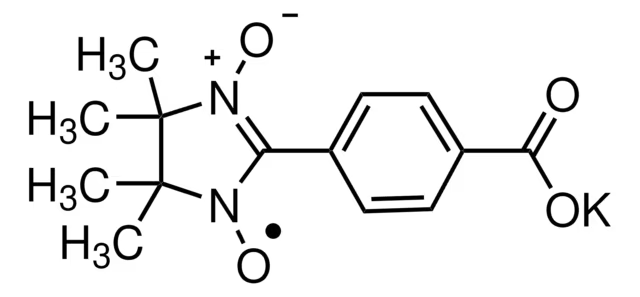
CAS Number148819-94-7
Synonyms2-(4-Carboxyphenyl)-4,4,5,5-tetramethylimidazoline-1-oxyl-3-oxide potassium salt; Carboxy-PTIO potassium salt; MFCD00216153; CARBOXY-PTIO
Molecular FormulaC14H17KN2O4
Molecular Weight315.39
Purity98.00%
Boiling Point456.3ºC at 760 mmHg
Melting Point141-143°C
AppearanceOdorless blue powder
Symbol
Signal WordWarning
| Chemical & Physical Properties | |
|---|---|
| CAS Number | 148819-94-7 |
| Catalog No. | 2A-1182750 |
| Chinese Name | 羧基-PTIO 钾盐 |
| Synonyms | 2-(4-Carboxyphenyl)-4,4,5,5-tetramethylimidazoline-1-oxyl-3-oxide potassium salt; Carboxy-PTIO potassium salt; MFCD00216153; CARBOXY-PTIO |
| Molecular Formula | C14H17KN2O4 |
| Molecular Weight | 315.39 |
| Purity | 98.00 |
| Boiling Point | 456.3ºC at 760 mmHg |
| Melting Point | 141-143°C |
| Appearance | Odorless blue powder |
| Water Solubility | H2O: >20 mg/mL |
| Storage Condition | Sealed in a cool, dry environment |
| Application | Carboxy-PTIO potassium is a potent nitric oxide (NO) antagonist that reacts rapidly with NO to produce NO2. Carboxy-PTIO potassium prevents hypotension and endotoxic shock through direct scavenging ef |
| PubChem ID | 24892474 |
| MDL Number | MFCD00216153 |
| SMILES | CC1(C)N(O)C(=[N+]([O-])C1(C)C)c2ccc(cc2)C([O-])=O |
| InChI | InChI=1S/C14H18N2O4/c1-13(2)14(3,4)16(20)11(15(13)19)9-5-7-10(8-6-9)12(17)18/h5-8,19H,1-4H3,(H,17,18)/p-1 |
| InChI Key | InChIKey=QSSNLQPWTLQYTB-UHFFFAOYSA-M |
| NACRES Code | NA.32 |
| UNSPSC | 12352200 |
| Hazard Symbols | transportation |
| Bioactivity | Carboxy-PTIO potassium is a potent nitric oxide (NO) inhibitor that can make a quick reaction with NO to produce NO2. Carboxy-PTIO can prevent hypotension and endotoxic shock through the direct scavenging action against NO in lipopolysaccharide-stimulated rat model[1][2][3]. Related Catalog Research Areas >> Cardiovascular Disease Signaling Pathways >> Immunology/Inflammation >> NO Synthase Research Areas >> Inflammation/Immunology Research Areas >> Metabolic Disease In Vitro Carboxy-PTIO potassium (200 μM; 1 h prior to physalin A; 24 hours) significantly suppresses the stimulation of NO expression induced by physalin A treatment, but no change is observed in Carboxy-PTIO treatment alone[1]. Carboxy-PTIO potassium (200 μM; 1 h prior to physalin A; 24 hours) reduces physalin A-induced cleavage of procaspase-3 and PARP, down-regulated ICAD expression,diminishing DNA fragmentation in nuclei[1]. Carboxy-PTIO potassium (200 μM; 1 h prior to physalin A; 24 hours) shows no effect on iNOS expression. However, decreased-mTOR and p-mTOR levels induced by physalin A is reversed by Carboxy-PTIO with concomitant suppression of LC3 I to LC3 II conversions in A375-S2 cells [1]. Western Blot Analysis[1] Cell Line: A375-S2 cells Concentration: 200 μM Incubation Time: 1 h prior to physalin A; 24 hours Result: Diminished physalin A-induced procaspase-3 and PARP cleavage. In Vivo Carboxy-PTIO (intravenous injection; 0.056-1.70 mg/kg/min; infused for 1 hr beginning 90 min after the LPS injection 90 min) treatment improves the hypotension, renal dysfunction and survival rate in Lps-treated rats. But it does not affect each parameter in naomal rats[3]. Animal Model: SD rats[3] Dosage: 0.056-1.70 mg/kg/min Administration: Intravenous injection; 0.056-1.70 mg/kg/min; infused for 1 hr beginning 90 min after the LPS injection 90 min Result: Exhibited a potent therapeutic value in endotoxin shock through the direct scavenging action against NO. References [1]. Hao He, et al.Nitric oxide induces apoptosis and autophagy; autophagy down-regulates NO synthesis in physalin A-treated A375-S2 human melanoma cells.Food Chem Toxicol. 2014 Sep;71:128-35. [2]. T Akaike, et al. Antagonistic action of imidazolineoxyl N-oxides against endothelium-derived relaxing factor/.NO through a radical reaction. Biochemistry. 1993 Jan 26;32(3):827-32. [3]. M Yoshid, et al. Therapeutic effects of imidazolineoxyl N-oxide against endotoxin shock through its direct nitric oxide-scavenging activity. Biochem Biophys Res Commun. 1994 Jul 29;202(2):923-30. Chemical & Physical Properties Boiling Point 456.3ºC at 760 mmHg Melting Point 141-143°C Molecular Formula C14H17KN2O4 Molecular Weight 315.386 Flash Point 229.7ºC Exact Mass 315.074707 PSA 69.29000 LogP 1.75670 Storage condition 2-8°C Water Solubility H2O: >20 mg/mL |
| Use of | Properties Name Carboxy-PTIO, Potassium Salt Synonym More Synonyms Carboxy-PTIO potassium Biological Activity Related Catalog Research Areas >> Cardiovascular Disease Signaling Pathways >> Immunology/Inflammation >> NO Synthase Research Areas >> Inflammation/Immunology Research Areas >> Metabolic Disease References [1]. Hao He, et al.Nitric oxide induces apoptosis and autophagy; autophagy down-regulates NO synthesis in physalin A-treated A375-S2 human melanoma cells.Food Chem Toxicol. 2014 Sep;71:128-35. [2]. T Akaike, et al. Antagonistic action of imidazolineoxyl N-oxides against endothelium-derived relaxing factor/.NO through a radical reaction. Biochemistry. 1993 Jan 26;32(3):827-32. [3]. M Yoshid, et al. Therapeutic effects of imidazolineoxyl N-oxide against endotoxin shock through its direct nitric oxide-scavenging activity. Biochem Biophys Res Commun. 1994 Jul 29;202(2):923-30. Chemical & Physical Properties Molecular Formula C14H17KN2O4 Exact Mass 315.074707 PSA 69.29000 LogP 1.75670 |
| Transport Info | Shipping Name: UN |
| MSDS Transport Info | Module 14. Shipping information 14.1 UN dangerous goods number European Land Transport Dangerous Regulations: -International Maritime Dangerous Regulations: -International Air Transport Dangerous Regulations: - 14.2 United Nations shipping name European Land Transport Dangerous Regulations: Non-dangerous goods IMDG Code: Non-dangerous goods International air transport dangerous goods regulations: non-dangerous goods 14.3 Transport hazard categories European Land Transport Dangerous Regulations: -International Maritime Dangerous Regulations: -International Air Transport Dangerous Regulations: - 14.4 Package group European Land Transport Dangerous Regulations: -International Maritime Dangerous Regulations: -International Air Transport Dangerous Regulations: - 14.5 Environmental hazards European Land Transport Danger Regulations: No International Maritime Danger Regulations International Air Transport Danger Regulations: No Marine pollutants (yes/no): No 14.6 Special reminder to users No data available See reverse side of invoice or packing slip. |
| Related Products in Specialty Chemicals | ||
|---|---|---|
| N-Methyl-N-(4-nitrophenyl)-2-(4-nitrosopiperazin-1-yl)acetamide | 2A-3182737 | 2A-3182737 |
| 3-(butyl(nitroso)amino)-4-phenoxy-5-sulfamoylbenzoic acid | 2A-1182740 | 2A-1182740 |
| INDENO(1,2,3-C,D)PYRENE | 193-39-5 | 2A-4182741 |
| N-Nitroso bis(2-chloroethyl)amine | 67856-68-2 | 2A-2182743 |
| N-Nitroso 1,3-Dimethyl-6-(3-Chloropropylamino)uracil | 2A-2182744 | 2A-2182744 |
| T0901317 | 293754-55-9 | 2A-1182751 |
| Catalase Assay Kit 5 | 2A-1182753 | 2A-1182753 |
| DISODIUM (E)-1-SULFONATODIAZEN-1-IUM-1,2-DIOLATE | 61142-90-3 | 2A-1182754 |
| 16,16-DIMETHYL PROSTAGLANDIN E2 | 39746-25-3 | 2A-1182756 |
| Etimicin Sulphate | 362045-44-1 | 2A-4182757 |
| Browse all Specialty Chemicals products » | ||
Phone:
630-322-8886
630-322-8887
Email:
Office Locations:
Chicago, IL, USA
San Francisco, CA, USA


 EN
EN


 SDS
SDS