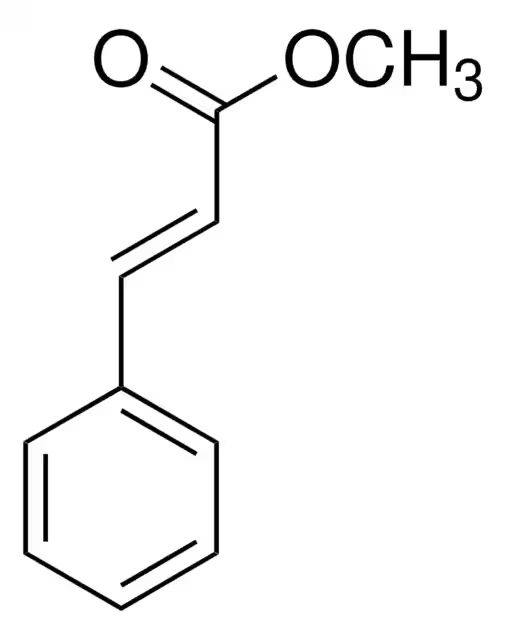
CAS Number103-26-4
SynonymsMETHYLCINNAMATE; Cinnamic acid methylester; E-3-phenyl-acrylic acid methyl ester; (E)-cinnamic acid methyl ester; TRANS-CINNAMIC ACID METHYL ESTER; cinnamic acid methyl ester; (2E)-3-Phenyl-2-propenoic acid methyl ester; trans-3-Phenylacrylic Acid Methyl Ester; METHYL-3-PHENYLPROPENOTE; Methyl (2E)-3-phenylacrylate; Methyl cinnamate; METHYL CINNAMATE/CINNAMIC ACID METHYL ESTER; EINECS 203-093-8; Methyl (E)-cinnamate; CINNAMICACIDMETHYLESTER; MFCD00008458; Methyl trans-3-Phenylacrylate; METHYL 3-PHENYLACRYLATE; methyl (2E)-3-phenylprop-2-enoate; METHYL CIMNAMATE NATURAL; METHYL CINNAMYLATE; Methyl trans-cinnamate; FEMA 2698
Molecular FormulaC6H5CH=CHCOOCH3
Molecular Weight162.19
Purity≥99.0 (GC)%
Density1.1±0.1 g/cm3
Boiling Point260-262 °C (lit.)
Melting Point33-38 °C (lit.)
Appearancecrystals
EINECS203-093-8
Symbol
Signal WordWarning
| Chemical & Physical Properties | |
|---|---|
| CAS Number | 103-26-4 |
| Catalog No. | 2A-9018329 |
| Chinese Name | 肉桂酸甲酯 |
| Synonyms | METHYLCINNAMATE; Cinnamic acid methylester; E-3-phenyl-acrylic acid methyl ester; (E)-cinnamic acid methyl ester; TRANS-CINNAMIC ACID METHYL ESTER; cinnamic acid methyl ester; (2E)-3-Phenyl-2-propenoic acid methyl ester; trans-3-Phenylacrylic Acid Methyl Ester; METHYL-3-PHENYLPROPENOTE; Methyl (2E)-3-phenylacrylate; Methyl cinnamate; METHYL CINNAMATE/CINNAMIC ACID METHYL ESTER; EINECS 203-093-8; Methyl (E)-cinnamate; CINNAMICACIDMETHYLESTER; MFCD00008458; Methyl trans-3-Phenylacrylate; METHYL 3-PHENYLACRYLATE; methyl (2E)-3-phenylprop-2-enoate; METHYL CIMNAMATE NATURAL; METHYL CINNAMYLATE; Methyl trans-cinnamate; FEMA 2698 |
| Molecular Formula | C6H5CH=CHCOOCH3 |
| Molecular Weight | 162.19 |
| Purity | ≥99.0 (GC) |
| Density | 1.1±0.1 g/cm3 |
| Boiling Point | 260-262 °C (lit.) |
| Melting Point | 33-38 °C (lit.) |
| Appearance | crystals |
| Water Solubility | insoluble |
| Storage Condition | Store in a cool, ventilated warehouse. Keep away f |
| Application | Methyl cinnamate (Methyl 3-phenylpropenoate) is the active ingredient of Zanthoxylum bungeanum and a widely used natural flavor compound. Methyl cinnamate (Methyl 3-phenylpropenoate) has antibacterial |
| EINECS | 203-093-8 |
| HTC | 2916399090 |
| PubChem ID | 57653759 |
| MDL Number | MFCD00008458 |
| SMILES | COC(=O)\C=C\c1ccccc1 |
| InChI | 1S/C10H10O2/c1-12-10(11)8-7-9-5-3-2-4-6-9/h2-8H,1H3/b8-7+ |
| InChI Key | CCRCUPLGCSFEDV-BQYQJAHWSA-N |
| Beilstein/REAXYS | 386468 |
| NACRES Code | NA.22 |
| UNSPSC | 12352100 |
| Hazard Symbols | Transport |
| MSDS | msds/18329_1_103_26_4.pdf |
| Bioactivity | Methyl cinnamate (Methyl 3-phenylpropenoate), an active component of Zanthoxylum armatum, is a widely used natural flavor compound. Methyl cinnamate (Methyl 3-phenylpropenoate) possesses antimicrobial activity and is a tyrosinase inhibitor that can prevent food browning. Methyl cinnamate (Methyl 3-phenylpropenoate) has antiadipogenic activity through mechanisms mediated, in part, by the CaMKK2-AMPK signaling pathway[1]. Related Catalog Signaling Pathways >> Epigenetics >> AMPK Research Areas >> Infection Signaling Pathways >> Metabolic Enzyme/Protease >> Tyrosinase Signaling Pathways >> PI3K/Akt/mTOR >> AMPK Research Areas >> Metabolic Disease Signaling Pathways >> Anti-infection >> Bacterial In Vitro In 3T3-L1 cell model, Methyl cinnamate (Methyl 3-phenylpropenoate) inhibits adipocyte differentiation by attenuating expression of the adipogenic transcription factors SREBP-1, PPARγ, and C/EBPα and the transcriptional activity of PPARγ. In addition, Methyl cinnamate (Methyl 3-phenylpropenoate) activates the CaMKK2−AMPK signaling cascade involved in the regulation of adipogenesis[1]. References [1]. Chen YY, et al. Methyl cinnamate inhibits adipocyte differentiation via activation of the CaMKK2-AMPK pathwayin 3T3-L1 preadipocytes. J Agric Food Chem. 2012 Feb 1;60(4):955-63. Chemical & Physical Properties Density 1.1±0.1 g/cm3 Boiling Point 261.9±0.0 °C at 760 mmHg Melting Point 34-38 °C(lit.) Molecular Formula C10H10O2 Molecular Weight 162.185 Flash Point 141.3±9.9 °C Exact Mass 162.068085 PSA 26.30000 LogP 2.18 Vapour Pressure 0.0±0.5 mmHg at 25°C Index of Refraction 1.559 InChIKey CCRCUPLGCSFEDV-BQYQJAHWSA-N SMILES COC(=O)C=Cc1ccccc1 Storage condition 0-10°C Water Solubility insoluble |
| Use of | Methyl cinnamate (Methyl 3-phenylpropenoate), an active component of Zanthoxylum armatum, is a widely used natural flavor compound. Methyl cinnamate (Methyl 3-phenylpropenoate) possesses antimicrobial activity and is a tyrosinase inhibitor that can prevent food browning. Methyl cinnamate (Methyl 3-phenylpropenoate) has antiadipogenic activity through mechanisms mediated, in part, by the CaMKK2-AMPK signaling pathway[1]. Properties Articles16 Name Methyl cinnamate Synonym More Synonyms Methyl cinnamate Biological Activity Description Methyl cinnamate (Methyl 3-phenylpropenoate), an active component of Zanthoxylum armatum, is a widely used natural flavor compound. Methyl cinnamate (Methyl 3-phenylpropenoate) possesses antimicrobial activity and is a tyrosinase inhibitor that can prevent food browning. Methyl cinnamate (Methyl 3-phenylpropenoate) has antiadipogenic activity through mechanisms mediated, in part, by the CaMKK2-AMPK signaling pathway[1]. Related Catalog Signaling Pathways >> Epigenetics >> AMPK Research Areas >> Infection Signaling Pathways >> Metabolic Enzyme/Protease >> Tyrosinase Signaling Pathways >> PI3K/Akt/mTOR >> AMPK Research Areas >> Metabolic Disease Signaling Pathways >> Anti-infection >> Bacterial References [1]. Chen YY, et al. Methyl cinnamate inhibits adipocyte differentiation via activation of the CaMKK2-AMPK pathwayin 3T3-L1 preadipocytes. J Agric Food Chem. 2012 Feb 1;60(4):955-63. Chemical & Physical Properties Molecular Formula C10H10O2 Exact Mass 162.068085 PSA 26.30000 Index of Refraction 1.559 InChIKey CCRCUPLGCSFEDV-BQYQJAHWSA-N Water Solubility insoluble |
| Tax Rebate | 9.0% |
| Supervision | None MFN tariff: 6.5% Ordinary tariff: 30.0% |
| Transport Info | Shipping Name: UN |
| MSDS Transport Info | Module 14. Shipping information 14.1 UN dangerous goods number European Land Transport Dangerous Regulations: -International Maritime Dangerous Regulations: -International Air Transport Dangerous Regulations: - 14.2 United Nations shipping name European Land Transport Dangerous Regulations: Non-dangerous goods IMDG Code: Non-dangerous goods International air transport dangerous goods regulations: non-dangerous goods 14.3 Transport hazard categories European Land Transport Dangerous Regulations: -International Maritime Dangerous Regulations: -International Air Transport Dangerous Regulations: - 14.4 Package group European Land Transport Dangerous Regulations: -International Maritime Dangerous Regulations: -International Air Transport Dangerous Regulations: - 14.5 Environmental hazards European Land Transport Danger Regulations: No International Maritime Danger Regulations International Air Transport Danger Regulations: No Marine pollutants (yes/no): No 14.6 Special reminder to users No data available |
| Related Products in Specialty Chemicals | ||
|---|---|---|
| (Phenylthio)acetic acid | 103-04-8 | 2A-9018322 |
| 2-Methyl-4-phenylbutan-2-ol | 103-05-9 | 2A-9018323 |
| 2-Ethylhexyl acetate | 103-09-3 | 2A-9018324 |
| 4-Benzyloxyphenol | 103-16-2 | 2A-9018326 |
| Methyl 3-phenylpropionate | 103-25-3 | 2A-9018328 |
| Benzyl isobutyrate | 103-28-6 | 2A-9018330 |
| N-Phenylbenzylamine | 103-32-2 | 2A-9018333 |
| Ethyl cinnamate | 103-36-6 | 2A-9018335 |
| Benzyl butyrate | 103-37-7 | 2A-9018336 |
| Benzyl cinnamate | 103-41-3 | 2A-9018338 |
| Browse all Specialty Chemicals products » | ||
Phone:
630-322-8886
630-322-8887
Email:
Office Locations:
Chicago, IL, USA
San Francisco, CA, USA


 EN
EN


 SDS
SDS