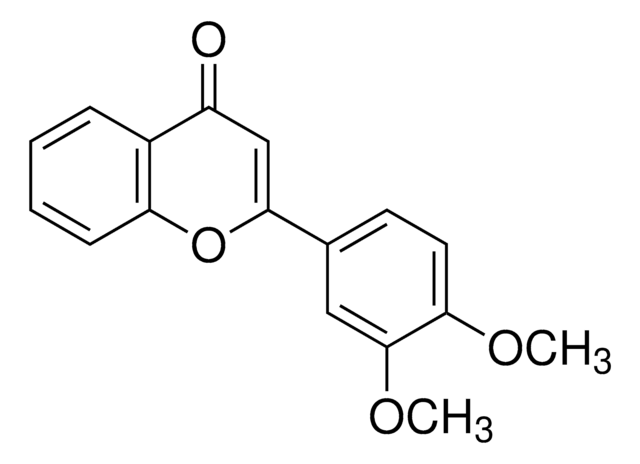
CAS Number4143-62-8
SynonymsMFCD00143009; 2-(3,4-Dimethoxyphenyl)chromen-4-one; 3',4'-DIMETHOXYFLAVONE
Molecular FormulaC17H14O4
Molecular Weight282.29
Density1.242g/cm3
Boiling Point428.5ºC at 760 mmHg
Melting Point154-155°C
AppearanceSolid;White to Light yellow powder to crystal
| Chemical & Physical Properties | |
|---|---|
| CAS Number | 4143-62-8 |
| Catalog No. | 2A-3181802 |
| Chinese Name | 3',4'-二甲氧基黄酮 |
| Synonyms | MFCD00143009; 2-(3,4-Dimethoxyphenyl)chromen-4-one; 3',4'-DIMETHOXYFLAVONE |
| Molecular Formula | C17H14O4 |
| Molecular Weight | 282.29 |
| Density | 1.242g/cm3 |
| Boiling Point | 428.5ºC at 760 mmHg |
| Melting Point | 154-155°C |
| Appearance | Solid;White to Light yellow powder to crystal |
| Storage Condition | Keep away from light, in a ventilated and dry plac |
| Application | 3',4'-Dimethoxyflavone is a fat-soluble flavonoid that can be isolated from primrose leaves. 3',4'-Dimethoxyflavone can reduce the synthesis and accumulation of PARP and protect cortical neurons from |
| HTC | 2914509090 |
| PubChem ID | 329798831 |
| MDL Number | MFCD00143009 |
| SMILES | COc1ccc(-c2cc(=O)c3ccccc3o2)cc1OC |
| InChI | InChI=1S/C17H14O4/c1-19-15-8-7-11(9-17(15)20-2)16-10-13(18)12-5-3-4-6-14(12)21-16/h3-10H,1-2H3 |
| InChI Key | ZGHORMOOTZTQFL-UHFFFAOYSA-N |
| NACRES Code | NA.77 |
| UNSPSC | 12352200 |
| Bioactivity | 3',4'-Dimethoxyflavone is a lipophilic flavone, can be isolated from the leaves of Primula veris. 3',4'-Dimethoxyflavone can reduce the synthesis and accumulation of PARP and protect cortical neurones against cell death induced by Parthanatos. 3',4'-Dimethoxyflavone is also an aryl hydrocarbon receptor antagonist in human breast cancer cells. 3',4'-Dimethoxyflavone can promote the proliferation of human hematopoietic stem cells. 3',4'-Dimethoxyflavone has various biological activities, including antioxidant, anti-cancer, anti-inflammatory, anti-atherogenic, hypolipidaemic, and neuroprotective or neurotrophic effects[1][2][3][4]. Related Catalog Research Areas >> Cancer Signaling Pathways >> Epigenetics >> PARP Research Areas >> Cardiovascular Disease Signaling Pathways >> Immunology/Inflammation >> Aryl Hydrocarbon Receptor Research Areas >> Inflammation/Immunology Research Areas >> Neurological Disease Signaling Pathways >> Cell Cycle/DNA Damage >> PARP Target PARP, Aryl hydrocarbon receptor[1] In Vitro 3',4'-Dimethoxyflavone (10 and 20 μM) has protection against the reduction in SH-SY5Y viability induced by Methylnitronitrosoguanidine (MNNG) (HY-128612)[2]. 3',4'-Dimethoxyflavone (6.25-25 μM) decreases the levels of PAR induced by MNNG in HeLa cells[2]. 3',4'-Dimethoxyflavone (12.5, 25, 50 and 100 μM; 15-20 h) reduces cortical neuronal death induced by exposure to NMDA (HY-17551)[2]. 3',4'-Dimethoxyflavone (0.1-10 μM; 24 h) exhibits significant inhibition of 2,3,7,8-Tetrachlorodibenzo-p-dioxin (TCDD)-induced EROD activity in MCF-7 and T47D cells[3]. 3',4'-Dimethoxyflavone inhibits AhR-dependent CYP1A1 induction and AhR-mediated inhibition of estrogen-induced gene expression in T47D and MCF-7 breast cancer cells[3]. 3′,4′-Dimethoxyflavone (2.5 μM; 7 days) promotes the proliferation of human hematopoietic stem cells[4]. Cell Viability Assay[2] Cell Line: Primary cortical neurones (isolated from fetal CD1 mice, incubated with NMDA) Concentration: 12.5, 25, 50 and 100 μM Incubation Time: 15-20 h Result: Reduced concentration-dependently neuronal death induced by exposure to NMDA. Cell Proliferation Assay[4] Cell Line: CD34+ cells Concentration: 2.5 μM Incubation Time: 7 days Result: Induced a significantly higher amplification of the CD34+ population under normoxia. References [1]. Budzianowski J, et al. Lipophilic flavones of Primula veris L. from field cultivation and in vitro cultures. Phytochemistry. 2005 May;66(9):1033-9. [2]. Fatokun AA, et al. Identification through high-throughput screening of 4'-methoxyflavone and 3',4'-dimethoxyflavone as novel neuroprotective inhibitors of parthanatos. Br J Pharmacol. 2013 Jul;169(6):1263-78. [3]. Lee JE, et al. 3',4'-dimethoxyflavone as an aryl hydrocarbon receptor antagonist in human breast cancer cells. Toxicol Sci. 2000 Dec;58(2):235-42. [4]. Kaur K, et al. 3',4'-Dimethoxyflavone and valproic acid promotes the proliferation of human hematopoietic stem cells. Stem Cell Res Ther. 2013 May 24;4(3):60. Chemical & Physical Properties Density 1.242g/cm3 Boiling Point 428.5ºC at 760 mmHg Melting Point 154-155°C Molecular Formula C17H14O4 Molecular Weight 282.29100 Flash Point 190.6ºC Exact Mass 282.08900 PSA 48.67000 LogP 3.47720 Index of Refraction 1.598 InChIKey ZGHORMOOTZTQFL-UHFFFAOYSA-N SMILES COc1ccc(-c2cc(=O)c3ccccc3o2)cc1OC Storage condition room temp |
| Use of | 3',4'-Dimethoxyflavone is a lipophilic flavone, can be isolated from the leaves of Primula veris. 3',4'-Dimethoxyflavone can reduce the synthesis and accumulation of PARP and protect cortical neurones against cell death induced by Parthanatos. 3',4'-Dimethoxyflavone is also an aryl hydrocarbon receptor antagonist in human breast cancer cells. 3',4'-Dimethoxyflavone can promote the proliferation of human hematopoietic stem cells. 3',4'-Dimethoxyflavone has various biological activities, including antioxidant, anti-cancer, anti-inflammatory, anti-atherogenic, hypolipidaemic, and neuroprotective or neurotrophic effects[1][2][3][4]. Properties Name 3′,4′-Dimethoxyflavone Synonym More Synonyms 3',4'-dimethoxyflavone Biological Activity Description 3',4'-Dimethoxyflavone is a lipophilic flavone, can be isolated from the leaves of Primula veris. 3',4'-Dimethoxyflavone can reduce the synthesis and accumulation of PARP and protect cortical neurones against cell death induced by Parthanatos. 3',4'-Dimethoxyflavone is also an aryl hydrocarbon receptor antagonist in human breast cancer cells. 3',4'-Dimethoxyflavone can promote the proliferation of human hematopoietic stem cells. 3',4'-Dimethoxyflavone has various biological activities, including antioxidant, anti-cancer, anti-inflammatory, anti-atherogenic, hypolipidaemic, and neuroprotective or neurotrophic effects[1][2][3][4]. Related Catalog Research Areas >> Cancer Signaling Pathways >> Epigenetics >> PARP Research Areas >> Cardiovascular Disease Signaling Pathways >> Immunology/Inflammation >> Aryl Hydrocarbon Receptor Research Areas >> Inflammation/Immunology Research Areas >> Neurological Disease Signaling Pathways >> Cell Cycle/DNA Damage >> PARP PARP, Aryl hydrocarbon receptor[1] References [1]. Budzianowski J, et al. Lipophilic flavones of Primula veris L. from field cultivation and in vitro cultures. Phytochemistry. 2005 May;66(9):1033-9. [2]. Fatokun AA, et al. Identification through high-throughput screening of 4'-methoxyflavone and 3',4'-dimethoxyflavone as novel neuroprotective inhibitors of parthanatos. Br J Pharmacol. 2013 Jul;169(6):1263-78. [3]. Lee JE, et al. 3',4'-dimethoxyflavone as an aryl hydrocarbon receptor antagonist in human breast cancer cells. Toxicol Sci. 2000 Dec;58(2):235-42. [4]. Kaur K, et al. 3',4'-Dimethoxyflavone and valproic acid promotes the proliferation of human hematopoietic stem cells. Stem Cell Res Ther. 2013 May 24;4(3):60. Chemical & Physical Properties Molecular Formula C17H14O4 Exact Mass 282.08900 PSA 48.67000 LogP 3.47720 Index of Refraction 1.598 InChIKey ZGHORMOOTZTQFL-UHFFFAOYSA-N Storage condition room temp |
| Tax Rebate | 9.0% |
| Supervision | None MFN tariff: 5.5% Ordinary tariff: 30.0% |
| Transport Info | Product name: Summary HS:2914509090 other ketones with other oxygen function VAT:17.0% Tax rebate rate:9.0% Supervision conditions:none MFN tariff:5.5% General tariff:30.0% |
| Related Products in Specialty Chemicals | ||
|---|---|---|
| 5-hydroxy-4',6,7- trimethoxy flavone | 2A-3181788 | 2A-3181788 |
| 6,3'-dihydroxy flavone | 2A-3181789 | 2A-3181789 |
| Aramid fibers | 308069-56-9 | 2A-2181792 |
| POLYETHERIMIDE | 61128-46-9 | 2A-2181795 |
| FLUOROLUBE GREASE, GR-362 | 9002-83-9 | 2A-2181796 |
| 2-methoxy-1,3-di-tert-butyl benzene | 1516-95-6 | 2A-3181803 |
| 1-chloro-1,3-dihydro-3,3-dimethyl benz iodoxole | 69352-04-1 | 2A-3181804 |
| 3,5-dimethyl-4-amino phenol | 5344-97-8 | 2A-3181806 |
| 4-nitrophenyl palmitate | 1492-30-4 | 2A-3181807 |
| 2-amino-4,6-dibromo phenol | 10539-14-7 | 2A-3181810 |
| Browse all Specialty Chemicals products » | ||
Phone:
630-322-8886
630-322-8887
Email:
Office Locations:
Chicago, IL, USA
San Francisco, CA, USA


 EN
EN


 SDS
SDS