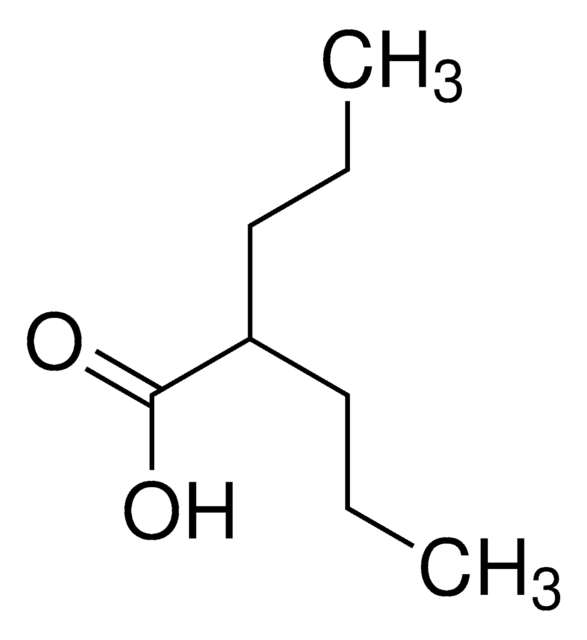
CAS Number99-66-1
SynonymsMylproin; Ergenyl; MFCD00879852; 2-Propylpentanoic acid; 2-Propylvaleric Acid; Depakine; di-n-propyl-acetic acid; Valproic acid; Depakene; 2-n-Propylpentanoic acid; Valproate; [3H]-Valproic acid; Convulex; Valproic-250; 2,2-BIS(TRIFLUOROMETHYL)PROPIONIC ACID; Dipropylacetic acid; 2-propyl-pentanoic acid; EINECS 202-777-3; sodium valproate
Molecular Formula(CH3CH2CH2)2CHCO2H
Molecular Weight144.21
Purity98%
Density0.9±0.1 g/cm3
Boiling Point220 °C (lit.)
Melting Point120 - 130ºC
Appearanceclear liquid
EINECS202-777-3
Symbol
Signal WordWarning
| Chemical & Physical Properties | |
|---|---|
| CAS Number | 99-66-1 |
| Catalog No. | 2A-9018149 |
| Chinese Name | 丙戊酸 |
| Synonyms | Mylproin; Ergenyl; MFCD00879852; 2-Propylpentanoic acid; 2-Propylvaleric Acid; Depakine; di-n-propyl-acetic acid; Valproic acid; Depakene; 2-n-Propylpentanoic acid; Valproate; [3H]-Valproic acid; Convulex; Valproic-250; 2,2-BIS(TRIFLUOROMETHYL)PROPIONIC ACID; Dipropylacetic acid; 2-propyl-pentanoic acid; EINECS 202-777-3; sodium valproate |
| Molecular Formula | (CH3CH2CH2)2CHCO2H |
| Molecular Weight | 144.21 |
| Purity | 98 |
| Density | 0.9±0.1 g/cm3 |
| Boiling Point | 220 °C (lit.) |
| Melting Point | 120 - 130ºC |
| Appearance | clear liquid |
| Water Solubility | slightly soluble |
| Storage Condition | Store in a cool, ventilated warehouse. Keep away f |
| Packaging | III |
| Application | Valproic acid is an HDAC inhibitor with an IC50 value of 0.5-2 mM. It inhibits the activity of HDAC1 (IC50, 400 μM) and induces the degradation of HDAC2. Valproic acid sodium salt can be used in the r |
| EINECS | 202-777-3 |
| HTC | 2915600000 |
| PubChem ID | 329823091 |
| MDL Number | MFCD00002672 |
| SMILES | CCCC(C(O)=O)CCC |
| InChI | 1S/C8H16O2/c1-3-5-7(6-4-2)8(9)10/h7H,3-6H2,1-2H3,(H,9,10) |
| InChI Key | NIJJYAXOARWZEE-UHFFFAOYSA-N |
| NACRES Code | NA.24 |
| UNSPSC | 41116107 |
| Hazard Symbols | 8 |
| MSDS | msds/18149_1_99_66_1.pdf |
| Bioactivity | Valproic acid is an HDAC inhibitor, with IC50 in the range of 0.5 and 2 mM, also inhibits HDAC1 (IC50, 400 μM), and induces proteasomal degradation of HDAC2; Valproic acid sodium salt is used in the treatment of epilepsy, bipolar disorder and prevention of migraine headaches. Related Catalog Signaling Pathways >> Autophagy >> Autophagy Signaling Pathways >> Cell Cycle/DNA Damage >> HDAC Signaling Pathways >> Epigenetics >> HDAC Signaling Pathways >> Autophagy >> Mitophagy Natural Products >> Acids and Aldehydes Research Areas >> Cancer Target HDAC1:400 μM (IC50) HDAC:0.5-2 mM (IC50) HDAC2 Autophagy Mitophagy In Vitro Valproic acid inhibits the growth dose- and time-dependently with an IC50 of appr 10 and 4 mM at 24 and 72 h, respectively. Valproic acid significantly attenuates the activities of total, cytosol and nuclear HDACs. Valproic acid increases the form of acetylated histone 3 in HeLa cells. Valproic acid (1-3 mM) induces a G1 phase arrest, while 10 mM Valproic acid significantly induces a G2/M phase arrest of cell cycle in HeLa cells. In addition, Valproic acid increases the percentage of sub-G1 cells in HeLa cells in a dose-dependent manner at 24 h[1]. Valproic acid inhibits the mRNA and protein expression of VEGF, VEGFR2 and bFGF. Valproic acid inhibits the protein expression of HDAC1, increases histone H3 acetylation, and enhances the accumulation of hyperacetylated histone H3 on VEGF promoters[2]. Valproic acid treatment results in increased levels of phosphorylated AMPK/ACC in primary mouse hepatocytes. Phosphorylation of ACC following Valproic acid treatment is AMPK-dependent. Valproic acid inhibits the deacetylase activity of both mouse liver nuclear extracts and human recombinant HDAC1 while of the metabolites of Valproic acid, only 2-ene-Valproic acid and 4-ene-Valproic acid diminish deacetylase activity[4]. In Vivo Valproic acid (500 mg/kg, i.p.) inhibits the tumor growth and angiogenesisin the mice transplanted with Kasumi-1 cells. The IR rate in the Valproic acid group is 57.25% at the end of the experiment[2]. Valproic acid (350 mg/kg, i.p.) demonstrates more social investigation and play fighting than control animals[3]. Kinase Assay The activity of caspase-3, -8 and -9 is assessed using the caspase-3, -8 and -9 colorimetric assay kits, respectively. In brief, 1×10⁶ cells in a 60-mm culture dish are incubated with 10 mM Valproic acid for 24 h. The cells are then washed in PBS and suspended in 5 volumes of lysis buffer provided with the kit. Protein concentrations are determined using the Bradford method. Supernatants containing 50 μg total protein are used to determine caspase-3, -8 and -9 activities. The supernatants are added to each well in 96-well microtiter plates with DEVD-pNA, IETD-pNA or LEHD-pNA as caspase-3, -8 and -9 substrates and the plates are incubated at 37°C for 1 h. The optical density of each well is measured at 405 nm using a microplate reader. The activity of caspase-3, -8 and -9 is expressed in arbitrary absorbance units. Cell Assay In brief, 5×10⁵ cells are seeded in 96-well microtiter plates for MTT assays. After exposure to the designated doses of Valproic acid for the indicated times, MTT solution [20 mL: 2 mg/mL in phosphate-buffered saline (PBS)] is added to each well of the 96-well plates. The plates are additionally incubated for 3 h at 37°C. Medium is withdrawn from the plates by pipetting and 200 mL DMSO is added to each well to solubilize the formazan crystals. The optical density is measured at 570 nm using a microplate reader. Animal Admin Splenectomies are performed on the BALB/c nude mice. One week after the splenectomies, the mice receiv whole body irradiation with 137Cs at a dose of 4 Gy. At 48-72 h post-irradiation, the mice are subcutaneously implanted with Kasumi-1 cells (2×10⁷ cells/mouse with 0.15-0.2 mL) in the right axillary region. The mice are randomLy assigned to two groups, the Valproic acid (n=6) and control (n=6) groups. When the tumors are appr 200 mm3 in size at appr 10 days post-implantation, 0.2 mL Valproic acid (500 mg/kg body weight) or 0.2 mL saline is injected intraperitoneally every day. Valproic acid is dissolved in saline at a concentration of 25 mg/mL. The longest diameter (a) and the shortest diameter (b) of the tumor are measured every three days, and the tumor volume (TV) is calculated according to the following formula: TV=1/2×a×b2. Following two weeks of injections, the mice are sacrificed by cervical dislocation and the tumor masses are removed for the following experiments. References [1]. Han BR, et al. Valproic acid inhibits the growth of HeLa cervical cancer cells via caspase-dependent apoptosis. Oncol Rep. 2013 Dec;30(6):2999-3005. [2]. Zhang ZH, et al. Valproic acid inhibits tumor angiogenesis in mice transplanted with Kasumi 1 leukemia cells. Mol Med Rep. 2013 Nov 28. [3]. Cohen OS, et al. Acute prenatal exposure to a moderate dose of valproic acid increases social behavior and alters gene expression in rats. Int J Dev Neurosci. 2013 Dec;31(8):740-50. [4]. Avery LB, et al. Valproic Acid Is a Novel Activator of AMP-Activated Protein Kinase and Decreases Liver Mass, Hepatic Fat Accumulation, and Serum Glucose in Obese Mice. Mol Pharmacol. 2014 Jan;85(1):1-10. [5]. Valproic acid, et al. Histone deacetylase is a direct target of valproic acid, a potent anticonvulsant, mood stabilizer, and teratogen. J Biol Chem. 2001 Sep 28;276(39):36734-41. Chemical & Physical Properties Density 0.9±0.1 g/cm3 Boiling Point 220.0±0.0 °C at 760 mmHg Melting Point 120 - 130ºC Molecular Formula C8H16O2 Molecular Weight 144.211 Flash Point 111.1±0.0 °C Exact Mass 144.115036 PSA 37.30000 LogP 2.72 Vapour Pressure 0.0±0.9 mmHg at 25°C Index of Refraction 1.435 InChIKey NIJJYAXOARWZEE-UHFFFAOYSA-N SMILES CCCC(CCC)C(=O)O Water Solubility slightly soluble |
| Use of | Properties Articles227 Name valproic acid Synonym More Synonyms Valproic acid Biological Activity Related Catalog Signaling Pathways >> Autophagy >> Autophagy Signaling Pathways >> Cell Cycle/DNA Damage >> HDAC Signaling Pathways >> Epigenetics >> HDAC Signaling Pathways >> Autophagy >> Mitophagy Natural Products >> Acids and Aldehydes Research Areas >> Cancer HDAC1:400 μM (IC50) References [1]. Han BR, et al. Valproic acid inhibits the growth of HeLa cervical cancer cells via caspase-dependent apoptosis. Oncol Rep. 2013 Dec;30(6):2999-3005. [3]. Cohen OS, et al. Acute prenatal exposure to a moderate dose of valproic acid increases social behavior and alters gene expression in rats. Int J Dev Neurosci. 2013 Dec;31(8):740-50. [4]. Avery LB, et al. Valproic Acid Is a Novel Activator of AMP-Activated Protein Kinase and Decreases Liver Mass, Hepatic Fat Accumulation, and Serum Glucose in Obese Mice. Mol Pharmacol. 2014 Jan;85(1):1-10. [5]. Valproic acid, et al. Histone deacetylase is a direct target of valproic acid, a potent anticonvulsant, mood stabilizer, and teratogen. J Biol Chem. 2001 Sep 28;276(39):36734-41. Chemical & Physical Properties Molecular Formula C8H16O2 Exact Mass 144.115036 PSA 37.30000 Index of Refraction 1.435 InChIKey NIJJYAXOARWZEE-UHFFFAOYSA-N SMILES CCCC(CCC)C(=O)O Water Solubility slightly soluble |
| Tax Rebate | 9.0% |
| Supervision | A. Customs clearance form for inbound goods B. Customs clearance form for outbound goods |
| Inspection | R. Imported food hygiene supervision and inspection S. Export food hygiene supervision and inspection M. Imported commodity inspection N. Exported commodity inspection |
| Transport Info | Product name: Purity: 98.0% |
| MSDS Transport Info | Module 14. Shipping information 14.1 UN dangerous goods number European Land Transport Danger Regulations: 1230 International Maritime Transport Danger Regulations: 1230 International Air Transport Danger Regulations: 1230 14.2 Names specified by the United Nations (UN) European Land Transport Danger Regulations: METHANOL International Maritime Dangerous Regulations: METHANOL International Air Transport Danger Regulations: Methanol 14.3 Transport hazard categories European land transport risk code: 3 (6.1) International sea transport risk code: 3 (6.1) International air transport risk code: 3 (6.1) 14.4 Package group European Dangerous Regulations for land transport: II International Dangerous Regulations for sea transport: II International Dangerous Regulations for air transport: II 14.5 Environmental hazards European Land Transport Dangerous Regulations: No International Maritime Transport Dangerous Regulations Maritime Pollutants: No International Air Transport Risk Regulations: No 14.6 Special reminder to users No data available |
| Related Products in Specialty Chemicals | ||
|---|---|---|
| 2-Amino-4-nitrophenol | 99-57-0 | 2A-9018141 |
| 3-Bromo-4-methoxybenzoic acid | 99-58-1 | 2A-9018142 |
| 2-Amino-4-nitro anisidine | 99-59-2 | 2A-9018143 |
| 2-Chloro-4-nitrobenzoic acid | 99-60-5 | 2A-9018144 |
| 3-(Dimethylamino)benzoic acid | 99-64-9 | 2A-9018147 |
| 4-(2-Butyl)phenol | 99-71-8 | 2A-9018150 |
| 2,4'-Dibromoacetophenone | 99-73-0 | 2A-9018151 |
| Methyl 4-methylbenzoate | 99-75-2 | 2A-9018152 |
| Ethyl p-nitrobenzoate | 99-77-4 | 2A-9018154 |
| 2-Bromo-4'-nitroacetophenone | 99-81-0 | 2A-9018155 |
| Browse all Specialty Chemicals products » | ||
Phone:
630-322-8886
630-322-8887
Email:
Office Locations:
Chicago, IL, USA
San Francisco, CA, USA


 EN
EN


 SDS
SDS