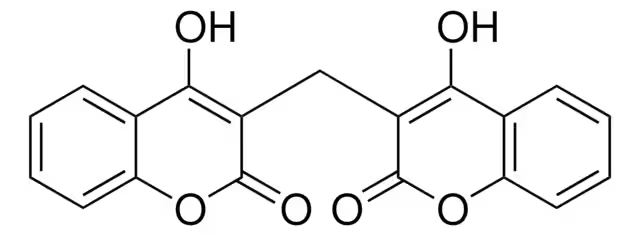
CAS Number66-76-2
SynonymsAcavyl; Antitrombosin; Dufalone; Cumid; Trombosan; 3,3'-Methylenebis[4-hydroxycoumarin]; 4-hydroxy-3-[(4-hydroxy-2-oxo-2H-chromen-3-yl)methyl]-2H-chromen-2-one; Baracoumin; Dicoumal; 3,3'-methanediylbis(4-hydroxy-2H-chromen-2-one); Temparin; Dicuman; 3,3'-methylenebis(4-hydroxy-2H-1-benzopyran-2-one); 4-hydroxy-3-[(4-hydroxy-2-oxochromen-3-yl)methyl]chromen-2-one; 3,3'-methylenebis(4-hydroxycoumarin); Dicumarol; Bishydroxycoumarin; 3,3'-Methylene-bis(4-hydroxycoumarin); EINECS 200-632-9; Dicoumarol; 3,3'-methylenebis(4-hydroxy-2H-chromen-2-one); Dicoumarin; 3,3'-Methylenebis(4-hydroxy-2H-chromen-2-one); 3,3'-Methylenebis[4-hydroxy-2H-1-benzopyran-2-one]; Acadyl; 3,3'-methylenebis[4-hydroxy-2H-1-benzopyran-2-one]; Dicumarine; MFCD00006857; Kumoran; Melitoxin
Molecular FormulaC19H12O6
Molecular Weight336.29
Density1.6±0.1 g/cm3
Boiling Point620.7±55.0 °C at 760 mmHg
Melting Point290-292 °C(lit.)
Appearancewhite powder
EINECS200-632-9
Symbol
Signal WordWarning
| Chemical & Physical Properties | |
|---|---|
| CAS Number | 66-76-2 |
| Catalog No. | 2A-2180476 |
| Chinese Name | 双羟香豆素 |
| Synonyms | Acavyl; Antitrombosin; Dufalone; Cumid; Trombosan; 3,3'-Methylenebis[4-hydroxycoumarin]; 4-hydroxy-3-[(4-hydroxy-2-oxo-2H-chromen-3-yl)methyl]-2H-chromen-2-one; Baracoumin; Dicoumal; 3,3'-methanediylbis(4-hydroxy-2H-chromen-2-one); Temparin; Dicuman; 3,3'-methylenebis(4-hydroxy-2H-1-benzopyran-2-one); 4-hydroxy-3-[(4-hydroxy-2-oxochromen-3-yl)methyl]chromen-2-one; 3,3'-methylenebis(4-hydroxycoumarin); Dicumarol; Bishydroxycoumarin; 3,3'-Methylene-bis(4-hydroxycoumarin); EINECS 200-632-9; Dicoumarol; 3,3'-methylenebis(4-hydroxy-2H-chromen-2-one); Dicoumarin; 3,3'-Methylenebis(4-hydroxy-2H-chromen-2-one); 3,3'-Methylenebis[4-hydroxy-2H-1-benzopyran-2-one]; Acadyl; 3,3'-methylenebis[4-hydroxy-2H-1-benzopyran-2-one]; Dicumarine; MFCD00006857; Kumoran; Melitoxin |
| Molecular Formula | C19H12O6 |
| Molecular Weight | 336.29 |
| Density | 1.6±0.1 g/cm3 |
| Boiling Point | 620.7±55.0 °C at 760 mmHg |
| Melting Point | 290-292 °C(lit.) |
| Appearance | white powder |
| Storage Condition | This product should be sealed and stored away from |
| Packaging | III |
| Application | Dicoumarol is an inhibitor of NAD(P)H:quinone oxidoreductase 1 (NQO1) and PDK1 with IC50 values of 0.37 and 19.42 μM, respectively. |
| EINECS | 200-632-9 |
| PubChem ID | 24896643 |
| MDL Number | MFCD00006857 |
| SMILES | O=c1oc2ccccc2c(O)c1Cc1c(O)c2ccccc2oc1=O |
| InChI | InChI=1S/C19H12O6/c20-16-10-5-1-3-7-14(10)24-18(22)12(16)9-13-17(21)11-6-2-4-8-15(11)25-19(13)23/h1-8,20-21H,9H2 |
| InChI Key | DOBMPNYZJYQDGZ-UHFFFAOYSA-N |
| NACRES Code | NA.47 |
| UNSPSC | 12352103 |
| Hazard Symbols | 6.1(b) |
| Bioactivity | Dicoumarol is an inhibitor of both NAD(P)H:quinone oxidoreductase 1 (NQO1) and PDK1 with IC50s of 0.37 and 19.42 μM, respectively. Related Catalog Signaling Pathways >> Metabolic Enzyme/Protease >> PDHK Research Areas >> Cancer Natural Products >> Phenylpropanoids Target IC50: 0.37 μM (NQO1)[1], 19.42 μM (PDK1)[2] In Vitro Dicoumarol is an inhibitor of both NAD(P)H:quinone oxidoreductase 1 (NQO1) and PDK1 with IC50s of 0.37±0.15 and 19.42±0.032 μM, respectively. The PDK1 activity is inhibited by Dicoumarol in a dose-dependent manner. The enzymatic activity of PDK1 is reduced by approximately 94% when treated with 200 μM Dicoumarol. Dicoumarol decreases the p-PDHA1 level by 26% (100 μM Dicoumarol) and by 72% (200 μM Dicoumarol), with no statistical difference in the total PDHA1 level. Both 100 μM and 200 μM Dicoumarol markedly induce apoptosis of SKOV3 cells. Similarly, flow cytometric analysis of annexin V+PI+ cells reveals that 100 μM and 200 μM Dicoumarol treatments generate approximately 20.87% and 24.94% apoptotic cells, respectively, significantly higher than vehicle treatment[2]. It is also observed that treatment of MCF-7-TAMR cells with Dicoumarol, a known NQO1 inhibitor, reverses their tamoxifen-resistance phenotype[3]. In Vivo Dichloroacetate (DCA) at 100 mg/kg, Dicoumarol at 30 mg/kg, and Dicoumarol at 50 mg/kg all significantly reduce tumor volume and decrease tumor weight, when compare to tumors from control or vehicle groups. Total caspase-3 and total anti-poly (ADP-ribose) polymerase (PARP) are significantly decreased in Dicoumarol-treated SKOV3 xenografts, when compare to tumors from the control or vehicle group[2]. Cell Assay The in vitro cell viability is examined using the standard MTT assay. SKOV3 or A2780 cells are seeded in 96-well plates at 8000 cells/well. The next day, increasing concentrations of Dicoumarol (DIC) are added into each well, and the plate is incubated for 24 h. Then, 10 μL of 10 mg/mL MTT reagent in phosphate-buffered saline (PBS) is added into each well, and the plate is incubated for an additional 4 h. The formazan crystals are dissolved in 150 μL of DMSO, and after the plate is shaken for 5 min, the optical density at 570 nm is recorded by the reader[2]. Animal Admin Twenty five female BALB/c-nu mice aged 5 to 6 weeks old and weighing approximately 15 g each are used. A total of 1×10⁷ SKOV3 cells are subcutaneously injected into the upper flank. After 10 days, when the tumor volume reaches approximately 100 mm3, the nude mice are randomized into five groups (n=5/group) and are given the following treatments intraperitoneally (i.p.) every other day, for a total of 12 days: control group, administered with 0.2 mL of 0.9% NaCl; vehicle group, administered with 1 mM NaOH; dichloroacetate (DCA) group, administered with 100 mg/kg DCA; Dicoumarol (DIC)-30 group, administered with 30 mg/kg Dicoumarol; and Dicoumarol-50 group, administered with 50 mg/kg Dicoumarol. The body weights and tumor volumes of each mouse are monitored every other day until sacrifice (on day 12 after the initial treatment)[2]. References [1]. Bian J, et al. Affinity-based small fluorescent probe for NAD(P)H:quinone oxidoreductase 1 (NQO1). Design, synthesis and pharmacological evaluation. Eur J Med Chem. 2017 Feb 15;127:828-839. [2]. Zhang W, et al. Dicumarol inhibits PDK1 and targets multiple malignant behaviors of ovarian cancer cells. PLoS One. 2017 Jun 15;12(6):e0179672. [3]. Fiorillo M, et al. Mitochondrial "power" drives tamoxifen resistance: NQO1 and GCLC are new therapeutic targets in breast cancer. Oncotarget. 2017 Mar 2;8(12):20309-20327. Chemical & Physical Properties Density 1.6±0.1 g/cm3 Boiling Point 620.7±55.0 °C at 760 mmHg Melting Point 290-292 °C(lit.) Molecular Formula C19H12O6 Molecular Weight 336.295 Flash Point 231.9±25.0 °C Exact Mass 336.063385 PSA 100.88000 LogP 3.55 Vapour Pressure 0.0±1.9 mmHg at 25°C Index of Refraction 1.731 InChIKey DOBMPNYZJYQDGZ-UHFFFAOYSA-N SMILES O=c1oc2ccccc2c(O)c1Cc1c(O)c2ccccc2oc1=O |
| Use of | Dicoumarol is an inhibitor of both NAD(P)H:quinone oxidoreductase 1 (NQO1) and PDK1 with IC50s of 0.37 and 19.42 μM, respectively. Properties Articles48 Name Dicoumarol Synonym More Synonyms Dicoumarol Biological Activity Description Dicoumarol is an inhibitor of both NAD(P)H:quinone oxidoreductase 1 (NQO1) and PDK1 with IC50s of 0.37 and 19.42 μM, respectively. Related Catalog Signaling Pathways >> Metabolic Enzyme/Protease >> PDHK Research Areas >> Cancer Natural Products >> Phenylpropanoids IC50: 0.37 μM (NQO1)[1], 19.42 μM (PDK1)[2] References [1]. Bian J, et al. Affinity-based small fluorescent probe for NAD(P)H:quinone oxidoreductase 1 (NQO1). Design, synthesis and pharmacological evaluation. Eur J Med Chem. 2017 Feb 15;127:828-839. [2]. Zhang W, et al. Dicumarol inhibits PDK1 and targets multiple malignant behaviors of ovarian cancer cells. PLoS One. 2017 Jun 15;12(6):e0179672. [3]. Fiorillo M, et al. Mitochondrial "power" drives tamoxifen resistance: NQO1 and GCLC are new therapeutic targets in breast cancer. Oncotarget. 2017 Mar 2;8(12):20309-20327. Chemical & Physical Properties Molecular Formula C19H12O6 Exact Mass 336.063385 PSA 100.88000 Index of Refraction 1.731 InChIKey DOBMPNYZJYQDGZ-UHFFFAOYSA-N |
| Transport Info | Product name: Chemical name |
| Related Products in Specialty Chemicals | ||
|---|---|---|
| HYODEOXYCHOLIC ACID METHYL ESTER | 2868-48-6 | 2A-2180468 |
| TETRAETHYLENE GLYCOL DI-P-TOSYLATE | 37860-51-8 | 2A-2180470 |
| 2-[(3-Iodo-1H-indazol-6-yl)sulfanyl]-N-methylbenzamide | 885126-34-1 | 2A-3180474 |
| POTASSIUM TETRAKIS(4-CHLOROPHENYL)BORATE | 14680-77-4 | 2A-2180472 |
| 2-(1H-indazol-6-ylthio)-N-Methyl- BenzaMide | 944835-85-2 | 2A-3180475 |
| 1,3,3-TRIMETHYLINDOLINO-6'-NITROBENZOPYRYLOSPIRAN | 1498-88-0 | 2A-2180479 |
| PHTHALIMIDE DBU SALT | 119812-51-0 | 2A-2180481 |
| DI-N-HEXYL PHTHALATE | 84-75-3 | 2A-2180482 |
| SULFAPHENAZOLE | 526-08-9 | 2A-2180484 |
| N-CAPROIC ACID 4-NITROPHENYL ESTER | 956-75-2 | 2A-2180485 |
| Browse all Specialty Chemicals products » | ||
Phone:
630-322-8886
630-322-8887
Email:
Office Locations:
Chicago, IL, USA
San Francisco, CA, USA


 EN
EN


 SDS
SDS