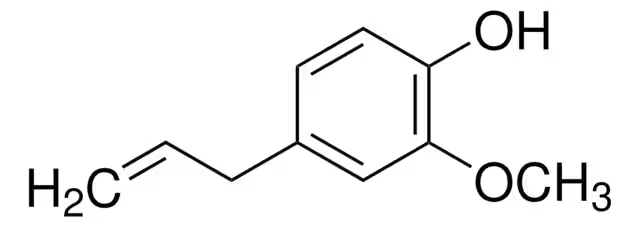
CAS Number97-53-0
Synonyms4-Allyl-2-methoxyphenol; Eugenic acid; p-Allylguaiacol; 2-methoxy-4-allyl phenol; 2-methoxy-4-(prop-2-en-1-yl)phenol; Eugenol; 2U1R DQ CO1; 4-allylguaiacol; 2-methoxy-4-(2-propen-1-yl)phenol; p-Eugenol; femano.2467; EINECS 202-589-1; 1-allyl-4-hydroxy-3-methoxybenzene; 2-Methoxy-4-allylphenol; Engenol; FA 100; Caryophyllic acid; FEMA 2467; MFCD00008654
Molecular Formula4-(H2C=CHCH2)C6H3-2-(OCH3)OH
Molecular Weight164.20
Purity99%
Density1.1±0.1 g/cm3
Boiling Point254 °C (lit.)
Melting Point−12-−10 °C (lit.)
Appearanceliquid
EINECS202-589-1
Symbol
Signal WordWarning
| Chemical & Physical Properties | |
|---|---|
| CAS Number | 97-53-0 |
| Catalog No. | 2A-9018015 |
| Chinese Name | 丁香酚 |
| Synonyms | 4-Allyl-2-methoxyphenol; Eugenic acid; p-Allylguaiacol; 2-methoxy-4-allyl phenol; 2-methoxy-4-(prop-2-en-1-yl)phenol; Eugenol; 2U1R DQ CO1; 4-allylguaiacol; 2-methoxy-4-(2-propen-1-yl)phenol; p-Eugenol; femano.2467; EINECS 202-589-1; 1-allyl-4-hydroxy-3-methoxybenzene; 2-Methoxy-4-allylphenol; Engenol; FA 100; Caryophyllic acid; FEMA 2467; MFCD00008654 |
| Molecular Formula | 4-(H2C=CHCH2)C6H3-2-(OCH3)OH |
| Molecular Weight | 164.20 |
| Purity | 99 |
| Density | 1.1±0.1 g/cm3 |
| Boiling Point | 254 °C (lit.) |
| Melting Point | −12-−10 °C (lit.) |
| Appearance | liquid |
| Water Solubility | slightly soluble |
| Storage Condition | Brown glass bottle with light-sealed packaging. St |
| Application | Eugenol is the essential oil found in cloves and has antibacterial, anthelmintic and antioxidant activity. Eugenol also inhibits lipid peroxidation. |
| EINECS | 202-589-1 |
| HTC | 29095090 |
| PubChem ID | 24894609 |
| MDL Number | MFCD00008654 |
| SMILES | COc1cc(CC=C)ccc1O |
| InChI | 1S/C10H12O2/c1-3-4-8-5-6-9(11)10(7-8)12-2/h3,5-7,11H,1,4H2,2H3 |
| InChI Key | RRAFCDWBNXTKKO-UHFFFAOYSA-N |
| Beilstein/REAXYS | 1366759 |
| NACRES Code | NA.22 |
| UNSPSC | 12352100 |
| Hazard Symbols | Transport |
| MSDS | msds/18015_1_97_53_0.pdf |
| Bioactivity | Eugenol is an essential oil found in cloves with antibacterial, anthelmintic and antioxidant activity. Eugenol is shown to inhibit lipid peroxidation. Related Catalog Signaling Pathways >> Anti-infection >> Bacterial Signaling Pathways >> Anti-infection >> Parasite Natural Products >> Phenols Research Areas >> Inflammation/Immunology Research Areas >> Infection Target Bacterial, Parasite[1] In Vitro The essential oil of O. gratissimum, as well as eugenol, are efficient in inhibiting eclodibility of H. contortus eggs, showing possible utilizations in the treatment of gastrointestinal helmintosis of small ruminants. At 0.50% concentration, the essential oil and eugenol show a maximum eclodibility inhibition[1]. Eugenol inhibits superoxide anion generation in xanthine-xanthine oxidase system to an extent of 50% at concentrations of 250 μM. Eugenol also inhibits the generation of hydroxyl radicals to an extent of 70%. The OH-radical formation measured by the hydroxylation of salicylate to 2, 3-dihydroxy benzoate is inhibited to an extent of 46% by eugenol at 250 μM[2]. Eugenol protects against RS-induced development of IBS-like gastrointestinal dysfunction through modulation of HPA-axis and brain monoaminergic pathways apart from its antioxidant effect. Eugenol (50 mg/kg) reduces 80% of RS-induced increase in fecal pellets similar to that of ondansetron. Eugenol attenuates 80% of stress-induced increase in plasma corticosterone and modulates the serotonergic system in the PFC and amygdala. Eugenol attenuates stress-induced changes in norepinephrine and potentiates the antioxidant defense system in all brain regions[3]. In Vivo Eugenol (33 mg/kg) administered orally for 2 days causes significant suppression of knee joint edema, which continues to be significantly reduced at the end of the treatment. After 2 days, eugenol-treated mycobacterial arthritic rats show a marked reduction in paw swelling[4]. Cell Assay The essential oil and eugenol are diluted in aqueous solution of Tween 20 (0.5%) in the following concentrations: 0.0625, 0.12, 0.25, 0.5 and 1.0% to be used in the egg hatch test[1]. Animal Admin Rats: The treatment groups of arthritic rats are given either ingwerol (0.33 mL/kg or 33 mg/kg) or eugenol (0.33 mL/kg or 33 mg/kg) orally 1 day prior to the induction of arthritis. This treatment is continued for 26 days on a daily basis. Mycobaterium trated rats receive physiological saline orally[4]. References [1]. Pessoa LM, et al. Anthelmintic activity of essential oil of Ocimum gratissimum Linn. and eugenol against Haemonchus contortus. Vet Parasitol. 2002 Oct 16;109(1-2):59-63. [2]. Reddy AC, et al. Studies on the inhibitory effects of curcumin and eugenol on the formation of reactive oxygenspecies and the oxidation of ferrous iron. Mol Cell Biochem. 1994 Aug 17;137(1):1-8. [3]. Garabadu D, et al. Protective effect of eugenol against restraint stress-induced gastrointestinal dysfunction: Potential use in irritable bowel syndrome. Pharm Biol. 2015 Jul;53(7):968-74. [4]. Sharma JN, et al. Suppressive effects of eugenol and ginger oil on arthritic rats. Pharmacology. 1994 Nov;49(5):314-8. Chemical & Physical Properties Density 1.1±0.1 g/cm3 Boiling Point 255.0±0.0 °C at 760 mmHg Melting Point −12-−10 °C(lit.) Molecular Formula C10H12O2 Molecular Weight 164.201 Flash Point 119.8±8.1 °C Exact Mass 164.083725 PSA 29.46000 LogP 2.20 Vapour Pressure 0.0±0.5 mmHg at 25°C Index of Refraction 1.536 InChIKey RRAFCDWBNXTKKO-UHFFFAOYSA-N SMILES C=CCc1ccc(O)c(OC)c1 Stability Stable. Combustible. Incompatible with strong oxidizing agents. Water Solubility slightly soluble |
| Use of | Eugenol is an essential oil found in cloves with antibacterial, anthelmintic and antioxidant activity. Eugenol is shown to inhibit lipid peroxidation. Properties Articles127 Name eugenol Synonym More Synonyms Eugenol Biological Activity Description Eugenol is an essential oil found in cloves with antibacterial, anthelmintic and antioxidant activity. Eugenol is shown to inhibit lipid peroxidation. Related Catalog Signaling Pathways >> Anti-infection >> Bacterial Signaling Pathways >> Anti-infection >> Parasite Natural Products >> Phenols Research Areas >> Inflammation/Immunology Research Areas >> Infection Bacterial, Parasite[1] Cell Assay The essential oil and eugenol are diluted in aqueous solution of Tween 20 (0.5%) in the following concentrations: 0.0625, 0.12, 0.25, 0.5 and 1.0% to be used in the egg hatch test[1]. References [1]. Pessoa LM, et al. Anthelmintic activity of essential oil of Ocimum gratissimum Linn. and eugenol against Haemonchus contortus. Vet Parasitol. 2002 Oct 16;109(1-2):59-63. [2]. Reddy AC, et al. Studies on the inhibitory effects of curcumin and eugenol on the formation of reactive oxygenspecies and the oxidation of ferrous iron. Mol Cell Biochem. 1994 Aug 17;137(1):1-8. [3]. Garabadu D, et al. Protective effect of eugenol against restraint stress-induced gastrointestinal dysfunction: Potential use in irritable bowel syndrome. Pharm Biol. 2015 Jul;53(7):968-74. [4]. Sharma JN, et al. Suppressive effects of eugenol and ginger oil on arthritic rats. Pharmacology. 1994 Nov;49(5):314-8. Chemical & Physical Properties Molecular Formula C10H12O2 Exact Mass 164.083725 PSA 29.46000 Index of Refraction 1.536 InChIKey RRAFCDWBNXTKKO-UHFFFAOYSA-N Stability Stable. Combustible. Incompatible with strong oxidizing agents. Water Solubility slightly soluble |
| Tax Rebate | 9.0% |
| Supervision | None. MFN tariff: 5.5%. Ordinary tariff: 30.0% |
| Transport Info | Shipping Name: UN |
| MSDS Transport Info | Module 14. Shipping information 14.1 UN dangerous goods number European Land Transport Dangerous Regulations: -International Maritime Dangerous Regulations: -International Air Transport Dangerous Regulations: - 14.2 United Nations shipping name European Land Transport Dangerous Regulations: Non-dangerous goods IMDG Code: Non-dangerous goods International air transport dangerous goods regulations: non-dangerous goods 14.3 Transport hazard categories European Land Transport Dangerous Regulations: -International Maritime Dangerous Regulations: -International Air Transport Dangerous Regulations: - 14.4 Package group European Land Transport Dangerous Regulations: -International Maritime Dangerous Regulations: -International Air Transport Dangerous Regulations: - 14.5 Environmental hazards European Land Transport Danger Regulations: No International Maritime Danger Regulations International Air Transport Danger Regulations: No Marine pollutants (yes/no): No 14.6 Special reminder to users No data available |
| Related Products in Specialty & Botanical Ingredients | ||
|---|---|---|
| 6-Methylcoumarin | 92-48-8 | 2A-9017749 |
| Methyl eugenol | 93-15-2 | 2A-9017796 |
| Methyl isoeugenol | 93-16-3 | 2A-9017797 |
| Safrole | 94-59-7 | 2A-9017859 |
| Dihydroisojasmone | 95-41-0 | 2A-9017901 |
| Isoeugenol | 97-54-1 | 2A-9018016 |
| alpha-Terpineol | 98-55-5 | 2A-9018072 |
| alpha-Hexylcinnamaldehyde | 101-86-0 | 2A-9018273 |
| Cinnamaldehyde | 104-55-2 | 2A-9018396 |
| Geranyl acetate | 105-87-3 | 2A-9018470 |
| Browse all Specialty & Botanical Ingredients products » | ||
Phone:
630-322-8886
630-322-8887
Email:
Office Locations:
Chicago, IL, USA
San Francisco, CA, USA


 EN
EN


 SDS
SDS