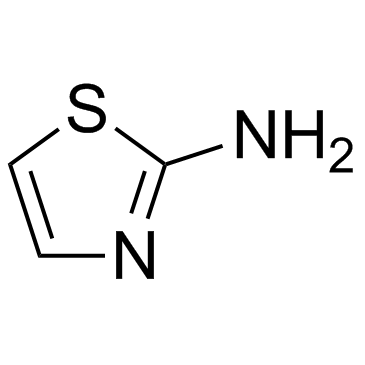
CAS Number96-50-4
Synonymsthiazole-2-amine; EINECS 202-511-6; usafek-p-5501; 2-amino-1,3-thiazole; Aminothiazole; 1,3-Thiazol-2-amine; BASEDOL; 2-Aminothiazole; ABADOLE; 2-thiazolylamine; 2-amino-thiazole; aminothiazol; RP 2921; 2-Thiazolamine; THIAZYLAMINE; Abadol; MFCD00005325; thiazol-2-amine; cp1585; 2-AMINO THIAZOLE
Molecular FormulaC3H4N2S
Molecular Weight100.142
Purity98.00%
Density1.3±0.1 g/cm3
Boiling Point216.4±9.0 °C at 760 mmHg
Melting Point91-93 °C(lit.)
AppearanceLight brown crystal or brown granular solid
| Chemical & Physical Properties | |
|---|---|
| CAS Number | 96-50-4 |
| Catalog No. | 2A-9017972 |
| Chinese Name | 2-氨基噻唑 |
| Synonyms | thiazole-2-amine; EINECS 202-511-6; usafek-p-5501; 2-amino-1,3-thiazole; Aminothiazole; 1,3-Thiazol-2-amine; BASEDOL; 2-Aminothiazole; ABADOLE; 2-thiazolylamine; 2-amino-thiazole; aminothiazol; RP 2921; 2-Thiazolamine; THIAZYLAMINE; Abadol; MFCD00005325; thiazol-2-amine; cp1585; 2-AMINO THIAZOLE |
| Molecular Formula | C3H4N2S |
| Molecular Weight | 100.142 |
| Purity | 98.00 |
| Density | 1.3±0.1 g/cm3 |
| Boiling Point | 216.4±9.0 °C at 760 mmHg |
| Melting Point | 91-93 °C(lit.) |
| Appearance | Light brown crystal or brown granular solid |
| Water Solubility | 100 g/L (20 ºC) |
| Storage Condition | Store in a cool, ventilated warehouse. Keep away f |
| Packaging | I; II; III |
| Application | Aminothiazole (2-Aminothiazole) is a component in the synthesis of a variety of active compounds, including antibiotics, dyes, etc., especially as a parent compound for the synthesis of prion inhibito |
| HTC | 2934999090 |
| SMILES | Nc1nccs1 |
| InChI | InChI=1S/C3H4N2S/c4-3-5-1-2-6-3/h1-2H,(H2,4,5) |
| InChI Key | RAIPHJJURHTUIC-UHFFFAOYSA-N |
| Bioactivity | Aminothiazole (2-Aminothiazole) is a beginning point for synthesis of many compounds including sulfur drugs, biocides, fungicides, dyes and chemical reaction accelerators.IC50 value:Target:2-Aminothiazole can be used as a thyroid inhibitor in the treatment of hyperthyroidism and it has antibacterial activity. Also used as the acid tartrate. Recent studies using prion-infected neuroblastoma cell lines have suggested that aminothiazole may be used as a therapeutic drug for prion diseases. Related Catalog Signaling Pathways >> Others >> Others Research Areas >> Others References [1]. Gallardo-Godoy A, et al. 2-Aminothiazoles as therapeutic leads for prion diseases. J Med Chem. 2011 Feb 24;54(4):1010-21. Chemical & Physical Properties Density 1.3±0.1 g/cm3 Boiling Point 216.4±9.0 °C at 760 mmHg Melting Point 91-93 °C(lit.) Molecular Formula C3H4N2S Molecular Weight 100.142 Flash Point 84.7±18.7 °C Exact Mass 100.009521 PSA 67.15000 LogP 0.38 Vapour Pressure 0.1±0.4 mmHg at 25°C Index of Refraction 1.645 InChIKey RAIPHJJURHTUIC-UHFFFAOYSA-N SMILES Nc1nccs1 Water Solubility 100 g/L (20 ºC) |
| Use of | Aminothiazole (2-Aminothiazole) is a beginning point for synthesis of many compounds including sulfur drugs, biocides, fungicides, dyes and chemical reaction accelerators.IC50 value:Target:2-Aminothiazole can be used as a thyroid inhibitor in the treatment of hyperthyroidism and it has antibacterial activity. Also used as the acid tartrate. Recent studies using prion-infected neuroblastoma cell lines have suggested that aminothiazole may be used as a therapeutic drug for prion diseases. Properties Articles34 Name 1,3-thiazol-2-amine Synonym More Synonyms 2-Aminothiazole Biological Activity Description Aminothiazole (2-Aminothiazole) is a beginning point for synthesis of many compounds including sulfur drugs, biocides, fungicides, dyes and chemical reaction accelerators.IC50 value:Target:2-Aminothiazole can be used as a thyroid inhibitor in the treatment of hyperthyroidism and it has antibacterial activity. Also used as the acid tartrate. Recent studies using prion-infected neuroblastoma cell lines have suggested that aminothiazole may be used as a therapeutic drug for prion diseases. Related Catalog Signaling Pathways >> Others >> Others Research Areas >> Others References [1]. Gallardo-Godoy A, et al. 2-Aminothiazoles as therapeutic leads for prion diseases. J Med Chem. 2011 Feb 24;54(4):1010-21. Chemical & Physical Properties Molecular Formula C3H4N2S Exact Mass 100.009521 PSA 67.15000 Index of Refraction 1.645 InChIKey RAIPHJJURHTUIC-UHFFFAOYSA-N SMILES Nc1nccs1 |
| Tax Rebate | 9.0% |
| Supervision | None. MFN tariff: 6.5%. Ordinary tariff: 20.0% |
| Transport Info | Product name: Chemical name |
| Related Products in Heterocyclic Building Blocks | ||
|---|---|---|
| N-Cyclohexyl-2-benzothiazolesulfenamide | 95-33-0 | 2A-9017900 |
| 2-Chloro-3-methylpyrazine | 95-58-9 | 2A-9017915 |
| 3-Chloro-2,5-dimethylpyrazine | 95-89-6 | 2A-9017938 |
| 2-Chlorothiophene | 96-43-5 | 2A-9017967 |
| 2-Methyltetrahydrofuran | 96-47-9 | 2A-9017969 |
| N-Methyl pyrrole | 96-54-8 | 2A-9017974 |
| Piperidine pentamethylenedithiocarbamate | 98-77-1 | 2A-9018088 |
| methyl6-chloropyridazine-4-carboxylate | 1093860-48-0 | 2A-9018105 |
| 2,5-Pyridinedicarboxylic acid | 100-26-5 | 2A-9018186 |
| 6,8-DI(TERT-BUTYL)-4-OXO-4H-CHROMENE-2-CARBOXYLIC ACID | 37456-21-6 | 2A-9018192 |
| Browse all Heterocyclic Building Blocks products » | ||
Phone:
630-322-8886
630-322-8887
Email:
Office Locations:
Chicago, IL, USA
San Francisco, CA, USA


 EN
EN


 SDS
SDS