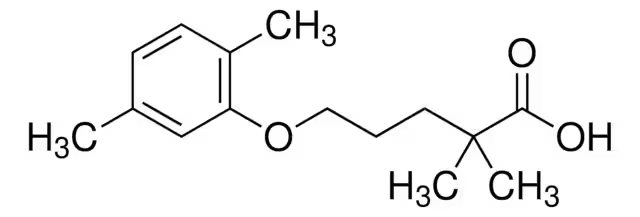
CAS Number25812-30-0
SynonymsGEMFIBROZIL,USP; 2,2-Dimethyl-5-(2,5-dimethylphenoxy)valeric Acid; Genlip; 5-(2,5-Dimethylphenoxy)-2,2-dimethylpentanoic acid; EINECS 247-280-2; lopid; CI-7; 2,2-Dimethyl-5-(2,5-dimethylphenoxy)pentanoic acid (2,2-Dimethyl-5-(2,5-xylyloxy)valeric acid; gevilon; Lipttr; ci-719; 2,2-Dimethyl-5-(2,5-dimethylphenoxy)pentanoic Acid; Decrelip; Gemfibrozil; MFCD00079335; C1-719; Lipozid
Molecular FormulaC15H22O3
Molecular Weight250.33
Purity98%%
Density1.0±0.1 g/cm3
Boiling Point394.7±30.0 °C at 760 mmHg
Melting Point61-63°C
Appearancepowder
EINECS247-280-2
Symbol
Signal WordWarning
| Chemical & Physical Properties | |
|---|---|
| CAS Number | 25812-30-0 |
| Catalog No. | 2A-4178780 |
| Chinese Name | 吉非罗齐 |
| Synonyms | GEMFIBROZIL,USP; 2,2-Dimethyl-5-(2,5-dimethylphenoxy)valeric Acid; Genlip; 5-(2,5-Dimethylphenoxy)-2,2-dimethylpentanoic acid; EINECS 247-280-2; lopid; CI-7; 2,2-Dimethyl-5-(2,5-dimethylphenoxy)pentanoic acid (2,2-Dimethyl-5-(2,5-xylyloxy)valeric acid; gevilon; Lipttr; ci-719; 2,2-Dimethyl-5-(2,5-dimethylphenoxy)pentanoic Acid; Decrelip; Gemfibrozil; MFCD00079335; C1-719; Lipozid |
| Molecular Formula | C15H22O3 |
| Molecular Weight | 250.33 |
| Purity | 98% |
| Density | 1.0±0.1 g/cm3 |
| Boiling Point | 394.7±30.0 °C at 760 mmHg |
| Melting Point | 61-63°C |
| Appearance | powder |
| Water Solubility | Soluble in: methanol |
| Storage Condition | -20°C Freezer |
| Application | Gemfibrozil is a PPAR-α activator and a lipid-lowering drug; Gemfibrozil is also a non-selective inhibitor of P450, with Ki values of 5.8, 24, 69 and 82 μM for CYP2C9, 2C19, 2C8 and 1A2 respectively |
| EINECS | 247-280-2 |
| HTC | 2918990090 |
| PubChem ID | 24895377 |
| MDL Number | MFCD00079335 |
| SMILES | Cc1ccc(C)c(OCCCC(C)(C)C(O)=O)c1 |
| InChI | 1S/C15H22O3/c1-11-6-7-12(2)13(10-11)18-9-5-8-15(3,4)14(16)17/h6-7,10H,5,8-9H2,1-4H3,(H,16,17) |
| InChI Key | HEMJJKBWTPKOJG-UHFFFAOYSA-N |
| NACRES Code | NA.77 |
| UNSPSC | 12352200 |
| Hazard Symbols | transportation |
| MSDS | msds/179481_1_25812_30_0.pdf |
| Bioactivity | Gemfibrozil is an activator of PPAR-α, used as a lipid-lowering drug; Gemfibrozil is also a nonselective inhibitor of several P450 isoforms, with Ki values for CYP2C9, 2C19, 2C8, and 1A2 of 5.8, 24, 69, and 82 μM, respectively. Related Catalog Signaling Pathways >> Metabolic Enzyme/Protease >> Cytochrome P450 Research Areas >> Cardiovascular Disease Research Areas >> Metabolic Disease Target PPAR-α CYP2C9:5.8 μM (Ki) CYP2C19:24 μM (Ki) CYP2C8:69 μM (Ki) CYP1A2:82 μM (Ki) In Vitro Gemfibrozil is an activator of PPAR-α, used as a lipid-lowering drug[1]; also a nonselective inhibitor of several P450 isoforms, with Ki values for CYP2C9, 2C19, 2C8, and 1A2 of 5.8, 24, 69, and 82 μM, respectively[3]. Gemfibrozil (100, 150, 200 μM) inhibits the cytokine-induced NO production in a concentration dependent manner in human U373MG astroglial cells, and such effects are not due to any change of the stability of iNOS mRNA. Gemfibrozil (50, 100, 200 μM) inhibits human iNOS promoter-derived luciferase activity in cytokine-stimulated human U373MG astroglial cells. Furthermore, Gemfibrozil (50, 100, 150, and 200 μM) shows no effects on the viability of the cells[1]. Gemfibrozil considerably inhibits both M-23 and M-1 formation (catalyzed by CYP2C8 and CYP3A4), with Ki (IC50) values of 69 μM (95 μM) and 273 μM (>250 μM), respectively, in human liver microsomes. Gemfibrozil (0-250 μM) dose dependently inhibits the formation of M-23 (IC50, 68 μM) and M-1 (IC50, 78 μM) in recombinant CYP2C8, but shows no appreciable effect on the formation of these metabolites in recombinant CYP3A4[3]. In Vivo Gemfibrozil (62 mg/kg/day, p.o.) treatment initiated 3 days before spinal cord injury (SCI) causes decreased locomotor function, and induces a trend for decreased white matter sparing after injury in mice. Gemfibrozil (62 mg/kg/day, p.o.) decreases macrophage immunoreactivity but increases T cell infiltration into spared tissue[2]. Kinase Assay Activities of CYP3A4 (testosterone 6β-hydroxylation) and CYP2C8 (paclitaxel 6α-hydroxylation) are determined. The marker substrate concentrations used, 25 μM testosterone and 1 to 5 μM paclitaxel, are comparable with or around the Km values of the reactions. Gemfibrozil is either coincubated at 37°C for 15 min with the marker substrate and NADPH (1 mM) before the reaction is initiated with human liver microsomes (0.1 mg/mL) or preincubated with human liver microsomes and NADPH for 15 min before adding the marker substrate[3]. Cell Assay Briefly, 400 μL of culture supernatant is allowed to react with 200 μL of Griess reagent and incubated at room temperature for 15 min. The optical density of the assay samples is measured spectrophotometrically at 570 nm. Fresh culture medium serves as the blank in all experiments. Nitrite concentrations are calculated from a standard curve derived from the reaction of NaNO2 in the assay[1]. Animal Admin Mice are given vehicle or gemfibrozil beginning 3 days before SCI to ensure drug availability at the time of the injury (n=5-6/group). The drug is delivered orally by dissolving it in ethanol (0.25% w/w of gemfibrozil) and coating food pellets such that each animal receives appr 62 mg/kg/day; chow for control groups is treated with ethanol. Ethanol for each group is allowed to completely evaporate before giving the food to the animals. In addition, animals receive an intraperitoneal injection of vehicle or gemfibrozil (500 µg dissolved in 200 µL PBS) 1 h after the injury, and then continued to receive the drug in their food until the end of the study (28 days post-injury)[2]. References [1]. Pahan K, et al. Gemfibrozil, a lipid-lowering drug, inhibits the induction of nitric-oxide synthase in human astrocytes. J Biol Chem. 2002 Nov 29;277(48):45984-91. Epub 2002 Sep 18. [2]. Almad A, et al. The PPAR alpha agonist gemfibrozil is an ineffective treatment for spinal cord injured mice. Exp Neurol. 2011 Dec;232(2):309-17. [3]. Wang JS, et al. Gemfibrozil inhibits CYP2C8-mediated cerivastatin metabolism in human liver microsomes. Drug Metab Dispos. 2002 Dec;30(12):1352-6. Chemical & Physical Properties Density 1.0±0.1 g/cm3 Boiling Point 394.7±30.0 °C at 760 mmHg Melting Point 61-63°C Molecular Formula C15H22O3 Molecular Weight 250.333 Flash Point 141.6±18.1 °C Exact Mass 250.156891 PSA 46.53000 LogP 4.39 Vapour Pressure 0.0±1.0 mmHg at 25°C Index of Refraction 1.512 InChIKey HEMJJKBWTPKOJG-UHFFFAOYSA-N SMILES Cc1ccc(C)c(OCCCC(C)(C)C(=O)O)c1 Storage condition -20°C Freezer |
| Use of | Properties Articles74 Name gemfibrozil Synonym More Synonyms Gemfibrozil Biological Activity Related Catalog Signaling Pathways >> Metabolic Enzyme/Protease >> Cytochrome P450 Research Areas >> Cardiovascular Disease Research Areas >> Metabolic Disease CYP1A2:82 μM (Ki) References [1]. Pahan K, et al. Gemfibrozil, a lipid-lowering drug, inhibits the induction of nitric-oxide synthase in human astrocytes. J Biol Chem. 2002 Nov 29;277(48):45984-91. Epub 2002 Sep 18. [2]. Almad A, et al. The PPAR alpha agonist gemfibrozil is an ineffective treatment for spinal cord injured mice. Exp Neurol. 2011 Dec;232(2):309-17. Chemical & Physical Properties Molecular Formula C15H22O3 Exact Mass 250.156891 PSA 46.53000 Index of Refraction 1.512 InChIKey HEMJJKBWTPKOJG-UHFFFAOYSA-N |
| Tax Rebate | 13.0% |
| Supervision | None. MFN tariff: 6.5%. Ordinary tariff: 30.0% |
| Transport Info | Shipping Name: UN |
| MSDS Transport Info | Module 14. Shipping information 14.1 UN dangerous goods number European Land Transport Dangerous Regulations: -International Maritime Dangerous Regulations: -International Air Transport Dangerous Regulations: - 14.2 United Nations shipping name European Land Transport Dangerous Regulations: Non-dangerous goods IMDG Code: Non-dangerous goods International air transport dangerous goods regulations: non-dangerous goods 14.3 Transport hazard categories European Land Transport Dangerous Regulations: -International Maritime Dangerous Regulations: -International Air Transport Dangerous Regulations: - 14.4 Package group European Land Transport Dangerous Regulations: -International Maritime Dangerous Regulations: -International Air Transport Dangerous Regulations: - 14.5 Environmental hazards European Land Transport Danger Regulations: No International Maritime Danger Regulations International Air Transport Danger Regulations: No Marine pollutants (yes/no): No 14.6 Special reminder to users No data available |
| Related Products in Specialty Chemicals | ||
|---|---|---|
| 1,4-dioxecane-5,10-dione | 15498-31-4 | 2A-1178773 |
| β-Dihydromuconic acid | 4440-68-0 | 2A-1178774 |
| AZD9496 | 1639042-08-2 | 2A-1178776 |
| TRANS-SIDURON PESTANAL 250 MG | 19123-21-8 | 2A-1178779 |
| 4-FLUORO-2-NITROANILINE | 364-71-6 | 2A-1178780 |
| 3-Fluoro-4-bromo aniline | 656-65-6 | 2A-1178781 |
| 3',4',5'-trimethoxycinnamoyl chloride | 10263-19-1 | 2A-1178785 |
| 4-Methyl-1-phenylquinolin-2(1H)-one | 2540-30-9 | 2A-1178787 |
| 2-CYANOPROP-2-ENOIC ACID | 263703-32-8 | 2A-1178789 |
| 2-ISOPROPYLANISOLE | 2944-47-0 | 2A-1178790 |
| Browse all Specialty Chemicals products » | ||
Phone:
630-322-8886
630-322-8887
Email:
Office Locations:
Chicago, IL, USA
San Francisco, CA, USA


 EN
EN


 SDS
SDS