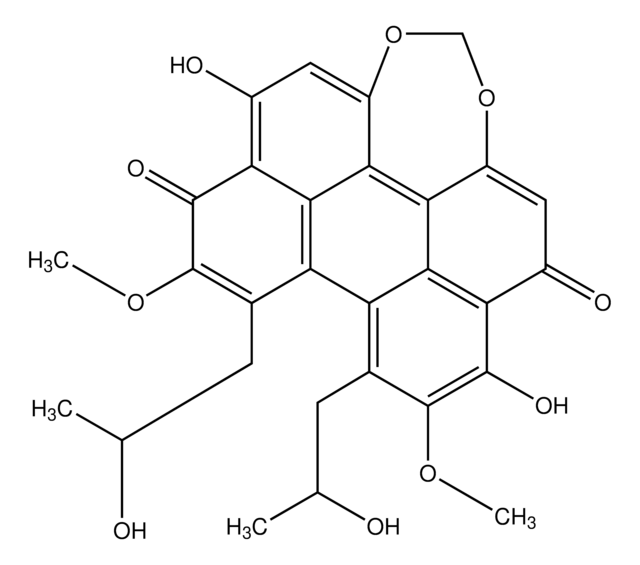
| Chemical & Physical Properties | |
|---|---|
| CAS Number | 35082-49-6 |
| Catalog No. | 2A-1177750 |
| Chinese Name | Cercosporin |
| Synonyms | cercosporin from cercospora hayii; cercosporin |
| Molecular Formula | C29H26O10 |
| Molecular Weight | 534.51 |
| Density | 1.59g/cm3 |
| Boiling Point | 886.9ºC at 760mmHg |
| Appearance | solid |
| Storage Condition | 2-8°C, sealed, dry |
| Application | Cercosporin is produced by the plant pathogen Cercosporakikuchii and elsinochromes, pigments of the elsinoe family of fungi. Cercosporin is a potent photosensitizer with a short activation wavelength |
| PubChem ID | 24892884 |
| MDL Number | MFCD00212919 |
| SMILES | COC1=C(CC(C)O)c2c3c(CC(C)O)c(OC)c(O)c4C(=O)C=C5OCOc6cc(O)c(C1=O)c2c6c5c34 |
| InChI | 1S/C29H26O10/c1-10(30)5-12-18-19-13(6-11(2)31)29(37-4)27(35)21-15(33)8-17-23(25(19)21)22-16(38-9-39-17)7-14(32)20(24(18)22)26(34)28(12)36-3/h7-8,10-11,30-32,35H,5-6,9H2,1-4H3 |
| InChI Key | JWFLIMIGORGZMQ-UHFFFAOYSA-N |
| NACRES Code | NA.85 |
| UNSPSC | 51102829 |
| Hazard Symbols | transportation |
| MSDS | msds/178338_1_35082_49_6.pdf |
| Bioactivity | Cercosporin is produced by a plant pathogen, Cercosporakikuchii, and the elsinochromes, pigments of the elsinoe family of fungi. Cercosporin is a potent photosensitizer with a short activation wavelength, mostly suitable for superficial photodynamic therapy (PDT) treatments, especially when it is necessary to avoid perforations[1].Cercosporin contains the perylenequinone structural features necessary to PKC activity with an IC50 of 0.6-1.3 μM[2]. Related Catalog Signaling Pathways >> Epigenetics >> PKC Research Areas >> Cancer Signaling Pathways >> TGF-beta/Smad >> PKC Target IC50: 0.6-1.3 μM (PKC)[2] In Vitro Cercosporin (0.8-8.0 μM; 30 s, 60 s, 90 s, 120 s) photodynamic therapy (PDT) effect is stronger in T98G cells than in U87 or MCF7 cells, the LD50 value for the T98G cells (0.14 J cm2) is much less than the LD50 value for MCF-7 and U87 cell lines (0.26 and 0.24 J cm2, respectively)[1]. Cercosporin (0-3 μΜ; 24 hours) interplays with copper results in a synergistic cytotoxicity in MCF7 and T98G cells, that is, S(CuSO4 + Cerco) ≪ S(CuSO4) x S(Cerco), barely has an additive effect in U87 cells[1]. Cell Viability Assay[1] Cell Line: Human GBM cell lines, T98G and U87; Breast carcinoma cell line, MCF-7 Concentration: 0 μM, 1 μM, 2 μM, 3 μM Incubation Time: 24 hours Result: Exhibited a synergistic cytotoxicity with copper only in the most respiratory cell lines (MCF-7 and T98G). References [1]. Mastrangelopoulou M, et al. Cytotoxic and Photocytotoxic Effects of Cercosporin on Human Tumor Cell Lines. Photochem Photobiol. 2019 Jan;95(1):387-396. [2]. Morgan BJ, et al. Design, synthesis, and investigation of protein kinase C inhibitors: total syntheses of (+)-calphostin D, (+)-phleichrome, cercosporin, and new photoactive perylenequinones. J Am Chem Soc. 2009 Jul 8;131(26):9413-25. Chemical & Physical Properties Density 1.59g/cm3 Boiling Point 886.9ºC at 760mmHg Molecular Formula C29H26O10 Molecular Weight 534.51100 Flash Point 299ºC Exact Mass 534.15300 PSA 151.98000 LogP 3.56450 Index of Refraction 1.754 InChIKey MXLWQNCWIIZUQT-NFJWQWPMSA-N SMILES COc1c(O)c2c(=O)cc3c4c5c(cc(=O)c6c(O)c(OC)c(CC(C)O)c(c(c1CC(C)O)c24)c65)OCO3 |
| Use of | Cercosporin is produced by a plant pathogen, Cercosporakikuchii, and the elsinochromes, pigments of the elsinoe family of fungi. Cercosporin is a potent photosensitizer with a short activation wavelength, mostly suitable for superficial photodynamic therapy (PDT) treatments, especially when it is necessary to avoid perforations[1].Cercosporin contains the perylenequinone structural features necessary to PKC activity with an IC50 of 0.6-1.3 μM[2]. Properties Articles29 Name cercosporin, pure Synonym More Synonyms Cercosporin Biological Activity Description Cercosporin is produced by a plant pathogen, Cercosporakikuchii, and the elsinochromes, pigments of the elsinoe family of fungi. Cercosporin is a potent photosensitizer with a short activation wavelength, mostly suitable for superficial photodynamic therapy (PDT) treatments, especially when it is necessary to avoid perforations[1].Cercosporin contains the perylenequinone structural features necessary to PKC activity with an IC50 of 0.6-1.3 μM[2]. Related Catalog Signaling Pathways >> Epigenetics >> PKC Research Areas >> Cancer Signaling Pathways >> TGF-beta/Smad >> PKC IC50: 0.6-1.3 μM (PKC)[2] References [1]. Mastrangelopoulou M, et al. Cytotoxic and Photocytotoxic Effects of Cercosporin on Human Tumor Cell Lines. Photochem Photobiol. 2019 Jan;95(1):387-396. [2]. Morgan BJ, et al. Design, synthesis, and investigation of protein kinase C inhibitors: total syntheses of (+)-calphostin D, (+)-phleichrome, cercosporin, and new photoactive perylenequinones. J Am Chem Soc. 2009 Jul 8;131(26):9413-25. Chemical & Physical Properties Molecular Formula C29H26O10 Exact Mass 534.15300 PSA 151.98000 LogP 3.56450 Index of Refraction 1.754 InChIKey MXLWQNCWIIZUQT-NFJWQWPMSA-N |
| Transport Info | Shipping Name: UN |
| MSDS Transport Info | Module 14. Shipping information 14.1 UN dangerous goods number European Land Transport Dangerous Regulations: -International Maritime Dangerous Regulations: -International Air Transport Dangerous Regulations: - 14.2 United Nations shipping name European Land Transport Dangerous Regulations: Non-dangerous goods IMDG Code: Non-dangerous goods International air transport dangerous goods regulations: non-dangerous goods 14.3 Transport hazard categories European Land Transport Dangerous Regulations: -International Maritime Dangerous Regulations: -International Air Transport Dangerous Regulations: - 14.4 Package group European Land Transport Dangerous Regulations: -International Maritime Dangerous Regulations: -International Air Transport Dangerous Regulations: - 14.5 Environmental hazards European Land Transport Danger Regulations: No International Maritime Danger Regulations International Air Transport Danger Regulations: No Marine pollutants (yes/no): No 14.6 Special reminder to users No data available |
| Related Products in Specialty Chemicals | ||
|---|---|---|
| APICIDIN | 183506-66-3 | 2A-1177746 |
| aureothricin | 574-95-8 | 2A-1177747 |
| 2-Amino Flubendazole | 82050-13-3 | 2A-3177748 |
| BORRELIDIN | 7184-60-3 | 2A-1177749 |
| Acetyl flupirtine | 88874-11-7 | 2A-3177749 |
| 4_-Hydroxy Flurbiprofen | 52807-12-2 | 2A-3177750 |
| CONCANAMYCIN A | 80890-47-7 | 2A-1177751 |
| Dehydrocurvularin, 10,11- | 1095588-70-7 | 2A-1177752 |
| DESTRUXIN A | 6686-70-0 | 2A-1177753 |
| DMAPT | 870677-05-7 | 2A-1177754 |
| Browse all Specialty Chemicals products » | ||
Phone:
630-322-8886
630-322-8887
Email:
Office Locations:
Chicago, IL, USA
San Francisco, CA, USA


 EN
EN


 SDS
SDS