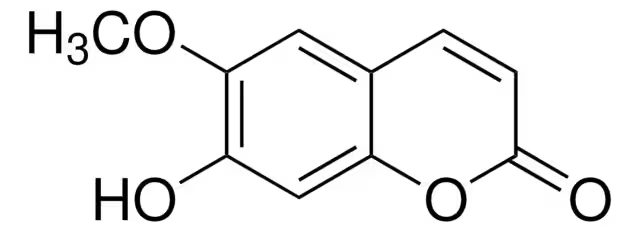
CAS Number92-61-5
Synonyms7-hydroxy-6-methoxychromen-2-one; 7-Hydroxy-6-methoxycoumarin; Scopoletine; Esculetin-6-methyl ether; 6-Methylesculetin; 6-Methoxyumbelliferone; Escopoletin; 6-methoxy-7-hydroxy-coumarin; Chrysatropic acid; Scopoletin; Gelseminic Acid; MFCD00006872; 7-hydroxy-6-methoxy-2H-benzopyran-2-one; 7-hydroxy-6-methoxy-2H-1-benzopyran-2-one; Scopoletol; EINECS 202-171-9; β-Methylesculetin; 6-O-Methylesculetin; 7-Hydroxy-6-methoxy-2H-chromen-2-one; b-Methylesculetin; Murrayetin; 7-Hydroxy-5-methoxycoumarin
Molecular FormulaC10H8O4
Molecular Weight192.17
Purity≥99%
Density1.4±0.1 g/cm3
Boiling Point413.5±45.0 °C at 760 mmHg
Melting Point203-205 °C (lit.)
AppearanceYellow to beige crystalline powder
EINECS202-171-9
| Chemical & Physical Properties | |
|---|---|
| CAS Number | 92-61-5 |
| Catalog No. | 2A-9017759 |
| Chinese Name | 东莨菪内酯; 莨菪亭 |
| Synonyms | 7-hydroxy-6-methoxychromen-2-one; 7-Hydroxy-6-methoxycoumarin; Scopoletine; Esculetin-6-methyl ether; 6-Methylesculetin; 6-Methoxyumbelliferone; Escopoletin; 6-methoxy-7-hydroxy-coumarin; Chrysatropic acid; Scopoletin; Gelseminic Acid; MFCD00006872; 7-hydroxy-6-methoxy-2H-benzopyran-2-one; 7-hydroxy-6-methoxy-2H-1-benzopyran-2-one; Scopoletol; EINECS 202-171-9; β-Methylesculetin; 6-O-Methylesculetin; 7-Hydroxy-6-methoxy-2H-chromen-2-one; b-Methylesculetin; Murrayetin; 7-Hydroxy-5-methoxycoumarin |
| Molecular Formula | C10H8O4 |
| Molecular Weight | 192.17 |
| Purity | ≥99 |
| Density | 1.4±0.1 g/cm3 |
| Boiling Point | 413.5±45.0 °C at 760 mmHg |
| Melting Point | 203-205 °C (lit.) |
| Appearance | Yellow to beige crystalline powder |
| Water Solubility | Slightly soluble |
| Storage Condition | This product should be kept sealed. |
| Application | Scopoletin is an acetylcholinesterase (AChE) inhibitor. |
| EINECS | 202-171-9 |
| HTC | 2932209090 |
| PubChem ID | 24899524 |
| MDL Number | MFCD00006872 |
| SMILES | COc1cc2C=CC(=O)Oc2cc1O |
| InChI | 1S/C10H8O4/c1-13-9-4-6-2-3-10(12)14-8(6)5-7(9)11/h2-5,11H,1H3 |
| InChI Key | RODXRVNMMDRFIK-UHFFFAOYSA-N |
| Beilstein/REAXYS | 156296 |
| NACRES Code | NA.28 |
| UNSPSC | 12171501 |
| MSDS | msds/17759_1_92_61_5.pdf |
| Bioactivity | Scopoletin is an inhibitor of acetylcholinesterase (AChE). Related Catalog Signaling Pathways >> Neuronal Signaling >> AChE Natural Products >> Phenylpropanoids Research Areas >> Inflammation/Immunology Target AChE[1] In Vitro Scopoletin (SCT) is identified as a putative inhibitor of acetylcholinesterase (AChE). Scopoletin enhances the K+-stimulated release of ACh from rat frontal cortex synaptosomes, showing a bell-shaped dose effect curve (Emax: 4 μM) [1]. Scopoletin inhibits PC3 proliferation by inducing apoptosis of PC3 cells. The IC50 of Scopoletin for inhibiting PC3, PAA (human lung cancer cell), and Hela cell proliferation is (157±25), (154±51), and (294±100) mg/L, respectively. Scopoletin induces a marked time- and concentration-dependent inhibition of PC3 cell proliferation. Scopoletin reduces the protein content and decreases the acid phosphatase activity (ACP) level in PC3 cells in a concentration-dependent manner. Cells treated by Scopoletin show typical morphologic changes of apoptosis by light microscope, fluorescence microscope, and transmission electronmicroscope. Apoptosis rate is 0.3 %, 2.1 %, 9.3 % and 35 % for Scopoletin 0, 100, 200, and 400 mg/L, respectively, and cells in G2 phase decrease markedly after being treated with Scopoletin[2]. In Vivo Scopoletin (2 μg, i.c.v.) increases T-maze alternation and ameliorated novel object recognition of mice with scopolamine-induced cholinergic deficit. It also reduces age-associated deficits in object memory of 15-18-month-old mice (2 mg/kg sc). Mice injected with 2 μg Scopoletin show an increased alternation rate of 71.3±2.5%[1]. Cell Assay PC3 cells (5×10⁷/L) 1 mL in exponential growth are seeded into four 24-well plates. The plates are incubated at 37°C in a humidified 5% CO2 atmospbee. After 24h, Scopoletin 33, 66, 133, 266, and 533 mg/L are added to wells (3 wells for each concentration for each plate). For control cells (3 wells foreach plate),only DMEM was added. The plates are incubated continually. The viable cells are counted by hemocytometer every day in the frist 4 d by Trypan blue dye exclusion method[2]. Animal Admin Mice[1] C56BL/6N male, 4-6-month-old and 16-18-month-old mice are used in the behavioral studies. The mice are housed in groups of four in cages at constant humidity (50-55%) and temperature (22±1°C) on a 12:12 h light/dark cycle (7:00-19:00 h), with food and water ad libitum. Younger mice (4-6 months) are implanted with i.c.v. cannulas for application of Scopolamine (SCOP) and Scopoletin. The aged mice are injected with Scopoletin by the s.c. route. Experiments are conducted between 8:00 and 16:00 h. Mice with i.c.v. cannulas are randomly divided into four experimental groups: vehicle; SCOP 20 μg; Scopoletin 2 μg; and SCOP 20 μg plus Scopoletin 2 μg. The drugs are applied in 1 μL of vehicle solution (SCOP: saline, Scopoletin: 3 DMSO: 7 sterile water). I.c.v. injections are carried out 15 min before the start of the tests. Aged mice obtained Scopoletin s.c. 30 min prior to object memory test (vehicle: 1 DMSO: 1 EtOH, diluted with olive oil as required)[1]. References [1]. Hornick A, et al. The coumarin Scopoletin potentiates acetylcholine release from synaptosomes, amplifies hippocampal long-term potentiation and ameliorates anticholinergic- and age-impaired memory. Neuroscience. 2011 Dec 1;197:280-92. [2]. Liu XL, et al. Effect of Scopoletin on PC3 cell proliferation and apoptosis. Acta Pharmacol Sin. 2001 Oct;22(10):929-33. Chemical & Physical Properties Density 1.4±0.1 g/cm3 Boiling Point 413.5±45.0 °C at 760 mmHg Melting Point 203-205 °C(lit.) Molecular Formula C10H8O4 Molecular Weight 192.168 Flash Point 172.4±22.2 °C Exact Mass 192.042252 PSA 59.67000 LogP 1.28 Vapour Pressure 0.0±1.0 mmHg at 25°C Index of Refraction 1.609 InChIKey RODXRVNMMDRFIK-UHFFFAOYSA-N SMILES COc1cc2ccc(=O)oc2cc1O Storage condition -20°C Freezer Water Solubility Slightly soluble |
| Use of | Scopoletin is an inhibitor of acetylcholinesterase (AChE). Properties Articles46 Name scopoletin Synonym More Synonyms Scopoletin Biological Activity Description Scopoletin is an inhibitor of acetylcholinesterase (AChE). Related Catalog Signaling Pathways >> Neuronal Signaling >> AChE Natural Products >> Phenylpropanoids Research Areas >> Inflammation/Immunology References [1]. Hornick A, et al. The coumarin Scopoletin potentiates acetylcholine release from synaptosomes, amplifies hippocampal long-term potentiation and ameliorates anticholinergic- and age-impaired memory. Neuroscience. 2011 Dec 1;197:280-92. Chemical & Physical Properties Molecular Formula C10H8O4 Exact Mass 192.042252 PSA 59.67000 Index of Refraction 1.609 InChIKey RODXRVNMMDRFIK-UHFFFAOYSA-N Water Solubility Slightly soluble |
| Tax Rebate | 13.0% |
| Supervision | None. MFN tariff: 6.5%. Ordinary tariff: 20.0% |
| Transport Info | Product name: Purity: 98.0% |
| MSDS Transport Info | Module 14. Shipping information United Nations classification: inconsistent with United Nations classification standards UN number: not specified |
| Related Products in Botanical Reference Standards | ||
|---|---|---|
| 2-tert-Butylanthraquinone | 84-47-9 | 2A-9017411 |
| 2-Anthraquinonesulfonic acid | 84-48-0 | 2A-9017412 |
| 2-Ethyl anthraquinone | 84-51-5 | 2A-9017413 |
| 2-Methyl anthraquinone | 84-54-8 | 2A-9017414 |
| 4-Methylumbelliferone | 90-33-5 | 2A-9017663 |
| alpha-D-Methylglucoside | 97-30-3 | 2A-9018007 |
| 4,4'-Stilbenedicarboxylic acid | 100-31-2 | 2A-9018190 |
| 1-Amino-4-hydroxyanthraquinone | 116-85-8 | 2A-9018961 |
| 1-Amino-5-benzoylaminoanthraquinone | 117-06-6 | 2A-9018962 |
| 1,8-Dihydroxyanthraquinone | 117-10-2 | 2A-9018964 |
| Browse all Botanical Reference Standards products » | ||
Phone:
630-322-8886
630-322-8887
Email:
Office Locations:
Chicago, IL, USA
San Francisco, CA, USA


 EN
EN


 SDS
SDS