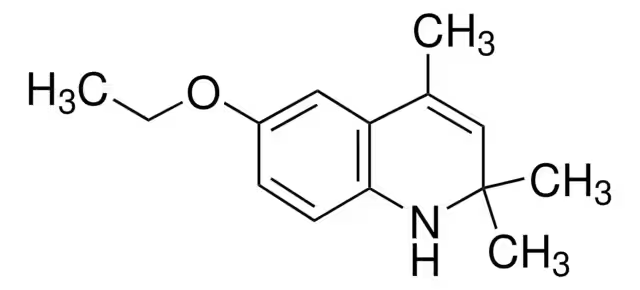
CAS Number91-53-2
Synonyms6-Ethoxy-2,2,4-trimethyl-1,2-dihydroquinoline; EINECS 202-075-7; 6-Ethoxy-1,2-dihydro-2,2,4-trimethylquinoline; emq; quinoled; 1,2-dihydro-2,2,4-trimethylquinolin-6-yl ethyl ether; UNII-9T1410R4OR; 2,2,4-trimethyl-6-ethoxy-1,2-dihydroquinoline; nocracaw; amea100; Santoquin; usafb-24; antageaw; niflex; ETMDQ; 1,2-dihydro-6-ethoxy-2,2,4-trimethylQUINOLINE; Santoflex; niflexd; MFCD00023883; Ethoxyquin
Molecular FormulaC14H19NO
Molecular Weight217.31
Purity98.00%
Density1.0±0.1 g/cm3
Boiling Point333.1±42.0 °C at 760 mmHg
Melting Point<0ºC
AppearanceYellow to red-brown liquid
EINECS202-075-7
Symbol
Signal WordWarning
| Chemical & Physical Properties | |
|---|---|
| CAS Number | 91-53-2 |
| Catalog No. | 2A-9017710 |
| Chinese Name | 乙氧基喹啉 |
| Synonyms | 6-Ethoxy-2,2,4-trimethyl-1,2-dihydroquinoline; EINECS 202-075-7; 6-Ethoxy-1,2-dihydro-2,2,4-trimethylquinoline; emq; quinoled; 1,2-dihydro-2,2,4-trimethylquinolin-6-yl ethyl ether; UNII-9T1410R4OR; 2,2,4-trimethyl-6-ethoxy-1,2-dihydroquinoline; nocracaw; amea100; Santoquin; usafb-24; antageaw; niflex; ETMDQ; 1,2-dihydro-6-ethoxy-2,2,4-trimethylQUINOLINE; Santoflex; niflexd; MFCD00023883; Ethoxyquin |
| Molecular Formula | C14H19NO |
| Molecular Weight | 217.31 |
| Purity | 98.00 |
| Density | 1.0±0.1 g/cm3 |
| Boiling Point | 333.1±42.0 °C at 760 mmHg |
| Melting Point | <0ºC |
| Appearance | Yellow to red-brown liquid |
| Water Solubility | ethanol: 50 mL/L, clear, brown | <0.1 g/100 mL at |
| Storage Condition | Should be sealed and stored in a cool, ventilated |
| Application | Ethoxyquin is an antioxidant that has been used in animal feed for many years and is an inhibitor of heat shock protein 90 (Hsp90). |
| EINECS | 202-075-7 |
| HTC | 2933499090 |
| PubChem ID | 329753793 |
| MDL Number | MFCD00023883 |
| SMILES | CCOc1ccc2NC(C)(C)C=C(C)c2c1 |
| InChI | 1S/C14H19NO/c1-5-16-11-6-7-13-12(8-11)10(2)9-14(3,4)15-13/h6-9,15H,5H2,1-4H3 |
| InChI Key | DECIPOUIJURFOJ-UHFFFAOYSA-N |
| Beilstein/REAXYS | 158223 |
| NACRES Code | NA.24 |
| UNSPSC | 41116107 |
| Hazard Symbols | Transport |
| MSDS | msds/17710_1_91_53_2.pdf |
| Bioactivity | Ethoxyquin is an antioxidant which has been used in animal feed for many years and also an inhibitor of heat shock protein 90 (Hsp90). Related Catalog Research Areas >> Cancer Target HSP90 In Vitro Ethoxyquin (EQ) does not block Paclitaxel's (PTX's) ability to induce cell death in 4 different breast cancer cell lines. Results demonstrate that only when Hsp90 level is down regulated is neuroprotec-tion provided by Ethoxyquin (EQ) no longer seen[2]. It is found that Ethoxyquin provides neuroprotection with a best efficacy range from 30 to 300 nM. It is interesting to note that higher (μM) concentrations of Ethoxyquin do not provide further neuroprotection and in fact at these higher concentrations Ethoxyquin loses its neuroprotective effects[3]. In Vivo Ethoxyquin (EQ) provides a dose-dependent neuroprotection. Although all 3 doses of Ethoxyquin provide partial neuroprotection against reduction in intraepidermal nerve fiber density, the peak efficacy is with the 75 μg/kg dose[2]. Rats treated with Ethoxyquin (EQ) alone or control vehicle treated rats gain weight as expected under normal physiological conditions[3]. Kinase Assay To evaluate the impact of Ethoxyquin (EQ) on Paclitaxel's (PTX's) ability to kill breast cancer cells, conditions for culturing 4 cancer cell lines and measuring the ATP levels are optimized for the 96-well plate format. Briefly, 1,500 cells/well in media are plated in 96-well plates for 24 hours. Constant concentrations of PTX with or without Ethoxyquin are added to the wells for another 24 hours. Cellular ATP levels are measured using kit according tomanufacturer 's protocol[2]. Cell Assay Briefly, DRGs are harvested from embryonic day 14.5 rats according to standard protocols, then cells are plated onto collagen-coated glass coverslips and allowed to extend neurites for 24 hours in media (Neurobasal medium, 50 mM pencillin-streptomycin (PS), 0.2% FBS, 0.5 mM glutamine, 1×B-27 supplement, 0.2% glucose,10 ng/mL glial cell line-derived neurotrophic factor). Ethoxyquin (EQ) or vehicle control is added to the wells for another 24-hour incubation. DRG cells are fixed with 4% paraformaldehyde and stained with anti-βIII-tubulin antibody to delineate the axons. Axon lengths are measured in multiple fields using a random sampling method[2]. Animal Admin To examine the effect of Ethoxyquin (EQ) on Paclitaxel's (PTX's) ability to reduce tumor burden in vivo, a mouse model in which breast cancer cell line SUM-159 (3×10⁶ tumor cells suspended in phosphate-buffered saline in a final volume of 0.15 mL) is injected subcutaneously into adult male nude mice. When the tumor size reaches 5 mm in diameter, the animals are randomly assigned to PTX or PTX with Ethoxyquin groups. Ethoxyquin is given by intraperitoneal administration on a daily basis for 3 weeks. At the end of 3 weeks, animals are euthanized and tumor size and weight are measured (n=5 per group)[2]. References [1]. Sadikot T, et al. Development of a high-throughput screening cancer cell-based luciferase refolding assay for identifying Hsp90 inhibitors. Assay Drug Dev Technol. 2013 Oct;11(8):478-88. [2]. Zhu J, et al. Ethoxyquin prevents chemotherapy-induced neurotoxicity via Hsp90 modulation. Ann Neurol. 2013 Dec;74(6):893-904. [3]. Zhu J, et al. Ethoxyquin provides neuroprotection against cisplatin-induced neurotoxicity. Sci Rep. 2016 Jun 28;6:28861. Chemical & Physical Properties Density 1.0±0.1 g/cm3 Boiling Point 333.1±42.0 °C at 760 mmHg Melting Point <0ºC Molecular Formula C14H19NO Molecular Weight 217.307 Flash Point 137.8±17.3 °C Exact Mass 217.146667 PSA 21.26000 LogP 3.93 Vapour Pressure 0.0±0.7 mmHg at 25°C Index of Refraction 1.512 InChIKey DECIPOUIJURFOJ-UHFFFAOYSA-N SMILES CCOc1ccc2c(c1)C(C)=CC(C)(C)N2 Stability Stable. Combustible. Incompatible with oxidizing agents, strong acids. Polymerizes if heated. May polymerize upon exposure to light and air. Water Solubility ethanol: 50 mL/L, clear, brown | <0.1 g/100 mL at 20 ºC |
| Use of | Ethoxyquin is an antioxidant which has been used in animal feed for many years and also an inhibitor of heat shock protein 90 (Hsp90). Properties Articles27 Name Ethoxyquin Synonym More Synonyms Ethoxyquin Biological Activity Description Ethoxyquin is an antioxidant which has been used in animal feed for many years and also an inhibitor of heat shock protein 90 (Hsp90). Related Catalog Research Areas >> Cancer In Vivo Ethoxyquin (EQ) provides a dose-dependent neuroprotection. Although all 3 doses of Ethoxyquin provide partial neuroprotection against reduction in intraepidermal nerve fiber density, the peak efficacy is with the 75 μg/kg dose[2]. Rats treated with Ethoxyquin (EQ) alone or control vehicle treated rats gain weight as expected under normal physiological conditions[3]. References [1]. Sadikot T, et al. Development of a high-throughput screening cancer cell-based luciferase refolding assay for identifying Hsp90 inhibitors. Assay Drug Dev Technol. 2013 Oct;11(8):478-88. [3]. Zhu J, et al. Ethoxyquin provides neuroprotection against cisplatin-induced neurotoxicity. Sci Rep. 2016 Jun 28;6:28861. Chemical & Physical Properties Molecular Formula C14H19NO Exact Mass 217.146667 PSA 21.26000 Index of Refraction 1.512 InChIKey DECIPOUIJURFOJ-UHFFFAOYSA-N Stability Stable. Combustible. Incompatible with oxidizing agents, strong acids. Polymerizes if heated. May polymerize upon exposure to light and air. |
| Tax Rebate | 13.0% |
| Supervision | None. MFN tariff: 6.5%. Ordinary tariff: 20.0% |
| Transport Info | Product name: Purity: 0.0% |
| MSDS Transport Info | Module 14. Shipping information 14.1 UN number European Land Transport Dangerous Regulations: -International Maritime Dangerous Regulations: -International Air Transport Dangerous Regulations: - 14.2 Names specified by the United Nations (UN) European Land Transport Dangerous Regulations: No dangerous goods IMDG Code: No dangerous goods International Air Transport Dangerous Regulations: No dangerous goods 14.3 Transport hazard categories European Land Transport Dangerous Regulations: -International Maritime Dangerous Regulations: -International Air Transport Dangerous Regulations: - 14.4 Package group European Land Transport Dangerous Regulations: -International Maritime Dangerous Regulations: -International Air Transport Dangerous Regulations: - 14.5 Environmental hazards European Land Transport Dangerous Regulations: No International Maritime Transport Dangerous Regulations Maritime Pollutants: No International Air Transport Risk Regulations: No 14.6 Special precautions for users No data available The company is not responsible for any damage caused by any operation or contact with the above products. For more terms of use, see invoice or package The reverse side of the mounting strip. |
| Related Products in Specialty Chemicals | ||
|---|---|---|
| 2-[[(3-Amino-4-hydroxyphenyl)sulphonyl]amino]benzoic acid | 91-35-0 | 2A-9017703 |
| 4-Chloro-2-nitro-1-phenoxybenzene | 91-39-4 | 2A-9017704 |
| N-Phenylanthranilic acid | 91-40-7 | 2A-9017705 |
| 1-Chloro-2,5-diethoxy-4-nitrobenzene | 91-43-0 | 2A-9017706 |
| N-Butylacetanilide | 91-49-6 | 2A-9017708 |
| 2-Chloronaphthalene | 91-58-7 | 2A-9017714 |
| 2-Aminonaphthalene | 91-59-8 | 2A-9017715 |
| 2-Naphthalenethiol | 91-60-1 | 2A-9017716 |
| Quinaldine | 91-63-4 | 2A-9017718 |
| 3-Diethylaminophenol | 91-68-9 | 2A-9017722 |
| Browse all Specialty Chemicals products » | ||
Phone:
630-322-8886
630-322-8887
Email:
Office Locations:
Chicago, IL, USA
San Francisco, CA, USA


 EN
EN


 SDS
SDS