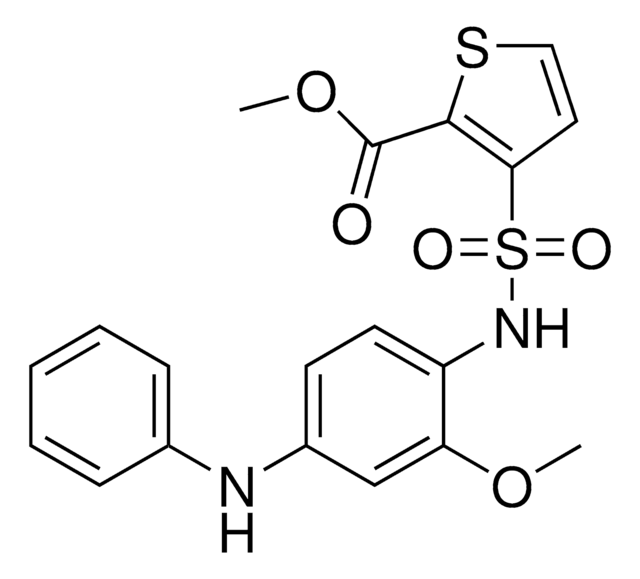
CAS Number1014691-61-2
SynonymsMethyl 3-[(4-anilino-2-methoxyphenyl)sulfamoyl]-2-thiophenecarboxylate; 2-Thiophenecarboxylic acid, 3-[[[2-methoxy-4-(phenylamino)phenyl]amino]sulfonyl]-, methyl ester; gsk0660; Methyl 3-[(4-anilino-2-methoxyphenyl)sulfamoyl]thiophene-2-carboxylate; qcr-147; GSK-0660
Molecular FormulaC19H18N2O5S2
Molecular Weight418.49
Purity≥98 (HPLC)%
Density1.4±0.1 g/cm3
Boiling Point608.1±65.0 °C at 760 mmHg
Appearancepowder
Symbol
Signal WordWarning
| Chemical & Physical Properties | |
|---|---|
| CAS Number | 1014691-61-2 |
| Catalog No. | 2A-1173979 |
| Chinese Name | 3-(N-(2-甲氧基-4-(苯氨基)苯基)氨磺酰基)噻吩-2-羧酸甲酯 |
| Synonyms | Methyl 3-[(4-anilino-2-methoxyphenyl)sulfamoyl]-2-thiophenecarboxylate; 2-Thiophenecarboxylic acid, 3-[[[2-methoxy-4-(phenylamino)phenyl]amino]sulfonyl]-, methyl ester; gsk0660; Methyl 3-[(4-anilino-2-methoxyphenyl)sulfamoyl]thiophene-2-carboxylate; qcr-147; GSK-0660 |
| Molecular Formula | C19H18N2O5S2 |
| Molecular Weight | 418.49 |
| Purity | ≥98 (HPLC) |
| Density | 1.4±0.1 g/cm3 |
| Boiling Point | 608.1±65.0 °C at 760 mmHg |
| Appearance | powder |
| Storage Condition | 2-8°C, protected from light, dry and sealed |
| Application | GSK0660 is a potent PPARβ and PPARδ antagonist with IC50 of 155 nM. |
| PubChem ID | 92098465 |
| MDL Number | MFCD12828770 |
| InChI | InChI=1S/C19H18N2O5S2/c1-25-16-12-14(20-13-6-4-3-5-7-13)8-9-15(16)21-28(23,24)17-10-11-27-18(17)19(22)26-2/h3-12,20-21H,1-2H3 |
| InChI Key | NDFKBGWLUHKMFY-UHFFFAOYSA-N |
| NACRES Code | NA.21 |
| Hazard Symbols | transportation |
| MSDS | msds/174313_1_1014691_61_2.pdf |
| Bioactivity | GSK0660 is a potent antagonist of PPARβ and PPARδ, with IC50s of 155 nM for both isoforms. Related Catalog Research Areas >> Metabolic Disease Target PPARβ/δ:155 nM (IC50) In Vitro GSK0660 is a potent antagonist of PPARβ and PPARδ, with IC50s of both 155 nM, and is nearly inactive on PPARα and PPARγ with IC50s of both >10 μM. GSK0660 antagonizes 100% of the activity of PPARβ/δ with a pIC50 of 6.8. GSK0660 (100 nM) reduces CPT1a (a PPARβ/δ target gene) expression below the basal vehicle-treated level by approximately 50%, but shows no effect on PDK4 expression, which is also a PPARβ/δ target gene in skeletal muscle cells[1]. GSK0660 (0.5 μM) reduces the levels of AMPK and eNOS phosphorylation, and BMP-2, Runx-2 mRNA expression in MC3T3-E1 cells. GSK0660 (0.1 and 0.5 μM) reverses the bezafibrate-induced enchancement of ALP activity on d 7 in MC3T3-E1 cells[2]. GSK0660 (1 μM) markedly blocks GW501516-mediated attenuation of glutamate release, and the effect of GW501516 on ROS generation in BV-2 cells stimulated with LPS. Furthermore, GSK0660 significantly reduces inhibitory effect of GW501516 on the LPS-induced expression of gp91phox mRNA in BV-2 cells[3]. Cell Assay Cell viability is determined by the MTT dye. MC3T3-E1 cells are incubated with bezafibrate (1−1000 μM) for 24, 48, or 72 h, and are pretreated with the AMPK inhibitor compound C (5 μM), PPARβ inhibitor GSK0660 (0.5 μM), PPARα inhibitor MK886 (10 μM), or NOS inhibitor L-NAME (1000 μM) followed by bezafibrate (100 μM) incubation for 48 h. After the incubations, 10 μL of MTT is added to each well of a 96-well microplate, and the microplates are placed in an incubator at 37°C for 4 h. One hundred fifty microliters of DMSO is added to all wells and mixed thoroughly to lyse the cells and dissolve the dark blue crystals. After 10 min, the absorbance is measured at 570 nm using a microplate reader[2]. References [1]. Shearer BG, et al. Identification and characterization of a selective peroxisome proliferator-activated receptor beta/delta (NR1C2) antagonist. Mol Endocrinol. 2008 Feb;22(2):523-9. Epub 2007 Nov 1. [2]. Zhong X, et al. Bezafibrate enhances proliferation and differentiation of osteoblastic MC3T3-E1 cells via AMPK and eNOS activation. Acta Pharmacol Sin. 2011 May;32(5):591-600. [3]. Lee WJ, et al. Activation of PPARδ attenuates neurotoxicity by inhibiting lipopolysaccharide-triggered glutamate release in BV-2 microglial cells. J Cell Biochem. 2018 Feb 1. Chemical & Physical Properties Density 1.4±0.1 g/cm3 Boiling Point 608.1±65.0 °C at 760 mmHg Molecular Formula C19H18N2O5S2 Molecular Weight 418.487 Flash Point 321.5±34.3 °C Exact Mass 418.065704 PSA 130.35000 LogP 2.75 Vapour Pressure 0.0±1.7 mmHg at 25°C Index of Refraction 1.650 |
| Use of | GSK0660 is a potent antagonist of PPARβ and PPARδ, with IC50s of 155 nM for both isoforms. Properties Name methyl 3-[(4-anilino-2-methoxyphenyl)sulfamoyl]thiophene-2-carboxylate Synonym More Synonyms GSK0660 Biological Activity Description GSK0660 is a potent antagonist of PPARβ and PPARδ, with IC50s of 155 nM for both isoforms. Related Catalog Research Areas >> Metabolic Disease PPARβ/δ:155 nM (IC50) References Chemical & Physical Properties Molecular Formula C19H18N2O5S2 Exact Mass 418.065704 PSA 130.35000 Index of Refraction 1.650 |
| Transport Info | Shipping Name: UN |
| MSDS Transport Info | Module 14. Shipping information European Land Transport Dangerous Regulations: -International Maritime Dangerous Regulations: -International Air Transport Dangerous Regulations: - 14.2 United Nations shipping name European Land Transport Dangerous Regulations: Non-dangerous goods IMDG Code: Non-dangerous goods International air transport dangerous goods regulations: non-dangerous goods 14.3 Transport hazard categories European Land Transport Dangerous Regulations: -International Maritime Dangerous Regulations: -International Air Transport Dangerous Regulations: - 14.4 Package group European Land Transport Dangerous Regulations: -International Maritime Dangerous Regulations: -International Air Transport Dangerous Regulations: - 14.5 Environmental hazards European Land Transport Danger Regulations: No International Maritime Danger Regulations International Air Transport Danger Regulations: No Marine pollutants (yes/no): No 14.6 Special reminder to users No data available |
| Related Products in Heterocyclic Building Blocks | ||
|---|---|---|
| 1,3-Dimethyl-6-nitro-1H-indazole | 1354224-47-7 | 2A-1173954 |
| 5-Pyrimidinecarboxaldehyde, 1,2-dihydro-2-oxo- (9CI) | 166757-62-6 | 2A-1173956 |
| 7,8-DiMethylquinoline | 20668-35-3 | 2A-1173958 |
| 1-METHYL-2-PHENYL-1H-PYRROLE | 938-37-4 | 2A-1173969 |
| 2-chloro-7-iodo-5-Methyl-5H-pyrrolo[3,2-d]pyriMidine | 1152475-62-1 | 2A-1173973 |
| (7S)-1′-{[5-(trifluoromethyl)furan-2-yl]methyl}spiro[furo[2,3-f][1,3]benzodioxole-7,3′-indol]-2′(1′H)-one | 1259933-16-8 | 2A-1173981 |
| 2-bromo-5-iodo-4-methylpyridine | 942206-07-7 | 2A-1173987 |
| 2-Hydroxy-5-iodo-3-nitropyridine | 25391-59-7 | 2A-1174000 |
| Pyridine, 2-[(difluoroMethyl)sulfonyl]- | 1219454-89-3 | 2A-1174004 |
| 1-[(trifluoromethyl)thio]-2,5-Pyrrolidinedione | 183267-04-1 | 2A-1174006 |
| Browse all Heterocyclic Building Blocks products » | ||
Phone:
630-322-8886
630-322-8887
Email:
Office Locations:
Chicago, IL, USA
San Francisco, CA, USA


 EN
EN


 SDS
SDS