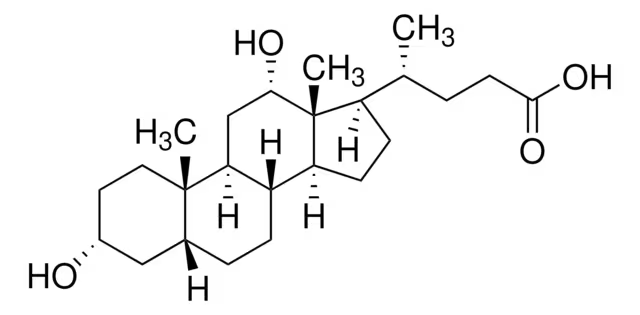
CAS Number83-44-3
Synonyms7-DEOXYCHOLIC ACID; 5b-Deoxycholic acid; Deoxycholatic acid; EINECS 201-478-5; Deoxycholic acid; 17b-(1-Methyl-3-carboxypropyl)etiocholane-3a,12a-diol; deoxy-Cholic acid; (3α,5β,12α)-3,12-Dihydroxycholan-24-oic acid; 7α-Deoxycholic acid; Kybella; 3α,12α-dihydroxy-5β-cholan-24-oic acid; ATX-101; 5b-Cholanic acid-3a,12a-diol; Dihydroxycholanoic acid; (3a,5b,12a)-3,12-Dihydroxy-5-cholan-24-oic Acid; MFCD00003673
Molecular FormulaC24H40O4
Molecular Weight392.57
Purity≥98 (HPLC)%
Density1.1±0.1 g/cm3
Boiling Point547.1±35.0 °C at 760 mmHg
Melting Point171-174 °C (lit.)
Appearancepowder
EINECS201-478-5
Symbol
Signal WordWarning
| Chemical & Physical Properties | |
|---|---|
| CAS Number | 83-44-3 |
| Catalog No. | 2A-9017393 |
| Chinese Name | 去氧胆酸 |
| Synonyms | 7-DEOXYCHOLIC ACID; 5b-Deoxycholic acid; Deoxycholatic acid; EINECS 201-478-5; Deoxycholic acid; 17b-(1-Methyl-3-carboxypropyl)etiocholane-3a,12a-diol; deoxy-Cholic acid; (3α,5β,12α)-3,12-Dihydroxycholan-24-oic acid; 7α-Deoxycholic acid; Kybella; 3α,12α-dihydroxy-5β-cholan-24-oic acid; ATX-101; 5b-Cholanic acid-3a,12a-diol; Dihydroxycholanoic acid; (3a,5b,12a)-3,12-Dihydroxy-5-cholan-24-oic Acid; MFCD00003673 |
| Molecular Formula | C24H40O4 |
| Molecular Weight | 392.57 |
| Purity | ≥98 (HPLC) |
| Density | 1.1±0.1 g/cm3 |
| Boiling Point | 547.1±35.0 °C at 760 mmHg |
| Melting Point | 171-174 °C (lit.) |
| Appearance | powder |
| Water Solubility | 0.24 g/L (15 ºC) |
| Storage Condition | This product should be sealed and stored in a cool |
| Application | Deoxycholic acid activates the G protein-coupled bile acid receptor TGR5. |
| EINECS | 201-478-5 |
| PubChem ID | 24893692 |
| MDL Number | MFCD00003673 |
| SMILES | C[C@H](CCC(O)=O)[C@H]1CC[C@H]2[C@@H]3CC[C@@H]4C[C@H](O)CC[C@]4(C)[C@H]3C[C@H](O)[C@]12C |
| InChI | 1S/C24H40O4/c1-14(4-9-22(27)28)18-7-8-19-17-6-5-15-12-16(25)10-11-23(15,2)20(17)13-21(26)24(18,19)3/h14-21,25-26H,4-13H2,1-3H3,(H,27,28)/t14-,15-,16-,17+,18-,19+,20+,21+,23+,24-/m1/s1 |
| InChI Key | KXGVEGMKQFWNSR-LLQZFEROSA-N |
| Beilstein/REAXYS | 3219882 |
| NACRES Code | NA.25 |
| UNSPSC | 12161900 |
| Hazard Symbols | Transport |
| MSDS | msds/17393_1_83_44_3.pdf |
| Bioactivity | Deoxycholic acid is specifically responsible for activating the G protein-coupled bile acid receptor TGR5 that stimulates brown adipose tissue (BAT) thermogenic activity. Related Catalog Signaling Pathways >> GPCR/G Protein >> GPCR19 Natural Products >> Steroids Research Areas >> Metabolic Disease Target Human Endogenous Metabolite In Vitro Deoxycholic acid (DCA) and chenoDeoxycholic acid (CDCA), as the common ingredients of duodenal reflux, act synergistically in many physiological and pathological processes. The cells are repeatedly exposed to 100 μM CDCA and Deoxycholic acid at pH 5.5 for up to 120 min. To simulate chronic local recurrent disease in vitro, the gastric cancer cell line MGC803 is exposed to acidified medium (pH 5.5) containing 100 μM Deoxycholic acid and CDCA. An untreated log-growth MGC803 cell line is generated to be used as a control in normal pH media. After daily 10 min exposure to the acidified bile acids for 60 weeks, MGC803-resistant cells are able to survive and proliferate after 120 min exposure[2]. Cell Assay MGC803 cells are cultured in Roswell Park Memorial Institute media supplemented with 10% fetal calf serum and 100 U/mL Penicillin and 100 mg/mL Streptomycin. To generate MGC803-resistant cells, the pH value of the MGC803 culture medium is adjusted to the experimental conditions using the hydrochloric acid (A). The bile acids GCDA and Deoxycholic acid are diluted to optimal working concentrations of 100 μM (B) with culture medium, and the overall pH (A+B) is adjusted to pH 5.5, simulating the gastric environment. Initially, MGC803 cells are chronically exposed to acidified medium with bile acids (A+B) for 10 min every 24 h. The experimental time and conditions are optimized in our preliminary experiments, which show that 10 min is enough and does not result in cell damage. This procedure is repeated and it takes 60 weeks for the MGC803 cells to survive and proliferate under the exposure of A+B for 120 min. Control untreated cells are cultured in neutral RPMI medium at pH 7.4 in parallel to the resistant cells for 60 weeks. The morphological changes in MGC803 cells exposed to acidified bile acids (A+B) are documented at 30 and 60 weeks[2]. References [1]. Somm E, et al. β-Klotho deficiency protects against obesity through a crosstalk between liver, microbiota, and brown adipose tissue. JCI Insight. 2017 Apr 20;2(8). pii: 91809. [2]. Wang X, et al. Acidified bile acids enhance tumor progression and telomerase activity of gastric cancer in micedependent on c-Myc expression. Cancer Med. 2017 Apr;6(4):788-797. Chemical & Physical Properties Density 1.1±0.1 g/cm3 Boiling Point 547.1±35.0 °C at 760 mmHg Melting Point 171-174 °C(lit.) Molecular Formula C24H40O4 Molecular Weight 392.572 Flash Point 298.8±22.4 °C Exact Mass 392.292664 PSA 77.76000 LogP 4.66 Vapour Pressure 0.0±3.3 mmHg at 25°C Index of Refraction 1.543 InChIKey KXGVEGMKQFWNSR-LLQZFEROSA-N SMILES CC(CCC(=O)O)C1CCC2C3CCC4CC(O)CCC4(C)C3CC(O)C12C Water Solubility 0.24 g/L (15 ºC) |
| Use of | Deoxycholic acid is specifically responsible for activating the G protein-coupled bile acid receptor TGR5 that stimulates brown adipose tissue (BAT) thermogenic activity. Properties Articles242 Name Deoxycholic Acid Synonym More Synonyms Deoxycholic acid Biological Activity Description Deoxycholic acid is specifically responsible for activating the G protein-coupled bile acid receptor TGR5 that stimulates brown adipose tissue (BAT) thermogenic activity. Related Catalog Signaling Pathways >> GPCR/G Protein >> GPCR19 Natural Products >> Steroids Research Areas >> Metabolic Disease Human Endogenous Metabolite References [1]. Somm E, et al. β-Klotho deficiency protects against obesity through a crosstalk between liver, microbiota, and brown adipose tissue. JCI Insight. 2017 Apr 20;2(8). pii: 91809. [2]. Wang X, et al. Acidified bile acids enhance tumor progression and telomerase activity of gastric cancer in micedependent on c-Myc expression. Cancer Med. 2017 Apr;6(4):788-797. Chemical & Physical Properties Molecular Formula C24H40O4 Exact Mass 392.292664 PSA 77.76000 Index of Refraction 1.543 InChIKey KXGVEGMKQFWNSR-LLQZFEROSA-N |
| Transport Info | Shipping Name: UN |
| MSDS Transport Info | Module 14. Shipping information 14.1 UN dangerous goods number European Land Transport Dangerous Regulations: -International Maritime Dangerous Regulations: -International Air Transport Dangerous Regulations: - 14.2 United Nations shipping name European Land Transport Dangerous Regulations: Non-dangerous goods IMDG Code: Non-dangerous goods International air transport dangerous goods regulations: non-dangerous goods 14.3 Transport hazard categories European Land Transport Dangerous Regulations: -International Maritime Dangerous Regulations: -International Air Transport Dangerous Regulations: - 14.4 Package group European Land Transport Dangerous Regulations: -International Maritime Dangerous Regulations: -International Air Transport Dangerous Regulations: - 14.5 Environmental hazards European Land Transport Danger Regulations: No International Maritime Danger Regulations International Air Transport Danger Regulations: No Marine pollutants (yes/no): No 14.6 Special reminder to users No data available |
| Related Products in Specialty Chemicals | ||
|---|---|---|
| Methyl Green | 82-94-0 | 2A-9017379 |
| Diphenylcarbamyl chloride | 83-01-2 | 2A-9017380 |
| 4-Aminoantipyrine | 83-07-8 | 2A-0202380 |
| 2,4,6-Trihydroxybenzoic acid | 83-30-7 | 2A-9017383 |
| 1,8-Naphthosultone | 83-31-8 | 2A-9017384 |
| 1,4-Dibromonaphthalene | 83-53-4 | 2A-9017397 |
| 5-Amino-1-naphthol | 83-55-6 | 2A-9017398 |
| 1,5-Dihydroxy naphthalene | 83-56-7 | 2A-9017399 |
| 5,7-Diiodo-8-quinolinol | 83-73-8 | 2A-9017403 |
| o-Terphenyl | 84-15-1 | 2A-9017408 |
| Browse all Specialty Chemicals products » | ||
Phone:
630-322-8886
630-322-8887
Email:
Office Locations:
Chicago, IL, USA
San Francisco, CA, USA


 EN
EN


 SDS
SDS