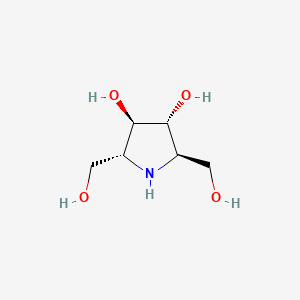
CAS Number59920-31-9
SynonymsEINECS 232-889-8; 2,4-DICHLORO-5,6-DIMETHYL-NICOTINIC ACID ETHYL ESTER 1-OXIDE,WHITE SOLID; Phenol,2,5-dicyclohexyl
Molecular FormulaC6H13NO4
Molecular Weight163.17200
Purity98.00%
Density1.408g/cm3
Boiling Point395.9ºC at 760 mmHg
Melting Point101-103ºC
Appearanceoff-white solid
Symbol
Signal WordWarning
| Chemical & Physical Properties | |
|---|---|
| CAS Number | 59920-31-9 |
| Catalog No. | 2A-1171128 |
| Chinese Name | Α-葡萄糖苷酶 |
| Synonyms | EINECS 232-889-8; 2,4-DICHLORO-5,6-DIMETHYL-NICOTINIC ACID ETHYL ESTER 1-OXIDE,WHITE SOLID; Phenol,2,5-dicyclohexyl |
| Molecular Formula | C6H13NO4 |
| Molecular Weight | 163.17200 |
| Purity | 98.00 |
| Density | 1.408g/cm3 |
| Boiling Point | 395.9ºC at 760 mmHg |
| Melting Point | 101-103ºC |
| Appearance | off-white solid |
| Storage Condition | 2-8℃ |
| Application | α-GLU stands for α-glucosidase. α-Glucose produces α-glucose via targeted terminal, non-reducing (1→4)-ligation of α-D-glucose residues. α-GLU is substrate selective [1]. |
| HTC | 29400090 |
| PubChem ID | 12329 |
| SMILES | OCC1NC(CO)C(O)C1O |
| InChI | InChI=1S/C6H13NO4/c8-1-3-5(10)6(11)4(2-9)7-3/h3-11H,1-2H2/t3-,4-,5-,6-/m1/s1 |
| InChI Key | PFYHYHZGDNWFIF-KVTDHHQDSA-N |
| Hazard Symbols | transportation |
| Bioactivity | α-GLU stands for α-glucosidase. α-GLU hydrolyzes starch and disaccharides via targeting to terminal, non-reducing (1→4)-linked α-D-glucose residues to produce α-glucose. α-GLU is substrate selective[1]. Related Catalog Signaling Pathways >> Others >> Others Research Areas >> Metabolic Disease References [1]. Chiba S. Molecular mechanism in alpha-glucosidase and glucoamylase. Biosci Biotechnol Biochem. 1997 Aug;61(8):1233-9. Chemical & Physical Properties Density 1.408g/cm3 Boiling Point 395.9ºC at 760 mmHg Melting Point 101-103ºC Molecular Formula C6H13NO4 Molecular Weight 163.17200 Flash Point 221.9ºC Exact Mass 163.08400 PSA 92.95000 Index of Refraction 1.559 InChIKey PFYHYHZGDNWFIF-KVTDHHQDSA-N SMILES OCC1NC(CO)C(O)C1O Storage condition 2-8°C |
| Use of | α-GLU stands for α-glucosidase. α-GLU hydrolyzes starch and disaccharides via targeting to terminal, non-reducing (1→4)-linked α-D-glucose residues to produce α-glucose. α-GLU is substrate selective[1]. Properties Name 2,5-dideoxy-2,5-imino-d-mannitol Synonym More Synonyms 2,5-DIDEOXY-2,5-IMINO-D-MANNITOL Biological Activity Description α-GLU stands for α-glucosidase. α-GLU hydrolyzes starch and disaccharides via targeting to terminal, non-reducing (1→4)-linked α-D-glucose residues to produce α-glucose. α-GLU is substrate selective[1]. Related Catalog Signaling Pathways >> Others >> Others Research Areas >> Metabolic Disease References [1]. Chiba S. Molecular mechanism in alpha-glucosidase and glucoamylase. Biosci Biotechnol Biochem. 1997 Aug;61(8):1233-9. Chemical & Physical Properties Molecular Formula C6H13NO4 Exact Mass 163.08400 PSA 92.95000 Index of Refraction 1.559 InChIKey PFYHYHZGDNWFIF-KVTDHHQDSA-N SMILES OCC1NC(CO)C(O)C1O |
| Transport Info | Shipping Name: UN |
| MSDS Transport Info | Module 14. Shipping information 14.1 UN dangerous goods number European Land Transport Dangerous Regulations: -International Maritime Dangerous Regulations: -International Air Transport Dangerous Regulations: - 14.2 United Nations shipping name European Land Transport Dangerous Regulations: Non-dangerous goods IMDG Code: Non-dangerous goods International air transport dangerous goods regulations: non-dangerous goods 14.3 Transport hazard categories European Land Transport Dangerous Regulations: -International Maritime Dangerous Regulations: -International Air Transport Dangerous Regulations: - 14.4 Package group European Land Transport Dangerous Regulations: -International Maritime Dangerous Regulations: -International Air Transport Dangerous Regulations: - 14.5 Environmental hazards European Land Transport Danger Regulations: No International Maritime Danger Regulations International Air Transport Danger Regulations: No Marine pollutants (yes/no): No 14.6 Special reminder to users No data available The above information is believed to be correct, but is not all-inclusive and should be used as a guide only. The information in this document is based on our current knowledge and is Correct safety instructions apply to this product. This information does not represent a warranty as to the properties of this product. See reverse side of invoice or packing slip. |
| Related Products in Specialty Chemicals | ||
|---|---|---|
| H-GLY-OBZL P-TOSYLATE | 114342-15-3 | 2A-1171122 |
| Miriplatin | 141977-79-9 | 2A-1171123 |
| MENADIOLSODIUMPHOSPHATEHEXAHYDRATE | 6700-40-1 | 2A-1171125 |
| 1-(4-NITROPHENYL)-2-NITROPROPENE | 52287-53-3 | 2A-1171114 |
| 1,2,3-BUTANETRIOL | 4435-50-1 | 2A-1171127 |
| E-4031 | 113559-13-0 | 2A-1171129 |
| 6,7-diphenyl-2-sulfanylidene-1H-pteridin-4-one | 14892-97-8 | 2A-1171130 |
| 2,3-DIHYDROXY-1,4-NAPHTHOQUINONE | 605-37-8 | 2A-1171131 |
| Adipic Acid-13C6 | 942037-55-0 | 2A-1171132 |
| ISOTHIOCYANIC ACID 3-BUTEN-1-YL ESTER | 3386-97-8 | 2A-1171134 |
| Browse all Specialty Chemicals products » | ||
Phone:
630-322-8886
630-322-8887
Email:
Office Locations:
Chicago, IL, USA
San Francisco, CA, USA


 EN
EN


 SDS
SDS