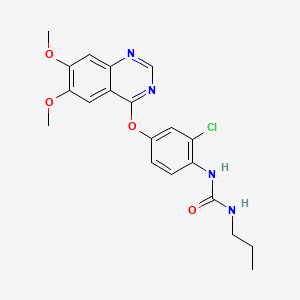
CAS Number286370-15-8
SynonymsN-{2-chloro-4-[(6,7-dimethoxy-4-quinazolinyl)oxy]phenyl}-N'-propylurea; N-(2-chloro-4-((6,7-dimethoxy-4-quinazolinyl)oxy)phenyl)-N'-propylurea; 1-(2-chloro-4-(6,7-dimethoxyquinazolin-4-yloxy)phenyl)-3-propylurea; 1-{2-chloro-4-[(6,7-dimethoxyquinazolin-4-yl)oxy]phenyl}-3-propylurea; KRN633,KRN-633,KRN 633; S1557_Selleck; 1-{2-Chloro-4-[(6,7-dimethoxy-4-quinazolinyl)oxy]phenyl}-3-propylurea; KRN633; KRN 633; KRN-633
Molecular FormulaC20H21ClN4O4
Molecular Weight416.858
Purity98%%
Density1.3±0.1 g/cm3
Boiling Point545.6±50.0 °C at 760 mmHg
Melting Point229 °C
Appearancewhite to beige
Symbol
Signal WordWarning
| Chemical & Physical Properties | |
|---|---|
| CAS Number | 286370-15-8 |
| Catalog No. | 2A-1170957 |
| Chinese Name | N-[2-氯-4-[(6,7-二甲氧基-4-喹唑啉基)氧基]苯基]-N'-丙基脲 |
| Synonyms | N-{2-chloro-4-[(6,7-dimethoxy-4-quinazolinyl)oxy]phenyl}-N'-propylurea; N-(2-chloro-4-((6,7-dimethoxy-4-quinazolinyl)oxy)phenyl)-N'-propylurea; 1-(2-chloro-4-(6,7-dimethoxyquinazolin-4-yloxy)phenyl)-3-propylurea; 1-{2-chloro-4-[(6,7-dimethoxyquinazolin-4-yl)oxy]phenyl}-3-propylurea; KRN633,KRN-633,KRN 633; S1557_Selleck; 1-{2-Chloro-4-[(6,7-dimethoxy-4-quinazolinyl)oxy]phenyl}-3-propylurea; KRN633; KRN 633; KRN-633 |
| Molecular Formula | C20H21ClN4O4 |
| Molecular Weight | 416.858 |
| Purity | 98% |
| Density | 1.3±0.1 g/cm3 |
| Boiling Point | 545.6±50.0 °C at 760 mmHg |
| Melting Point | 229 °C |
| Appearance | white to beige |
| Water Solubility | DMSO: soluble3mg/mL, clear (warmed) |
| Storage Condition | ?20°C |
| Application | KRN-633 is a potent inhibitor of VEGFR, with IC50 values of 170, 160 and 125 nM for VEGFR1, VEGFR2 and VEGFR3 respectively. |
| PubChem ID | 14720360 |
| SMILES | CCCNC(=O)Nc1ccc(Oc2ncnc3cc(OC)c(OC)cc23)cc1Cl |
| InChI | InChI=1S/C20H21ClN4O4/c1-4-7-22-20(26)25-15-6-5-12(8-14(15)21)29-19-13-9-17(27-2)18(28-3)10-16(13)23-11-24-19/h5-6,8-11H,4,7H2,1-3H3,(H2,22,25,26) |
| InChI Key | VPBYZLCHOKSGRX-UHFFFAOYSA-N |
| Hazard Symbols | transportation |
| MSDS | msds/171139_2_286370_15_8.pdf |
| Bioactivity | KRN-633 is a potent VEGFR inhibitor with IC50s of 170, 160 and 125 nM for VEGFR1, VEGFR2 and VEGFR3, respectively. Related Catalog Research Areas >> Cancer Target VEGFR1:170 nM (IC50) VEGFR2:160 nM (IC50) VEGFR3:125 nM (IC50) In Vitro KRN-633 inhibits tyrosine phosphorylation of VEGFR-1, VEGFR2, c-Kit, and PDGFR-β (IC50=11.7, 1.16, 8.01, 130 nM) in human umbilical vein endothelial cells. KRN-633 also inhibits the VEGF-driven proliferation of HUVECs (IC50=14.9 nM). KRN-633 suppresses capillary tube formation of endothelial cells[1]. In Vivo KRN-633 inhibits tumor growth in several tumor xenograft models with diverse tissue origins, including lung, colon, and prostate, in athymic mice and rats. KRN-633 also causes the regression of some well-established tumors and those that have regrown after the cessation of treatment. KRN-633 is well tolerated and has no significant effects on body weight or the general health of the animals. Histologic analysis of tumor xenografts treated with KRN-633 reveals a reduction in the number of endothelial cells in non-necrotic areas and a decrease in vascular permeability[1]. Kinase Assay Cell-free kinase assays are done to obtain IC50 values against a variety of recombinant receptor and non-RTKs. KRN-633 is tested from 0.3 nM to 10 μM. All assays are done in quadruplicate with 1 μM ATP[1]. Cell Assay A549, Ls174T, HT29, DU145, LNCap, and PC-3 cells cancer cells are cultured for 24 hours before adding KRN-633 (0.01 to 10 μM) or vehicle (0.1% DMSO in medium) and then grow for a further 96 hours. Cell viability is measured using WST-1 reagent. The percentage viability is determined relative to the untreated control[1]. Animal Admin Rats: Human tumor xenografts are established in the hind flank of athymic rats (BALB/cA, Jcl-nu). Rats are randomized into groups of five at the point when the tumors reach the average size indicated (162 to 657 mm3) and are then treated with KRN-633 or vehicle, either once (qd) or twice (bid) per day, at the dosages shown. The percentage of tumor growth inhibition compared with the vehicle-treated group is calculated on the day after the last treatment (day 14)[1]. Mice: The mice are randomized into groups of five at the point when the tumors reached the average sizes: 103 to 260 mm3 or 500 to 667 mm3. They are then treated with KRN-633 or vehicle, either once (qd) or twice (bid) per day, at the dosages of 10-100 mg/kg. The percentage of tumor growth inhibition (TGI) compared with the vehicle-treated group is calculated on the day after the last treatment[1]. References [1]. Nakamura K, et al. KRN633: A selective inhibitor of vascular endothelial growth factor receptor-2 tyrosine kinase that suppresses tumor angiogenesis and growth. Mol Cancer Ther. 2004 Dec;3(12):1639-49. Chemical & Physical Properties Density 1.3±0.1 g/cm3 Boiling Point 545.6±50.0 °C at 760 mmHg Melting Point 229 °C Molecular Formula C20H21ClN4O4 Molecular Weight 416.858 Flash Point 283.7±30.1 °C Exact Mass 416.125122 PSA 98.09000 LogP 4.14 Appearance of Characters white to beige Vapour Pressure 0.0±1.5 mmHg at 25°C Index of Refraction 1.629 InChIKey VPBYZLCHOKSGRX-UHFFFAOYSA-N SMILES CCCNC(=O)Nc1ccc(Oc2ncnc3cc(OC)c(OC)cc23)cc1Cl Storage condition ?20°C Water Solubility DMSO: soluble3mg/mL, clear (warmed) |
| Use of | KRN-633 is a potent VEGFR inhibitor with IC50s of 170, 160 and 125 nM for VEGFR1, VEGFR2 and VEGFR3, respectively. Properties Name 1-[2-chloro-4-(6,7-dimethoxyquinazolin-4-yl)oxyphenyl]-3-propylurea Synonym More Synonyms KRN-633 Biological Activity Description KRN-633 is a potent VEGFR inhibitor with IC50s of 170, 160 and 125 nM for VEGFR1, VEGFR2 and VEGFR3, respectively. Related Catalog Research Areas >> Cancer VEGFR1:170 nM (IC50) VEGFR2:160 nM (IC50) VEGFR3:125 nM (IC50) In Vitro KRN-633 inhibits tyrosine phosphorylation of VEGFR-1, VEGFR2, c-Kit, and PDGFR-β (IC50=11.7, 1.16, 8.01, 130 nM) in human umbilical vein endothelial cells. KRN-633 also inhibits the VEGF-driven proliferation of HUVECs (IC50=14.9 nM). KRN-633 suppresses capillary tube formation of endothelial cells[1]. In Vivo KRN-633 inhibits tumor growth in several tumor xenograft models with diverse tissue origins, including lung, colon, and prostate, in athymic mice and rats. KRN-633 also causes the regression of some well-established tumors and those that have regrown after the cessation of treatment. KRN-633 is well tolerated and has no significant effects on body weight or the general health of the animals. Histologic analysis of tumor xenografts treated with KRN-633 reveals a reduction in the number of endothelial cells in non-necrotic areas and a decrease in vascular permeability[1]. Kinase Assay Cell-free kinase assays are done to obtain IC50 values against a variety of recombinant receptor and non-RTKs. KRN-633 is tested from 0.3 nM to 10 μM. All assays are done in quadruplicate with 1 μM ATP[1]. References [1]. Nakamura K, et al. KRN633: A selective inhibitor of vascular endothelial growth factor receptor-2 tyrosine kinase that suppresses tumor angiogenesis and growth. Mol Cancer Ther. 2004 Dec;3(12):1639-49. Chemical & Physical Properties Exact Mass 416.125122 PSA 98.09000 Appearance of Characters white to beige Index of Refraction 1.629 InChIKey VPBYZLCHOKSGRX-UHFFFAOYSA-N |
| Transport Info | Shipping Name: UN |
| MSDS Transport Info | Module 14. Shipping information European Land Transport Dangerous Regulations: -International Maritime Dangerous Regulations: -International Air Transport Dangerous Regulations: - 14.2 United Nations shipping name European Land Transport Dangerous Regulations: Non-dangerous goods IMDG Code: Non-dangerous goods International air transport dangerous goods regulations: non-dangerous goods 14.3 Transport hazard categories European Land Transport Dangerous Regulations: -International Maritime Dangerous Regulations: -International Air Transport Dangerous Regulations: - 14.4 Package group European Land Transport Dangerous Regulations: -International Maritime Dangerous Regulations: -International Air Transport Dangerous Regulations: - 14.5 Environmental hazards European Land Transport Danger Regulations: No International Maritime Danger Regulations International Air Transport Danger Regulations: No Marine pollutants (yes/no): No 14.6 Special reminder to users No data available |
| Related Products in Specialty Chemicals | ||
|---|---|---|
| GSK2656157 | 1337532-29-2 | 2A-1170950 |
| CUDC-101 | 1012054-59-9 | 2A-1170952 |
| Hesperadin | 422513-13-1 | 2A-1170953 |
| REVERSINE | 656820-32-5 | 2A-1170954 |
| AT-13148 | 1056901-62-2 | 2A-1170955 |
| TRV-130 | 1401031-39-7 | 2A-1170958 |
| UNC0379 | 1620401-82-2 | 2A-1170959 |
| T-1095 | 209746-59-8 | 2A-1170960 |
| Temozolomideacid | 113942-30-6 | 2A-1170961 |
| Ganetespib | 888216-25-9 | 2A-1170963 |
| Browse all Specialty Chemicals products » | ||
Phone:
630-322-8886
630-322-8887
Email:
Office Locations:
Chicago, IL, USA
San Francisco, CA, USA


 EN
EN


 SDS
SDS