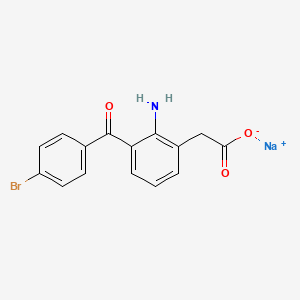
CAS Number91714-93-1
SynonymsBromfenacsodium; BENZENEACETIC ACID, 2-AMINO-3-(4-BROMOBENZOYL)-, MONOSODIUM SALT; BENZENEACETIC ACID,2-AMINO-3-(4-BROMOBENZOYL)-, SODIUM SALT (1:1); bromfenac sodium salt; {2-amino-3-[(4-bromophényl)carbonyl]phényl}acétate de sodium; sodium {2-amino-3-[(4-bromophenyl)carbonyl]phenyl}acetate; Sodium [2-amino-3-(4-bromobenzoyl)phenyl]acetate; Natrium-{2-amino-3-[(4-bromphenyl)carbonyl]phenyl}acetat; Bronuck; Benzeneacetic acid, 2-amino-3-(4-bromobenzoyl)-, sodium salt (1:1); Bromfenac sodium
Molecular FormulaC15H11BrNNaO3
Molecular Weight356.147
Purity98%%
Boiling Point562.2ºC at 760 mmHg
Melting Point285ºC
Appearancefaint yellow to dark yellow
Symbol
Signal WordWarning
| Chemical & Physical Properties | |
|---|---|
| CAS Number | 91714-93-1 |
| Catalog No. | 2A-1170790 |
| Chinese Name | 溴芬酸钠 |
| Synonyms | Bromfenacsodium; BENZENEACETIC ACID, 2-AMINO-3-(4-BROMOBENZOYL)-, MONOSODIUM SALT; BENZENEACETIC ACID,2-AMINO-3-(4-BROMOBENZOYL)-, SODIUM SALT (1:1); bromfenac sodium salt; {2-amino-3-[(4-bromophényl)carbonyl]phényl}acétate de sodium; sodium {2-amino-3-[(4-bromophenyl)carbonyl]phenyl}acetate; Sodium [2-amino-3-(4-bromobenzoyl)phenyl]acetate; Natrium-{2-amino-3-[(4-bromphenyl)carbonyl]phenyl}acetat; Bronuck; Benzeneacetic acid, 2-amino-3-(4-bromobenzoyl)-, sodium salt (1:1); Bromfenac sodium |
| Molecular Formula | C15H11BrNNaO3 |
| Molecular Weight | 356.147 |
| Purity | 98% |
| Boiling Point | 562.2ºC at 760 mmHg |
| Melting Point | 285ºC |
| Appearance | faint yellow to dark yellow |
| Water Solubility | H2O: ≥5mg/mL |
| Storage Condition | 2-8°C |
| Application | Bromfenac sodium is a potent and orally active COX inhibitor with IC50 values for inhibiting COX-1 and COX-2 of 5.56 and 7.45 nM, respectively. Bromfenac sodium is a brominated nonsteroidal anti-inf |
| PubChem ID | 14901127 |
| SMILES | Nc1c(CC(=O)[O-])cccc1C(=O)c1ccc(Br)cc1.[Na+] |
| InChI | InChI=1S/C15H12BrNO3.Na/c16-11-6-4-9(5-7-11)15(20)12-3-1-2-10(14(12)17)8-13(18)19;/h1-7H,8,17H2,(H,18,19);/q;+1/p-1 |
| InChI Key | HZFGMQJYAFHESD-UHFFFAOYSA-M |
| Hazard Symbols | transportation |
| MSDS | msds/170970_2_91714_93_1.pdf |
| Bioactivity | Bromfenac sodium is a potent and orally active inhibitor of COX, with IC50s of 5.56 and 7.45 nM for COX-1 and COX-2, respectively. Bromfenac sodium is a brominated non-steroidal anti-inflammatory/analgesic drug (NSAID), and it is commonly used for the research of postoperative inflammation and pain following cataract surgery, and pseudophakic cystoid macular edema (CME)[1][2]. Related Catalog Research Areas >> Inflammation/Immunology Signaling Pathways >> Immunology/Inflammation >> COX Target COX-1:5.56 nM (IC50) COX-2:7.45 nM (IC50) In Vitro Bromfenac (90 μg/mL; 48 h) inhibits TGF-b1-induced extracellular matrix (ECM) synthesis and myofibroblast activation in HConFs and HPFs[3]. Bromfenac (30-90 μg/mL; 48 h) decreases the protein and mRNA expression levels of FN, COL3, a-SMA, and survivin in a dose-dependent manner in HConFs and HPFs[3]. Bromfenac (30-90 μg/mL; 48 h) declines the phosphorylated protein levels of AKT, ERK1/2, and GSK-3b-S9 with dosage in HPFs and HConFs[3]. In Vivo Bromfenac (0.0032-3.16%; 100 or 200 μL; rubbed onto the backs) produces significant anti-inflammatory activity at concentrations as low as 0.1% (4 h pretreatment time) or 0.32% (18h pretreatment time) in rats[2]. Bromfenac (0.032-3.16%; 100 μL; rubbed onto the paws) produces dose-related anti-inflammatory activity in rats[2]. Bromfenac (0.032-1.0%; 50 μL) is 26 times more potent than indomethacin in blocking the erythema when applied directly onto the skin area exposed to UV light in guinea pigs[2]. Bromfenac (0.0032-0.1%; 50μL; rubbed onto the uninjected paw for 4 h per day and 5 days per week) produces a dose and time dependent reduction in the paw volume of both hind limbs in rats[2]. Bromfenac (0.32%; 50μL; rubbed onto the abdomen) produces significant blockade of abdominal constriction to ACh challenge in mice[2]. Animal Model: Male Sprague-Dawley rats (150-250 g) are injected carrageenan[2] Dosage: 0.0032, 0.01, 0.032, 0.1, 0.32, 1.0, 3.16% (100 or 200 μL) Administration: Rubbed onto the backs before 1-72 h of injected carrageenan Result: Produced significant anti-inflammatory activity when applied 1, 2, and 4 h prior to carrageenan challenge at 0.32%. Applied 1 or 4 h prior to carrageenan challenge was active, but not when applied 24 h (or longer) prior to challenge at 0.2%. References [1]. Schechter BA, et, al. Use of topical bromfenac for treating ocular pain and inflammation beyond cataract surgery: a review of published studies. Clin Ophthalmol. 2019 Aug 1; 13:1439-1460. [2]. Nolan JC, et, al. The topical anti-inflammatory and analgesic properties of bromfenac in rodents. Agents Actions. 1988 Aug; 25(1-2): 77-85. [3]. Chen K, et, al. Bromfenac Inhibits TGF-β1-Induced Fibrotic Effects in Human Pterygium and Conjunctival Fibroblasts. Invest Ophthalmol Vis Sci. 2019 Mar 1; 60(4): 1156-1164. Chemical & Physical Properties Boiling Point 562.2ºC at 760 mmHg Melting Point 285ºC Molecular Formula C15H11BrNNaO3 Molecular Weight 356.147 Flash Point 293.8ºC Exact Mass 354.981995 PSA 83.22000 LogP 2.13590 Appearance of Characters faint yellow to dark yellow Vapour Pressure 1.77E-13mmHg at 25°C InChIKey HZFGMQJYAFHESD-UHFFFAOYSA-M SMILES Nc1c(CC(=O)[O-])cccc1C(=O)c1ccc(Br)cc1.[Na+] Storage condition 2-8°C Water Solubility H2O: ≥5mg/mL |
| Use of | Bromfenac sodium is a potent and orally active inhibitor of COX, with IC50s of 5.56 and 7.45 nM for COX-1 and COX-2, respectively. Bromfenac sodium is a brominated non-steroidal anti-inflammatory/analgesic drug (NSAID), and it is commonly used for the research of postoperative inflammation and pain following cataract surgery, and pseudophakic cystoid macular edema (CME)[1][2]. Properties Articles25 Name bromfenac sodium salt Synonym More Synonyms Bromfenac Sodium Biological Activity Description Bromfenac sodium is a potent and orally active inhibitor of COX, with IC50s of 5.56 and 7.45 nM for COX-1 and COX-2, respectively. Bromfenac sodium is a brominated non-steroidal anti-inflammatory/analgesic drug (NSAID), and it is commonly used for the research of postoperative inflammation and pain following cataract surgery, and pseudophakic cystoid macular edema (CME)[1][2]. Related Catalog Research Areas >> Inflammation/Immunology Signaling Pathways >> Immunology/Inflammation >> COX COX-1:5.56 nM (IC50) COX-2:7.45 nM (IC50) References [1]. Schechter BA, et, al. Use of topical bromfenac for treating ocular pain and inflammation beyond cataract surgery: a review of published studies. Clin Ophthalmol. 2019 Aug 1; 13:1439-1460. [2]. Nolan JC, et, al. The topical anti-inflammatory and analgesic properties of bromfenac in rodents. Agents Actions. 1988 Aug; 25(1-2): 77-85. [3]. Chen K, et, al. Bromfenac Inhibits TGF-β1-Induced Fibrotic Effects in Human Pterygium and Conjunctival Fibroblasts. Invest Ophthalmol Vis Sci. 2019 Mar 1; 60(4): 1156-1164. Chemical & Physical Properties Molecular Formula C15H11BrNNaO3 Exact Mass 354.981995 PSA 83.22000 LogP 2.13590 Appearance of Characters faint yellow to dark yellow InChIKey HZFGMQJYAFHESD-UHFFFAOYSA-M |
| Transport Info | Product name: Purity: 99.0% |
| MSDS Transport Info | Module 14. Shipping information 14.1 UN dangerous goods number European Land Transport Danger Regulations: 3077 International Maritime Transport Danger Regulations: 3077 International Air Transport Danger Regulations: 3077 14.2 Names specified by the United Nations (UN) European land transport hazard regulations: ENVIRONMENTALLY HAZARDOUS SUBSTANCE, SOLID, N.O.S. (2-Amino-3-(4- bromobenzoyl)benzeneacetic acid sodium salt) IMDG: ENVIRONMENTALLY HAZARDOUS SUBSTANCE, SOLID, N.O.S. (2-Amino-3-(4- bromobenzoyl)benzeneacetic acid sodium salt) International Air Transport Hazardous Regulations: Environmentally hazardous substance, solid, n.o.s. (2-Amino-3-(4- bromobenzoyl)benzeneacetic acid sodium salt) 14.3 Transport hazard categories European land transport Dangerous Regulations: 9 International sea transport Dangerous Regulations: 9 International air transport Dangerous Regulations: 9 14.4 Package group European Land Transport Danger Regulations: III International Maritime Transport Danger Regulations: III International Air Transport Danger Regulations: III 14.5 Environmental hazards European Land Transport Dangerous Regulations: Yes International Maritime Transport Dangerous Regulations Maritime Pollutants: Yes International Air Transport Dangerous Regulations: Yes 14.6 Special reminder to users further information Dangerous goods are individually packaged, with liquids exceeding 5 liters or solids exceeding 5 kilograms. The outer packaging of each independent package and the combined independent inner package must have EHS on it. Identification (according to European ADR Regulation 2.2.9.1.10, IMDG Regulation 2.10.3), |
| Related Products in Specialty Chemicals | ||
|---|---|---|
| 1,3-Dichloro-2,4,6-trifluoro-5-iodobenzene | 31612-68-7 | 2A-1170781 |
| Lithium tetrakis(pentafluorophenyl)borate’s etherate | 371162-53-7 | 2A-1170783 |
| 2,2-Difluoroethylamine | 430-67-1 | 2A-1170784 |
| Ethyl 4,4-difluoropentanoate | 659-72-3 | 2A-1170785 |
| Ethyl 2,2-difluorohexanoate | 74106-81-3 | 2A-1170786 |
| 7-Phenylcarbamoylheptanoic acid | 149648-52-2 | 2A-1170791 |
| 1,4-DIPHENYLBUTANE | 1083-56-3 | 2A-1170770 |
| 1,3-DIPHENYLPROPANE | 1081-75-0 | 2A-1170792 |
| Z-VAL-VAL-OH | 19542-54-2 | 2A-1170793 |
| TASP0390325 | 1642187-96-9 | 2A-1170795 |
| Browse all Specialty Chemicals products » | ||
Phone:
630-322-8886
630-322-8887
Email:
Office Locations:
Chicago, IL, USA
San Francisco, CA, USA


 EN
EN


 SDS
SDS