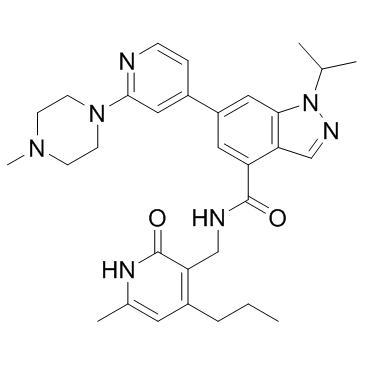
| Chemical & Physical Properties | |
|---|---|
| CAS Number | 1346704-33-3 |
| Catalog No. | 2A-1170724 |
| Chinese Name | 1-异丙基-N-[(6-甲基-2-氧代-4-丙基-1,2-二氢-3-吡啶基)甲基]-6-[2-(4-甲基-1-哌嗪基)-4-吡啶基]-1H-吲唑-4-甲酰胺 |
| Synonyms | 3-methyl-1-(methylethyl)pyrazole-4-carboxylic acid; GSK343; GSK-343 |
| Molecular Formula | C31H39N7O2 |
| Molecular Weight | 541.687 |
| Density | 1.3±0.1 g/cm3 |
| Boiling Point | 797.4±60.0 °C at 760 mmHg |
| Appearance | , white to beige to brown |
| Water Solubility | DMSO: soluble15mg/mL, clear |
| Storage Condition | 2-8°C |
| Application | GSK343 is a highly potent and selective EZH2 inhibitor with an IC50 of 4 nM. |
| SMILES | CCCc1cc(C)[nH]c(=O)c1CNC(=O)c1cc(-c2ccnc(N3CCN(C)CC3)c2)cc2c1cnn2C(C)C |
| InChI Key | ULNXAWLQFZMIHX-UHFFFAOYSA-N |
| MSDS | msds/170902_2_1346704_33_3.pdf |
| Bioactivity | GSK343 is a highly potent and selective EZH2 inhibitor with an IC50 of 4 nM. Related Catalog Signaling Pathways >> Autophagy >> Autophagy Signaling Pathways >> Epigenetics >> Epigenetic Reader Domain Signaling Pathways >> Epigenetics >> Histone Methyltransferase Research Areas >> Cancer Target IC50: 4 nM (EZH2), 240 nM (EZH1)[1] In Vitro GSK343, which contains an n-propyl group at the 4-position of the pyridone, has EZH2 Kiapp=1.2±0.2 nM. In this 6-day proliferation assay, among the cell lines evaluated in this study, the prostate cancer cell line LNCaP is the most sensitive to EZH2 inhibition, with growth IC50 value of 2.9 μM for GSK343[1]. GSK343 is found to have half maximal inhibitory concentration values of 13 μM in HeLa cells and 15 μM in SiHa cells[2]. In Vivo Compare with the controls, GSK343 (5 mg/kg)-treated mice exhibits significantly inhibited tumor growth. The average tumor volume and weight of the GSK343-treated cohort is remarkably reduced. As early as 20 days post-implantation, a significant reduction in tumor growth is observed in the GSK343-treated cohort relative to the control cohort; this difference persisted through the remainder of the study. In addition, compare with the control cohort, the GSK343-treated animals in the xenograft model show a remarkable increase in messenger RNA levels of E-cadherin but a significant decrease in vimentin messenger RNA levels[2]. Kinase Assay Activity against EZH2 is assessed using 5 member PRC2 complex (Flag-EZH2, EED, SUZ12, AEBP2, RbAp48). The assay protocol may be summarized as follows: 10 mM stocks of GSK343 are prepared from solid in 100% DMSO. An 11 point serial dilution master plate is prepared in 384 well format (1:3 dilution, columns 6 and 18 are equal volume DMSO controls) and dispensed to assay ready plates using acoustic dispensing technology to create a 100 nL stamp of GSK343 and DMSO controls. The assay additions consisted of equal volume additions of 10 nM EZH2 and the substrate solution (5 μg/mL HeLa nucleosomes and 0.25 μM [3H]-SAM) dispensed into assay plates using a multi-drop combi dispense. Reaction plates are incubated for 1 hr and quenched with an equal volume addition of 0.5 mg/mL PS-PEI Imaging Beads (RPNQ0098) containing 0.1 mM unlabeled SAM. The plates are sealed, dark adapted for 30 minutes, and a 5 minute endpoint luminescence image is acquired using a Viewlux imager. Plate statistics such as Z' and signal to background as well as dose response curves are analyzed using ActivityBaseXE. The in vitro biochemical activity of EZH1 is assessed as part of a 5 member PRC2 complex using a 384 well SPA assay identical to EZH2. Buffer components, reagent dispensing, GSK343 plate preparation, quench conditions and data analysis are identical for EZH1 and EZH2 with final assay concentrations of 20 nM EZH1, 5 μg/mL HeLa nucleosomes and 0.25 μM [3H]-SAM. Further data analysis, pIC50 pivots and visualizations are enabled by TIBCO Spotfire[1]. Cell Assay To account for varying doubling rates among cancer cell lines, the optimal cell seeding is determined empirically for all cell lines by examining their growth in a 384-well plate over 6 days with a wide range of seeding densities. Cells are then plated at the optimal seeding density and allowed to adhere overnight. Cells are treated in duplicate with a 20-point 2-fold dilution series of GSK343 or 0.147% DMSO (vehicle control) and incubated for 6 days at 37°C in 5% CO2. Cells are then lysed with 25 μL CellTiter-Glo per well and chemiluminescence is quantified with a TECAN Safire2 microplate reader. In addition, an untreated plate of cells is harvested at the time of GSK343 addition (T0) to quantify the starting number of cells. CTG values after 6 days of treatment are expressed as a percent of the T0 value and plotted against GSK343 concentration. Data are fit with a 4-parameter equation to generate a concentration response curve and the concentration of GSK343 required to inhibit 50% of growth (gIC50) is determined[1]. Animal Admin Mice[2] Six-week-old female nude BALB/c mice are used. To study the effect of the EZH2 inhibitor GSK343, 5 mg/kg in 100-μL phosphate-buffered saline is injected intraperitoneally every other day into BALB/c nude mice (n=6) after the tumor volume reaches 100 mm3. In this analysis, the negative control group (n=6) received saline. After 40 days, the mice are killed, and the subcutaneous tumors are surgically excised, weighed, photographed, sectioned, and fixed in 10% formalin. The expression levels of E-cadherin, N-cadherin, and vimentin in the tumours are measured by real-time reverse transcription polymerase chain reaction. References [1]. Sharad K, et al. Identification of Potent, Selective, Cell-Active Inhibitors of the Histone Lysine Methyltransferase EZH2. ACS Med Chem Lett. 2012 Oct 19;3(12):1091-6. [2]. Ding M, et al. The polycomb group protein enhancer of zeste 2 is a novel therapeutic target for cervical cancer. Clin Exp Pharmacol Physiol. 2015 May;42(5):458-64. Chemical & Physical Properties Density 1.3±0.1 g/cm3 Boiling Point 797.4±60.0 °C at 760 mmHg Molecular Formula C31H39N7O2 Molecular Weight 541.687 Flash Point 436.0±32.9 °C Exact Mass 541.316528 PSA 99.41000 LogP 3.22 Appearance of Characters , white to beige to brown Vapour Pressure 0.0±2.8 mmHg at 25°C Index of Refraction 1.654 InChIKey ULNXAWLQFZMIHX-UHFFFAOYSA-N SMILES CCCc1cc(C)[nH]c(=O)c1CNC(=O)c1cc(-c2ccnc(N3CCN(C)CC3)c2)cc2c1cnn2C(C)C Storage condition 2-8°C Water Solubility DMSO: soluble15mg/mL, clear |
| Use of | GSK343 is a highly potent and selective EZH2 inhibitor with an IC50 of 4 nM. Properties Name N-((2-hydroxy-6-methyl-4-propylpyridin-3-yl)methyl)-1-isopropyl-6-(2-(4-methylpiperazin-1-yl)pyridin-4-yl)-1H-indazole-4-carboxamide Synonym More Synonyms GSK343 Biological Activity Description GSK343 is a highly potent and selective EZH2 inhibitor with an IC50 of 4 nM. Related Catalog Signaling Pathways >> Autophagy >> Autophagy Signaling Pathways >> Epigenetics >> Epigenetic Reader Domain Signaling Pathways >> Epigenetics >> Histone Methyltransferase Research Areas >> Cancer IC50: 4 nM (EZH2), 240 nM (EZH1)[1] References [1]. Sharad K, et al. Identification of Potent, Selective, Cell-Active Inhibitors of the Histone Lysine Methyltransferase EZH2. ACS Med Chem Lett. 2012 Oct 19;3(12):1091-6. [2]. Ding M, et al. The polycomb group protein enhancer of zeste 2 is a novel therapeutic target for cervical cancer. Clin Exp Pharmacol Physiol. 2015 May;42(5):458-64. Chemical & Physical Properties Molecular Formula C31H39N7O2 Exact Mass 541.316528 PSA 99.41000 Appearance of Characters , white to beige to brown Index of Refraction 1.654 InChIKey ULNXAWLQFZMIHX-UHFFFAOYSA-N |
| Transport Info | Product name: GSK343 |
| Related Products in Specialty Chemicals | ||
|---|---|---|
| P-TERPHENYL-D14 | 1718-51-0 | 2A-1170719 |
| JQ-1 acid | 202592-23-2 | 2A-1170720 |
| OTX015 | 202590-98-5 | 2A-1170721 |
| GNE317 | 1394076-92-6 | 2A-1170722 |
| UNC 1999 | 1431612-23-5 | 2A-1170723 |
| I-BET 151 | 1300031-49-5 | 2A-1170725 |
| ARV 825 | 1818885-28-7 | 2A-1170726 |
| d-BET 1 | 1799711-21-9 | 2A-1170727 |
| RO0921 | 1446790-62-0 | 2A-1170728 |
| Tinostamustine EDO-SI01 | 1793059-58-1 | 2A-1170729 |
| Browse all Specialty Chemicals products » | ||
Phone:
630-322-8886
630-322-8887
Email:
Office Locations:
Chicago, IL, USA
San Francisco, CA, USA


 EN
EN


 SDS
SDS