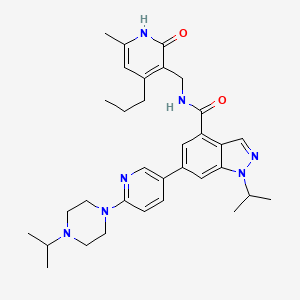
| Chemical & Physical Properties | |
|---|---|
| CAS Number | 1431612-23-5 |
| Catalog No. | 2A-1170723 |
| Chinese Name | N-[(1,2-二氢-6-甲基-2-氧代-4-丙基-3-吡啶基)甲基]-1-(1-甲基乙基)-6-[6-[4-(1-甲基乙基)-1-哌嗪基]-3-吡啶基]-1H-吲唑-4-甲酰胺 |
| Synonyms | s7165; unc1999 |
| Molecular Formula | C33H43N7O2 |
| Molecular Weight | 569.740 |
| Density | 1.2±0.1 g/cm3 |
| Boiling Point | 804.7±65.0 °C at 760 mmHg |
| Appearance | white to beige |
| Water Solubility | DMSO: soluble15mg/mL, clear |
| Storage Condition | 2-8°C |
| Application | UNC1999 is a potent, selective and SAM-competitive inhibitor of EZH2 and EZH1 with IC50 of 10 nM and 45 nM, respectively. |
| PubChem ID | 85738197 |
| SMILES | CCCc1cc(C)[nH]c(=O)c1CNC(=O)c1cc(-c2ccc(N3CCN(C(C)C)CC3)nc2)cc2c1cnn2C(C)C |
| InChI | InChI=1S/C33H43N7O2/c1-7-8-24-15-23(6)37-33(42)28(24)19-35-32(41)27-16-26(17-30-29(27)20-36-40(30)22(4)5)25-9-10-31(34-18-25)39-13-11-38(12-14-39)21(2)3/h9-10,15-18,20-22H,7-8,11-14,19H2,1-6H3,(H,35,41)(H,37,42) |
| InChI Key | DPJNKUOXBZSZAI-UHFFFAOYSA-N |
| MSDS | msds/170901_2_1431612_23_5.pdf |
| Bioactivity | UNC1999 is a SAM-competitive, potent and selective inhibitor of EZH1/2 with IC50s of 10 nM and 45 nM, repectively. Related Catalog Signaling Pathways >> Autophagy >> Autophagy Signaling Pathways >> Epigenetics >> Epigenetic Reader Domain Signaling Pathways >> Epigenetics >> Histone Methyltransferase Research Areas >> Cancer Target IC50: <10 nM (EZH2), 45 nM (EZH1)[1] In Vitro UNC1999, the first orally bioavailable inhibitor that has high in vitro potency for wild-type and mutant EZH2 as well as EZH1, a closely related H3K27 methyltransferase that shares 96% sequence identity with EZH2 in their respective catalytic domains. UNC1999 is highly selective for EZH2 and EZH1 over a broad range of epigenetic and non-epigenetic targets, competitive with the cofactor SAM, and non-competitive with the peptide substrate. UNC1999 has Ki values of 4,700 nM, 65 nM, 300 nM, and 1,500 nM for sigma1, sigma2, histamine H3, and NET (norepinephrine transporter), respectively. NC1999 selectively kills DB cells, a DLBCL cell line with the EZH2 Y641N mutation. UNC1999 displays a concentration- and time-dependent inhibition of DB cell proliferation (EC50=633±101 nM (n=3))[1]. In Vivo A single intraperitoneal (IP) injection of UNC1999 at 15, 50, or 150 mg/kg achieved high Cmax (9,700-11,800 nM) and exhibited dose linearity in male Swiss albino mice. Both the 150 and 50 mg/kg IP doses resulted in the plasma concentrations of UNC1999 above its cellular IC50 over the entire 24 h period while the 15 mg/kg IP dose led to the plasma concentrations of UNC1999 above its cellular IC50 for approximately 12 h. We next examined whether UNC1999 is orally bioavailable and are pleased to find that a single 50 mg/kg oral dose of UNC1999 achieved high Cmax (4,700 nM) and good exposure levels in male Swiss albino mice. The plasma concentrations of UNC1999 are maintained above its cellular IC50 for approximately 20 h following this single oral dose. It is worth noting that all doses including the 150 mg/kg IP dose are well tolerated by all test mice, and no adverse effects are observed[1]. Kinase Assay EZH2 Y641N mutant is generated and assayed by BPS Bioscience. A series of dilutions of UNC1999 are prepared with 10% DMSO in HMT assay buffer and 5 μL of the dilution is added to a 50 μL reaction so that the final concentration of DMSO is 1% in all of reactions. All of the enzymatic reactions are conducted in duplicate at room temperature for 60 minutes (EZH2) and 180 minutes (EZH2 Y641N) in a 50 μL mixture containing HMT assay buffer, S-adenoslymethionine, enzyme, and UNC1999. These 50 μL reactions are carried out in wells of a HMT substrate pre-coated plate. After enzymatic reactions, the reaction mixtures are discarded and each of the wells is washed three times with TBST buffer, and slowly shaken with Blocking Buffer for 10 minutes. Wells are emptied, and 100 μL of diluted 1°antibody is added. The plate is then slowly shaken for 60 minutes at room temperature. As before, the plate is emptied and washed three times, and shaken with Blocking Buffer for 10 minutes at room temperature. After discarding the Blocking Buffer, 100 μL of diluted 2°antibody is added. The plate is then slowly shaken for 30 minutes at room temperature. As before, the plate is emptied and washed three times, and shaken with Blocking Buffer for 10 minutes at room temperature. Blocking Buffer is discarded and a mixture of the HRP chemiluminescent substrates is freshly prepared. 100 μL of this mixture is added to each empty well. Immediately, the luminescence of the samples is measured in a BioTek SynergyTM 2 microplate reader[1]. Cell Assay DB cells, a diffuse-large B-cell lymphoma cell line harboring the EZH2 Y641N mutation, are obtained from ATCC and cultured in RPMI 1640 supplemented with 10% fetal bovine serum, antibiotics, and various concentration of UNC1999 (0.1, 0.2, 0.3, 0.4, 0.5, 1, 2, 3, and 5 μM) or UNC2400 and DMSO control. The medium containing the test compound or control is refreshed every three days. The numbers of viable cells from at least three independent experiments are measured using TC20 automated cell counter system. Total histones are prepared from cell nuclei using an acidic extraction protocol. About 1 microgram of total histones is separated using 15% of SDS-PAGE, transferred to PVDF membranes, and probed with histone antibodies. Antibodies used in this study are those against EZH2, general H3, and H3K27me3[1]. Animal Admin Mice[1] Standard PK studies are conducted using male Swiss albino mice at Sai Life Sciences. Four doses (15, 50, and 150 mg/kg IP, and 50 mg/kg PO) of UNC1999 are evaluated. Each study lasted 24 h. Plasma concentrations of UNC1999 reported at each of the eight time points (0.08, 0.25, 0.5, 1, 2, 4, 8, and 24 h post dosing) are the average values from 3 test animals. References [1]. Konze KD, et al. An Orally Bioavailable Chemical Probe of the Lysine Methyltransferases EZH2 and EZH1. ACS Chem Biol. 2013;8(6):1324-34. Chemical & Physical Properties Density 1.2±0.1 g/cm3 Boiling Point 804.7±65.0 °C at 760 mmHg Molecular Formula C33H43N7O2 Molecular Weight 569.740 Flash Point 440.4±34.3 °C Exact Mass 569.347839 PSA 99.41000 LogP 4.17 Appearance of Characters white to beige Vapour Pressure 0.0±2.9 mmHg at 25°C Index of Refraction 1.643 InChIKey DPJNKUOXBZSZAI-UHFFFAOYSA-N SMILES CCCc1cc(C)[nH]c(=O)c1CNC(=O)c1cc(-c2ccc(N3CCN(C(C)C)CC3)nc2)cc2c1cnn2C(C)C Storage condition 2-8°C Water Solubility DMSO: soluble15mg/mL, clear |
| Use of | Properties Name N-[(6-methyl-2-oxo-4-propyl-1H-pyridin-3-yl)methyl]-1-propan-2-yl-6-[6-(4-propan-2-ylpiperazin-1-yl)pyridin-3-yl]indazole-4-carboxamide Synonym More Synonyms UNC1999 Biological Activity Related Catalog Signaling Pathways >> Autophagy >> Autophagy Signaling Pathways >> Epigenetics >> Epigenetic Reader Domain Signaling Pathways >> Epigenetics >> Histone Methyltransferase Research Areas >> Cancer IC50: <10 nM (EZH2), 45 nM (EZH1)[1] References [1]. Konze KD, et al. An Orally Bioavailable Chemical Probe of the Lysine Methyltransferases EZH2 and EZH1. ACS Chem Biol. 2013;8(6):1324-34. Chemical & Physical Properties Molecular Formula C33H43N7O2 Exact Mass 569.347839 PSA 99.41000 Appearance of Characters white to beige Index of Refraction 1.643 InChIKey DPJNKUOXBZSZAI-UHFFFAOYSA-N |
| Transport Info | Product name: UNC1999 |
| Related Products in Specialty Chemicals | ||
|---|---|---|
| POLYQUATERNIUM-1 | 68518-54-7 | 2A-1170714 |
| P-TERPHENYL-D14 | 1718-51-0 | 2A-1170719 |
| JQ-1 acid | 202592-23-2 | 2A-1170720 |
| OTX015 | 202590-98-5 | 2A-1170721 |
| GNE317 | 1394076-92-6 | 2A-1170722 |
| GSK 34 | 1346704-33-3 | 2A-1170724 |
| I-BET 151 | 1300031-49-5 | 2A-1170725 |
| ARV 825 | 1818885-28-7 | 2A-1170726 |
| d-BET 1 | 1799711-21-9 | 2A-1170727 |
| RO0921 | 1446790-62-0 | 2A-1170728 |
| Browse all Specialty Chemicals products » | ||
Phone:
630-322-8886
630-322-8887
Email:
Office Locations:
Chicago, IL, USA
San Francisco, CA, USA


 EN
EN


 SDS
SDS