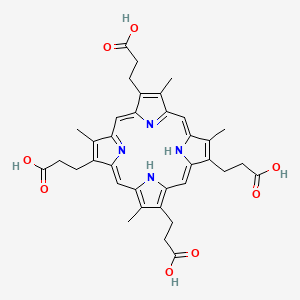
CAS Number14643-66-4
Synonyms3,3',3'',3'''-(3,8,13,17-tetramethyl-porphyrin-2,7,12,18-tetrayl)-tetra-propionic acid; COPROPORPHYRIN III DIHYDROCHLORIDE; 3,3',3'',3'''-(3,8,13,17-Tetramethyl-porphyrin-2,7,12,18-tetrayl)-tetra-propionsaeure; 3,3',3'',3'''-(3,8,13,17-tetramethyl-21H,23H-porphine-2,7,12,18-tetrayl)-tetrakis-propionic acid; CoproporphyrinIII Dihyrochloride; 2,7,12,18-Tetramethyl-21H,23H-porphyrin-3,8,13,17-tetrapropionic acid; coproporphyrin; Coproporphyrin III; Coproporphyrin dihydrochloride; coproporphyriniii2HCl; 3,8,13,17-tetramethylporphyrin-2,7,12,18-tetrapropanoic acid; 3,8,13,17-TETRAMETHYL-21H,23H-PORPHINE-2,7,12,18-TETRAPROPIONIC ACID DIHYDROCHLORIDE; Koproporphyrin III
Molecular FormulaC36H38N4O8
Molecular Weight654.71
Purity98.00%
Density1.366 g/cm3
Boiling Point1258ºC at 760 mmHg
Appearancepurple crystal
| Chemical & Physical Properties | |
|---|---|
| CAS Number | 14643-66-4 |
| Catalog No. | 2A-1170701 |
| Chinese Name | 粪卟啉III二盐酸盐 |
| Synonyms | 3,3',3'',3'''-(3,8,13,17-tetramethyl-porphyrin-2,7,12,18-tetrayl)-tetra-propionic acid; COPROPORPHYRIN III DIHYDROCHLORIDE; 3,3',3'',3'''-(3,8,13,17-Tetramethyl-porphyrin-2,7,12,18-tetrayl)-tetra-propionsaeure; 3,3',3'',3'''-(3,8,13,17-tetramethyl-21H,23H-porphine-2,7,12,18-tetrayl)-tetrakis-propionic acid; CoproporphyrinIII Dihyrochloride; 2,7,12,18-Tetramethyl-21H,23H-porphyrin-3,8,13,17-tetrapropionic acid; coproporphyrin; Coproporphyrin III; Coproporphyrin dihydrochloride; coproporphyriniii2HCl; 3,8,13,17-tetramethylporphyrin-2,7,12,18-tetrapropanoic acid; 3,8,13,17-TETRAMETHYL-21H,23H-PORPHINE-2,7,12,18-TETRAPROPIONIC ACID DIHYDROCHLORIDE; Koproporphyrin III |
| Molecular Formula | C36H38N4O8 |
| Molecular Weight | 654.71 |
| Purity | 98.00 |
| Density | 1.366 g/cm3 |
| Boiling Point | 1258ºC at 760 mmHg |
| Appearance | purple crystal |
| Storage Condition | 2-8℃ |
| Application | Coproporphyrin III is a porphyrin derivative. |
| PubChem ID | 8065 |
| SMILES | CC1=C(CCC(=O)O)c2cc3nc(cc4[nH]c(cc5[nH]c(cc1n2)c(C)c5CCC(=O)O)c(CCC(=O)O)c4C)C(CCC(=O)O)=C3C |
| InChI | InChI=1S/C36H38N4O8.2ClH/c1-17-21(5-9-33(41)42)29-14-27-19(3)22(6-10-34(43)44)30(39-27)15-28-20(4)24(8-12-36(47)48)32(40-28)16-31-23(7-11-35(45)46)18(2)26(38-31)13-25(17)37-29;;/h13-16,38,40H,5-12H2,1-4H3,(H,41,42)(H,43,44)(H,45,46)(H,47,48);2*1H |
| InChI Key | XNBNKCLBGTWWSD-UHFFFAOYSA-N |
| Bioactivity | Coproporphyrin III is a porphyrin derivative. Related Catalog Research Areas >> Others Natural Products >> Others Target Human Endogenous Metabolite In Vitro Coproporphyrin III methyl ester is repeatedly isolated in considerable amount from both feces and urine. A great increase of coproporphyrin III excretion is unaccompanied by symptoms or signs of porphyria, metal or chemical poisoning or liver disease[1]. Primary cultures of chick embryo hepatocytes have been used to study the mechanism by which chemicals cause accumulation of intermediates of the heme synthetic pathway. In the presence of the porphyrin precursor, 5-aminolevulinate (ALA), addition of insulin causes a striking increase in accumulation of uroporphyrin I and coproporphyrin III. Antioxidants abolishes the uroporphyrin I accumulation and increases coproporphyrin III[2]. In Vivo Urinary DMA and porphyrin profile can be used as an early warning biomarker for chronic MMA exposure before the onset of cancer. After 4 weeks the level of coproporphyrin III concentration significantly increases in all the treatment groups compared to the control[3]. References [1]. Watson CJ, et al. Studies of coproporphyrin. iii. idiopathic coproporphyrinuria; a hitherto unrecognized form characterized by lack of symptoms in spite of the excretion of large amounts of coproporphyrin. J Clin Invest. 1949 May;28(3):465-8. [2]. Trask HW, et al. Effect of insulin and glucagon on accumulation of uroporphyrin and coproporphyrin from 5-aminolevulinate in hepatocyte cultures. Arch Biochem Biophys. 2005 Jul 1;439(1):1-11. [3]. Krishnamohan M, et al. Urinary arsenic and porphyrin profile in C57BL/6J mice chronically exposed to monomethylarsonous acid (MMAIII) for two years. Toxicol Appl Pharmacol. 2007 Oct 1;224(1):89-97. Chemical & Physical Properties Density 1.366 g/cm3 Boiling Point 1258ºC at 760 mmHg Molecular Formula C36H38N4O8 Molecular Weight 654.71 Flash Point 714.6ºC PSA 205.50000 LogP 4.69760 Vapour Pressure 0mmHg at 25°C Index of Refraction 1.638 InChIKey XNBNKCLBGTWWSD-UHFFFAOYSA-N SMILES CC1=C(CCC(=O)O)c2cc3nc(cc4[nH]c(cc5[nH]c(cc1n2)c(C)c5CCC(=O)O)c(CCC(=O)O)c4C)C(CCC(=O)O)=C3C Storage condition 2-8℃ |
| Use of | Coproporphyrin III is a porphyrin derivative. Properties Name coproporphyrin III Synonym More Synonyms Coproporphyrin III Biological Activity Description Coproporphyrin III is a porphyrin derivative. Related Catalog Research Areas >> Others Natural Products >> Others Human Endogenous Metabolite In Vitro Coproporphyrin III methyl ester is repeatedly isolated in considerable amount from both feces and urine. A great increase of coproporphyrin III excretion is unaccompanied by symptoms or signs of porphyria, metal or chemical poisoning or liver disease[1]. Primary cultures of chick embryo hepatocytes have been used to study the mechanism by which chemicals cause accumulation of intermediates of the heme synthetic pathway. In the presence of the porphyrin precursor, 5-aminolevulinate (ALA), addition of insulin causes a striking increase in accumulation of uroporphyrin I and coproporphyrin III. Antioxidants abolishes the uroporphyrin I accumulation and increases coproporphyrin III[2]. In Vivo Urinary DMA and porphyrin profile can be used as an early warning biomarker for chronic MMA exposure before the onset of cancer. After 4 weeks the level of coproporphyrin III concentration significantly increases in all the treatment groups compared to the control[3]. References [1]. Watson CJ, et al. Studies of coproporphyrin. iii. idiopathic coproporphyrinuria; a hitherto unrecognized form characterized by lack of symptoms in spite of the excretion of large amounts of coproporphyrin. J Clin Invest. 1949 May;28(3):465-8. [2]. Trask HW, et al. Effect of insulin and glucagon on accumulation of uroporphyrin and coproporphyrin from 5-aminolevulinate in hepatocyte cultures. Arch Biochem Biophys. 2005 Jul 1;439(1):1-11. [3]. Krishnamohan M, et al. Urinary arsenic and porphyrin profile in C57BL/6J mice chronically exposed to monomethylarsonous acid (MMAIII) for two years. Toxicol Appl Pharmacol. 2007 Oct 1;224(1):89-97. Chemical & Physical Properties Molecular Formula C36H38N4O8 PSA 205.50000 LogP 4.69760 Index of Refraction 1.638 InChIKey XNBNKCLBGTWWSD-UHFFFAOYSA-N Storage condition 2-8℃ |
| Transport Info | Product Name: Coproporphyrin III |
| Related Products in Specialty Chemicals | ||
|---|---|---|
| S-Allyl-D-cysteine | 770742-93-3 | 2A-1170697 |
| IRON PEPTONATE | 91079-40-2 | 2A-1170698 |
| Polyhexamethylene guanidine | 31961-54-3 | 2A-1170698 |
| ATV-FX1 sodium salt | 1315629-79-8 | 2A-1170699 |
| Ribonuclease (rana pipiens) | 196488-72-9 | 2A-1170700 |
| COPROPORPHYRIN I DIHYDROCHLORIDE | 69477-27-6 | 2A-1170702 |
| Dimethanesulfonyl peroroxyde | 1001-62-3 | 2A-1170703 |
| NSC19005 | 5452-87-9 | 2A-1170704 |
| Selonsertib | 1448428-04-3 | 2A-1170704 |
| Benzene, 4-chloro-2-fluoro-1-isocyano- (9CI) | 602262-00-0 | 2A-1170706 |
| Browse all Specialty Chemicals products » | ||
Phone:
630-322-8886
630-322-8887
Email:
Office Locations:
Chicago, IL, USA
San Francisco, CA, USA


 EN
EN


 SDS
SDS