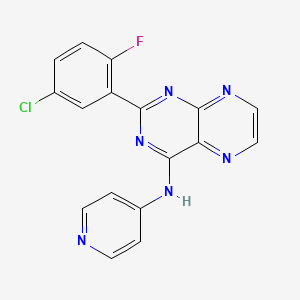
CAS Number627536-09-8
Synonyms2-(5-chloro-2-fluorophenyl)-N-(pyridin-4-yl)pteridin-4-amine; 2-(5-Chloro-2-fluorophenyl)-N-(4-pyridinyl)-4-pteridinamine; SD-208; SD208
Molecular FormulaC17H10ClFN6
Molecular Weight352.753
Density1.5±0.1 g/cm3
Boiling Point460.4±45.0 °C at 760 mmHg
Appearanceoff-white to tan
Symbol
Signal WordWarning
| Chemical & Physical Properties | |
|---|---|
| CAS Number | 627536-09-8 |
| Catalog No. | 2A-1170254 |
| Chinese Name | 2-(5-氯-2-氟苯基)-N-4-吡啶基-4-蝶啶胺 |
| Synonyms | 2-(5-chloro-2-fluorophenyl)-N-(pyridin-4-yl)pteridin-4-amine; 2-(5-Chloro-2-fluorophenyl)-N-(4-pyridinyl)-4-pteridinamine; SD-208; SD208 |
| Molecular Formula | C17H10ClFN6 |
| Molecular Weight | 352.753 |
| Density | 1.5±0.1 g/cm3 |
| Boiling Point | 460.4±45.0 °C at 760 mmHg |
| Appearance | off-white to tan |
| Water Solubility | DMSO: >5mg/mL |
| Storage Condition | 2-8°C |
| Application | SD-208 is a selective inhibitor of TGF-βRI (ALK5) with an IC50 value of 48 nM and is more than 100-fold selective for TGF-βRII. |
| PubChem ID | 15325148 |
| SMILES | Fc1ccc(Cl)cc1-c1nc(Nc2ccncc2)c2nccnc2n1 |
| InChI | InChI=1S/C17H10ClFN6/c18-10-1-2-13(19)12(9-10)15-24-16-14(21-7-8-22-16)17(25-15)23-11-3-5-20-6-4-11/h1-9H,(H,20,22,23,24,25) |
| InChI Key | BERLXWPRSBJFHO-UHFFFAOYSA-N |
| Hazard Symbols | transportation |
| MSDS | msds/170399_2_627536_09_8.pdf |
| Bioactivity | SD-208 is a selective TGF-βRI (ALK5) inhibitor with IC50 of 48 nM, and > 100-fold selectivity over TGF-βRII. Related Catalog Signaling Pathways >> TGF-beta/Smad >> TGF-β Receptor Research Areas >> Cancer Target IC50: 48 nM (TGF-βRI) In Vitro SD-208 inhibits the cell growth and constitutive and TGF-beta-evoked migration and invasion, and enhances immunogenicity in murine SMA-560 and human LN-308 glioma cells[1]. SD-208 blocks TGF-beta-induced phosphorylation of the receptor-associated Smads, Smad2 and Smad3, and stimulates epithelial-to-mesenchymal transdifferentiation, migration, and invasiveness into Matrigel in vitro[2]. SD-208 also abolishes the promoting effect of TGF-β on neointimal smooth muscle-like cell (SMLC) proliferation and migration in vitro[3]. In Vivo SD-208 (1 mg/mL, p.o.) significantly prolongs the median survival of SMA-560 glioma-bearing mice[1]. In syngeneic 129S1 mice, SD-208 (60 mg/kg/d, p.o.) inhibits primary R3T tumor growth, and reduces the number and the size of lung metastases[2]. In the murine aortic allograft model, SD-208 effectively reduces the formation of intimal hyperplasia of transplant arteriosclerosis (TA)[3]. Kinase Assay Various kinase activities are assayed by measuring the incorporation of radiolabeled ATP into a peptide or protein substrate. The reactions are performed in 96-well plates and included the relevant kinase, substrate, ATP, and appropriate cofactors. The reactions are incubated and then stopped by the addition of phosphoric acid. Substrate is captured onto a phosphocellulose filter, which is washed free of unreacted ATP. The counts incorporated are determined by counting on a microplate scintillation counter. The ability of SD-208 to inhibit the respective kinase is determined by comparing counts incorporated in the presence of compound with those incorporated in the absence of compound. Cell Assay Glioma cells are cultured in the absence or presence of SD-208 (1 μM) for 48 hours. The cells are pulsed for the last 24 hours with [methyl-3H]thymidine (0.5 μCi) and harvested, and incorporated radioactivity is determined in a liquid scintillation counter. Animal Admin VM/Dk mice are purchased from the TSE Resource Center. Mice of 6 to 12 weeks of age are used for the survival experiments. Groups of eight mice are anesthesized before all intracranial procedures and placed in a stereotaxic fixation device. A burr hole is drilled in the skull 2 mm lateral to the bregma. The needle of a Hamilton syringe is introduced to a depth of 3 mm. SMA-560 cells [5×10³cells] resuspended in a volume of 2 μL of PBS are injected into the right striatum. Three days later, the mice are allowed to drink SD-208 at 1 mg/mL in deionized water. The mice are observed daily and, in the survival experiments, sacrificed on development of neurologic symptoms. References [1]. Uhl M, et al. SD-208, a novel transforming growth factor beta receptor I kinase inhibitor, inhibits growth and invasiveness and enhances immunogenicity of murine and human glioma cells in vitro and in vivo. Cancer Res. 2004 Nov 1;64(21):7954-61. [2]. Ge R, et al. Inhibition of growth and metastasis of mouse mammary carcinoma by selective inhibitor of transforming growth factor-beta type I receptor kinase in vivo. Clin Cancer Res. 2006 Jul 15;12(14 Pt 1):4315-30. [3]. Sun Y, et al. Inhibition of intimal hyperplasia in murine aortic allografts by the oral administration of the transforming growth factor-beta receptor I kinase inhibitor SD-208. J Heart Lung Transplant. 2014 Jun;33(6):654-61. Chemical & Physical Properties Density 1.5±0.1 g/cm3 Boiling Point 460.4±45.0 °C at 760 mmHg Molecular Formula C17H10ClFN6 Molecular Weight 352.753 Flash Point 232.2±28.7 °C Exact Mass 352.063965 PSA 76.48000 LogP 2.69 Appearance of Characters off-white to tan Vapour Pressure 0.0±1.1 mmHg at 25°C Index of Refraction 1.717 InChIKey BERLXWPRSBJFHO-UHFFFAOYSA-N SMILES Fc1ccc(Cl)cc1-c1nc(Nc2ccncc2)c2nccnc2n1 Storage condition 2-8°C Water Solubility DMSO: >5mg/mL |
| Use of | SD-208 is a selective TGF-βRI (ALK5) inhibitor with IC50 of 48 nM, and > 100-fold selectivity over TGF-βRII. Properties Name 2-(5-chloro-2-fluorophenyl)-N-pyridin-4-ylpteridin-4-amine Synonym More Synonyms SD-208 Biological Activity Description SD-208 is a selective TGF-βRI (ALK5) inhibitor with IC50 of 48 nM, and > 100-fold selectivity over TGF-βRII. Related Catalog Signaling Pathways >> TGF-beta/Smad >> TGF-β Receptor Research Areas >> Cancer IC50: 48 nM (TGF-βRI) Kinase Assay Various kinase activities are assayed by measuring the incorporation of radiolabeled ATP into a peptide or protein substrate. The reactions are performed in 96-well plates and included the relevant kinase, substrate, ATP, and appropriate cofactors. The reactions are incubated and then stopped by the addition of phosphoric acid. Substrate is captured onto a phosphocellulose filter, which is washed free of unreacted ATP. The counts incorporated are determined by counting on a microplate scintillation counter. The ability of SD-208 to inhibit the respective kinase is determined by comparing counts incorporated in the presence of compound with those incorporated in the absence of compound. Cell Assay Glioma cells are cultured in the absence or presence of SD-208 (1 μM) for 48 hours. The cells are pulsed for the last 24 hours with [methyl-3H]thymidine (0.5 μCi) and harvested, and incorporated radioactivity is determined in a liquid scintillation counter. References [1]. Uhl M, et al. SD-208, a novel transforming growth factor beta receptor I kinase inhibitor, inhibits growth and invasiveness and enhances immunogenicity of murine and human glioma cells in vitro and in vivo. Cancer Res. 2004 Nov 1;64(21):7954-61. [2]. Ge R, et al. Inhibition of growth and metastasis of mouse mammary carcinoma by selective inhibitor of transforming growth factor-beta type I receptor kinase in vivo. Clin Cancer Res. 2006 Jul 15;12(14 Pt 1):4315-30. [3]. Sun Y, et al. Inhibition of intimal hyperplasia in murine aortic allografts by the oral administration of the transforming growth factor-beta receptor I kinase inhibitor SD-208. J Heart Lung Transplant. 2014 Jun;33(6):654-61. Chemical & Physical Properties Exact Mass 352.063965 PSA 76.48000 Appearance of Characters off-white to tan Index of Refraction 1.717 InChIKey BERLXWPRSBJFHO-UHFFFAOYSA-N |
| Transport Info | Product name: Purity: 98.0% |
| MSDS Transport Info | Module 14. Shipping information 14.1 UN dangerous goods number European Land Transport Dangerous Regulations: -International Maritime Dangerous Regulations: -International Air Transport Dangerous Regulations: - 14.2 Names specified by the United Nations (UN) European Land Transport Dangerous Regulations: Non-dangerous goods IMDG Code: Non-dangerous goods International air transport dangerous goods regulations: non-dangerous goods 14.3 Transport hazard categories European Land Transport Dangerous Regulations: -International Maritime Dangerous Regulations: -International Air Transport Dangerous Regulations: - 14.4 Package group European Land Transport Dangerous Regulations: -International Maritime Dangerous Regulations: -International Air Transport Dangerous Regulations: - 14.5 Environmental hazards European Land Transport Dangerous Regulations: No International Maritime Transport Dangerous Regulations Maritime Pollutants: No International Air Transport Risk Regulations: No 14.6 Special reminder to users No data available |
| Related Products in Specialty Chemicals | ||
|---|---|---|
| PF-06463922 | 1454846-35-5 | 2A-1170249 |
| 2-Methyl-1,2-benzothiazol-3(2H)-one | 2527-66-4 | 2A-1170250 |
| ML234 | 1222800-79-4 | 2A-1170251 |
| AC710 | 1351522-04-7 | 2A-1170252 |
| AC-5216 | 226954-04-7 | 2A-1170253 |
| RGB-286638 (free base) | 784210-88-4 | 2A-1170255 |
| HTH-01-015 | 1613724-42-7 | 2A-1170256 |
| PF-04554878 | 1345713-71-4 | 2A-1170257 |
| Supect | 926037-48-1 | 2A-1170258 |
| PF-06447475 | 1527473-33-1 | 2A-1170260 |
| Browse all Specialty Chemicals products » | ||
Phone:
630-322-8886
630-322-8887
Email:
Office Locations:
Chicago, IL, USA
San Francisco, CA, USA


 EN
EN


 SDS
SDS