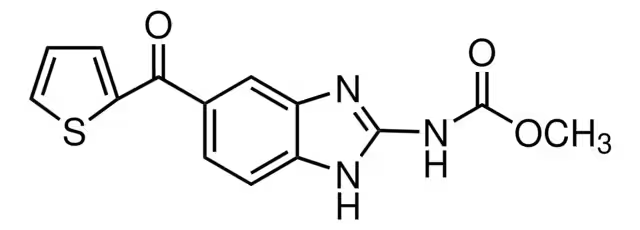
CAS Number31430-18-9
Synonyms2-Benzimidazolecarbamic acid, 5-(2-thienylcarbonyl)-, methyl ester; Methyl N-(5-thenoyl-2-benzimidazolyl)carbamate; methyl N-[6-(thiophene-2-carbonyl)-1H-benzimidazol-2-yl]carbamate; Methyl [5-(2-thienylcarbonyl)-1H-benzimidazol-2-yl]carbamate; Nocodazole; Nocidazole; 2-Benzimidazolecarbamic acid, 5-(2-thienoyl)-, methyl ester; Methyl 5-(2-thienoyl)-2-benzimidazolecarbamate; nocodazolum; Nocodazol; methyl [5-(thiophen-2-ylcarbonyl)-1H-benzimidazol-2-yl]carbamate; EINECS 250-626-5; Carbamic acid, N-[5-(2-thienylcarbonyl)-1H-benzimidazol-2-yl]-, methyl ester; Oncodazole; MFCD00005588; methyl 5-(thiophene-2-carbonyl)-1H-benzo[d]imidazol-2-ylcarbamate
Molecular FormulaC14H11N3O3S
Molecular Weight301.32
Purity≥99 (TLC)%
Density1.5±0.1 g/cm3
Melting Point300 °C (dec.)
Appearancepowder
EINECS250-626-5
Symbol
Signal WordWarning
| Chemical & Physical Properties | |
|---|---|
| CAS Number | 31430-18-9 |
| Catalog No. | 2A-9017017 |
| Chinese Name | 诺考达唑 |
| Synonyms | 2-Benzimidazolecarbamic acid, 5-(2-thienylcarbonyl)-, methyl ester; Methyl N-(5-thenoyl-2-benzimidazolyl)carbamate; methyl N-[6-(thiophene-2-carbonyl)-1H-benzimidazol-2-yl]carbamate; Methyl [5-(2-thienylcarbonyl)-1H-benzimidazol-2-yl]carbamate; Nocodazole; Nocidazole; 2-Benzimidazolecarbamic acid, 5-(2-thienoyl)-, methyl ester; Methyl 5-(2-thienoyl)-2-benzimidazolecarbamate; nocodazolum; Nocodazol; methyl [5-(thiophen-2-ylcarbonyl)-1H-benzimidazol-2-yl]carbamate; EINECS 250-626-5; Carbamic acid, N-[5-(2-thienylcarbonyl)-1H-benzimidazol-2-yl]-, methyl ester; Oncodazole; MFCD00005588; methyl 5-(thiophene-2-carbonyl)-1H-benzo[d]imidazol-2-ylcarbamate |
| Molecular Formula | C14H11N3O3S |
| Molecular Weight | 301.32 |
| Purity | ≥99 (TLC) |
| Density | 1.5±0.1 g/cm3 |
| Melting Point | 300 °C (dec.) |
| Appearance | powder |
| Water Solubility | DMSO: 10 mg/mL, soluble |
| Storage Condition | Sealed, stored at 2ºC -8ºC |
| Packaging | III |
| Application | Nocodazole is a rapidly reversible microtubule inhibitor. Nocodazole binds to β-tubulin and disrupts microtubule assembly/disassembly dynamics, thereby preventing mitosis and inducing tumor cell apopt |
| EINECS | 250-626-5 |
| HTC | 2934999090 |
| PubChem ID | 24278535 |
| MDL Number | MFCD00005588 |
| SMILES | COC(=O)Nc1nc2cc(ccc2[nH]1)C(=O)c3cccs3 |
| InChI | 1S/C14H11N3O3S/c1-20-14(19)17-13-15-9-5-4-8(7-10(9)16-13)12(18)11-3-2-6-21-11/h2-7H,1H3,(H2,15,16,17,19) |
| InChI Key | KYRVNWMVYQXFEU-UHFFFAOYSA-N |
| Beilstein/REAXYS | 1085978 |
| NACRES Code | NA.77 |
| UNSPSC | 12352200 |
| Hazard Symbols | 6.1(b) |
| MSDS | msds/17017_1_31430_18_9.pdf |
| Bioactivity | Nocodazole is a rapidly-reversible inhibitor of microtubule. Nocodazole binds to β-tubulin and disrupts microtubule assembly/disassembly dynamics, which prevents mitosis and induces apoptosis in tumor cells. Related Catalog Signaling Pathways >> Autophagy >> Autophagy Signaling Pathways >> Protein Tyrosine Kinase/RTK >> Bcr-Abl Signaling Pathways >> Cell Cycle/DNA Damage >> CRISPR/Cas9 Signaling Pathways >> Cell Cycle/DNA Damage >> Microtubule/Tubulin Signaling Pathways >> Cytoskeleton >> Microtubule/Tubulin Research Areas >> Cancer Target Abl:91 nM (Kd) ABL(E255K):120 nM (Kd) ABL(T315I):170 nM (Kd) BRAF:1.8 μM (Kd) BRAF(V600E):1.1 μM (Kd) c-KIT:1.6 μM (Kd) MEK1:1.7 μM (Kd) MEK2:1.6 μM (Kd) MET:1.7 μM (Kd) PI3Kγ:1.5 μM (Kd) Microtubule/Tubulin CRISPR/Cas9 In Vitro Nocodazole exhibits good affinity toward c-KIT, with a Kd value of 1.6 μM in highly malignant human cancer cells. Nocodazole displays good binding affinity toward the components of the mitogen-activated protein kinase (MAPK) pathway, such as BRAF (Kd=1.8 μM), BRAF(V600E) (Kd=1.1 μM), MEK1 (Kd=1.7 μM), and MEK2 (Kd=1.6 μM)[1]. Nocodazole has the highest affinity for αβIV and the lowest affinity for αβIII[2]. After release from the nocodazole block, cells synchronized in mitosis remaine sensitive to very low concentrations of paclitaxel for < 30 min, the time required for spindle formation, yet remains sensitive to vinblastine for > 90 min[3]. Nocodazole (1 nM) induces apoptosis of COLO 205 cancer cells[4]. Nocodazole (≥ 30 µg/mL) significantly increases the percentage of annexin-V-binding cells without significantly modifying average forward scatter of human erythrocytes[5]. In Vivo Nocodazole (5 mg/kg/three times per week, i.p.) has antitumor effects in athymic mice bearing COLO 205 tumor xenografts. Nocodazole (1 nM) + ketoconazole dramatically increase the levels of p21/CIP1 and p27/KIP1 protein in the tumor tissues[4]. Cell Assay Proteins are loaded at 50 μg/lane and separated by 12% (w:v) sodium dodecyl sulfate-polyacrylamide gel electrophoresis, blotted, and probed with antibodies for cyclin E, p53, p21/CIP1, p27/KIP1, glyceraldehyde 3-phosphate dehydrogenase (GAPDH), cyclin A, cyclin D1, cyclin D3, cyclin B, CDK2, CDK4, and cytochrome C. Immunoreactive bands are visualized by incubating with the colorigenic substrates nitroblue tetrazolium and 5-bromo-4-chloro-3-indolyl-phosphate. The expression of GAPDH is used as the control for equal protein loading. Animal Admin COLO 205 cells are grown in RPMI 1640 supplemented with 10% FCS. Cells are harvested through two consecutive trypsinizations, centrifuged at 300×g; for 5 min, washed twice, and resuspended in sterile phosphate-buffered saline (PBS). Cells (5×10⁵) in 0.1 mL are injected subcutaneously between the scapulae of each nude mouse. After transplantation, tumor size is measured with calipers, and the tumor volume is estimated. Once tumors reach a mean size of 200 mm3, animals receive intraperitoneal injections of DMSO (25 μL), ketoconazole (50 mg/kg), nocodazole (5 mg/kg), or ketoconazole + nocodazole three times per week for 6 wk. References [1]. Park H, et al. Nocodazole is a high-affinity ligand for the cancer-related kinases ABL, c-KIT, BRAF, and MEK. ChemMedChem. 2012 Jan 2;7(1):53-6. [2]. Keliang Xu, et al. Interaction of nocodazole with tubulin isotypes. Drug Development Research 2002 [3]. Long BH, et al. Paclitaxel inhibits progression of mitotic cells to G1 phase by interference with spindle formation without affecting other microtubule functions during anaphase and telephase. Cancer Res. 1994 Aug 15;54(16):4355-61. [4]. Wang YJ, et al. Ketoconazole potentiates the antitumor effects of nocodazole: In vivo therapy for human tumor xenografts in nude mice. Mol Carcinog. 2002 Aug;34(4):199-210. [5]. Signoretto E, et al. Nocodazole Induced Suicidal Death of Human Erythrocytes. Cell Physiol Biochem. 2016;38(1):379-92. [6]. Zhang JP, et al. Efficient precise knockin with a double cut HDR donor after CRISPR/Cas9-mediated double-stranded DNA cleavage. Genome Biol. 2017 Feb 20;18(1):35. Chemical & Physical Properties Density 1.5±0.1 g/cm3 Melting Point 300 °C (dec.) Molecular Formula C14H11N3O3S Molecular Weight 301.320 Exact Mass 301.052124 PSA 112.32000 LogP 2.43 Index of Refraction 1.732 InChIKey KYRVNWMVYQXFEU-UHFFFAOYSA-N SMILES COC(=O)Nc1nc2ccc(C(=O)c3cccs3)cc2[nH]1 Storage condition 2-8°C Water Solubility DMSO: 10 mg/mL, soluble |
| Use of | Nocodazole is a rapidly-reversible inhibitor of microtubule. Nocodazole binds to β-tubulin and disrupts microtubule assembly/disassembly dynamics, which prevents mitosis and induces apoptosis in tumor cells. Properties Articles431 Name nocodazole Synonym More Synonyms Nocodazole Biological Activity Description Nocodazole is a rapidly-reversible inhibitor of microtubule. Nocodazole binds to β-tubulin and disrupts microtubule assembly/disassembly dynamics, which prevents mitosis and induces apoptosis in tumor cells. Related Catalog Signaling Pathways >> Autophagy >> Autophagy Signaling Pathways >> Protein Tyrosine Kinase/RTK >> Bcr-Abl Signaling Pathways >> Cell Cycle/DNA Damage >> CRISPR/Cas9 Signaling Pathways >> Cell Cycle/DNA Damage >> Microtubule/Tubulin Signaling Pathways >> Cytoskeleton >> Microtubule/Tubulin Research Areas >> Cancer Abl:91 nM (Kd) ABL(E255K):120 nM (Kd) ABL(T315I):170 nM (Kd) BRAF:1.8 μM (Kd) BRAF(V600E):1.1 μM (Kd) c-KIT:1.6 μM (Kd) MEK1:1.7 μM (Kd) MEK2:1.6 μM (Kd) MET:1.7 μM (Kd) PI3Kγ:1.5 μM (Kd) Microtubule/Tubulin CRISPR/Cas9 References [1]. Park H, et al. Nocodazole is a high-affinity ligand for the cancer-related kinases ABL, c-KIT, BRAF, and MEK. ChemMedChem. 2012 Jan 2;7(1):53-6. [2]. Keliang Xu, et al. Interaction of nocodazole with tubulin isotypes. Drug Development Research 2002 [3]. Long BH, et al. Paclitaxel inhibits progression of mitotic cells to G1 phase by interference with spindle formation without affecting other microtubule functions during anaphase and telephase. Cancer Res. 1994 Aug 15;54(16):4355-61. [4]. Wang YJ, et al. Ketoconazole potentiates the antitumor effects of nocodazole: In vivo therapy for human tumor xenografts in nude mice. Mol Carcinog. 2002 Aug;34(4):199-210. [5]. Signoretto E, et al. Nocodazole Induced Suicidal Death of Human Erythrocytes. Cell Physiol Biochem. 2016;38(1):379-92. [6]. Zhang JP, et al. Efficient precise knockin with a double cut HDR donor after CRISPR/Cas9-mediated double-stranded DNA cleavage. Genome Biol. 2017 Feb 20;18(1):35. Chemical & Physical Properties Molecular Formula C14H11N3O3S Exact Mass 301.052124 PSA 112.32000 Index of Refraction 1.732 InChIKey KYRVNWMVYQXFEU-UHFFFAOYSA-N |
| Tax Rebate | 13.0% |
| Supervision | None. MFN tariff: 6.5%. Ordinary tariff: 20.0% |
| Transport Info | Shipping Name: UN |
| MSDS Transport Info | Module 14. Shipping information 14.1 UN dangerous goods number European Land Transport Dangerous Regulations: -International Maritime Dangerous Regulations: -International Air Transport Dangerous Regulations: - 14.2 United Nations shipping name European Land Transport Dangerous Regulations: Non-dangerous goods IMDG Code: Non-dangerous goods International air transport dangerous goods regulations: non-dangerous goods 14.3 Transport hazard categories European Land Transport Dangerous Regulations: -International Maritime Dangerous Regulations: -International Air Transport Dangerous Regulations: - 14.4 Package group European Land Transport Dangerous Regulations: -International Maritime Dangerous Regulations: -International Air Transport Dangerous Regulations: - 14.5 Environmental hazards European Land Transport Danger Regulations: No International Maritime Danger Regulations International Air Transport Danger Regulations: No Marine pollutants (yes/no): No 14.6 Special reminder to users No data available |
| Related Products in Polymer Intermediates | ||
|---|---|---|
| Sodium iodate | 7681-55-2 | 2A-9015692 |
| Sodium periodate | 7790-28-5 | 2A-9015719 |
| Tetrabromophthalic anhydride | 632-79-1 | 2A-9015891 |
| Tetrachlorophthalic anhydride | 117-08-8 | 2A-9015898 |
| Triethylene glycol | 112-27-6 | 2A-9016024 |
| Tetrabromobisphenol A | 79-94-7 | 2A-9017288 |
| 4-Bromo-1,8-naphthalic anhydride | 81-86-7 | 2A-9017361 |
| 4-Bromophthalic anhydride | 82-73-5 | 2A-9017375 |
| Hexahydrophthalic anhydride | 85-42-7 | 2A-9017444 |
| 4-Bromophthalic anhydride | 86-90-8 | 2A-9017496 |
| Browse all Polymer Intermediates products » | ||
Phone:
630-322-8886
630-322-8887
Email:
Office Locations:
Chicago, IL, USA
San Francisco, CA, USA


 EN
EN


 SDS
SDS