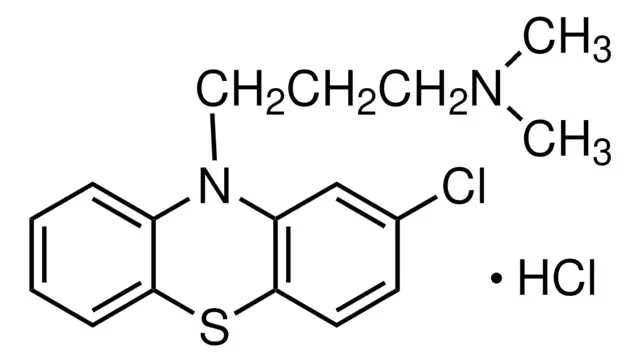
CAS Number69-09-0
SynonymsCHLORAZIN; CHLORPROMAZINE HCL; chloracetil; Hibernal; Phenothiazine, 2-chloro-10-(3-dimethylaminopropyl)-, hydrochloride; 2-Chloro-10-[3-(dimethylamino)-1-propyl]phenothiazine Hydrochloride; Chloropromazin hydrochloride; Phenothiazine, 2-chloro-10-[3- (dimethylamino)propyl]-, monohydrochloride; Fenactil monohydrochloride; Ampliactil; hibanil; UNII-9WP59609J6; Plegomazin; Largactil; 10H-Phenothiazine-10-propanamine, 2-chloro-N,N-dimethyl-, hydrochloride (1:1); Contomin hydrochloride; 3-(2-Chloro-10H-phenothiazin-10-yl)-N,N-dimethylpropan-1-amine hydrochloride (1:1); Aminazin Hydrochloride; Propaphenin; Largaktyl; Chlorpromazine hydrochloride; Thorazine; Chloractil; Megaphen; MFCD00012654; Chlorpromazine monohydrochloride; EINECS 200-701-3; 2-Chloro-10-(3-dimethylaminopropyl)phenothiazine mo
Molecular FormulaC17H20Cl2N2S
Molecular Weight355.33
Purity≥98 (TLC)%
Density1.077 g/cm3 (15 C)
Boiling Point450.1ºC at 760 mmHg
Melting Point194-196 °C
Appearancepowder
EINECS200-701-3
Symbol
Signal WordWarning
| Chemical & Physical Properties | |
|---|---|
| CAS Number | 69-09-0 |
| Catalog No. | 2A-9016979 |
| Chinese Name | 盐酸氯丙嗪 |
| Synonyms | CHLORAZIN; CHLORPROMAZINE HCL; chloracetil; Hibernal; Phenothiazine, 2-chloro-10-(3-dimethylaminopropyl)-, hydrochloride; 2-Chloro-10-[3-(dimethylamino)-1-propyl]phenothiazine Hydrochloride; Chloropromazin hydrochloride; Phenothiazine, 2-chloro-10-[3- (dimethylamino)propyl]-, monohydrochloride; Fenactil monohydrochloride; Ampliactil; hibanil; UNII-9WP59609J6; Plegomazin; Largactil; 10H-Phenothiazine-10-propanamine, 2-chloro-N,N-dimethyl-, hydrochloride (1:1); Contomin hydrochloride; 3-(2-Chloro-10H-phenothiazin-10-yl)-N,N-dimethylpropan-1-amine hydrochloride (1:1); Aminazin Hydrochloride; Propaphenin; Largaktyl; Chlorpromazine hydrochloride; Thorazine; Chloractil; Megaphen; MFCD00012654; Chlorpromazine monohydrochloride; EINECS 200-701-3; 2-Chloro-10-(3-dimethylaminopropyl)phenothiazine mo |
| Molecular Formula | C17H20Cl2N2S |
| Molecular Weight | 355.33 |
| Purity | ≥98 (TLC) |
| Density | 1.077 g/cm3 (15 C) |
| Boiling Point | 450.1ºC at 760 mmHg |
| Melting Point | 194-196 °C |
| Appearance | powder |
| Water Solubility | ≥10 g/100 mL at 24 ºC |
| Storage Condition | Store in an airtight container away from light. |
| Packaging | III |
| Application | Chlorpromazine Hydrochloride is an antagonist of D2, 5HT2A, potassium channels and sodium channels. Chlorpromazine binds D2 and 5HT2A with Ki of 363 nM and 8.3 nM, respectively. |
| EINECS | 200-701-3 |
| HTC | 2932999099 |
| PubChem ID | 57654045 |
| MDL Number | MFCD00012654 |
| SMILES | Cl[H].CN(C)CCCN1c2ccccc2Sc3ccc(Cl)cc13 |
| InChI | 1S/C17H19ClN2S.ClH/c1-19(2)10-5-11-20-14-6-3-4-7-16(14)21-17-9-8-13(18)12-15(17)20;/h3-4,6-9,12H,5,10-11H2,1-2H3;1H |
| InChI Key | FBSMERQALIEGJT-UHFFFAOYSA-N |
| Beilstein/REAXYS | 3779989 |
| NACRES Code | NA.77 |
| UNSPSC | 12352200 |
| Hazard Symbols | 6.1(b) |
| MSDS | msds/16979_1_69_09_0.pdf |
| Bioactivity | Chlorpromazine Hydrochloride is an antagonist of the dopamine D2, 5HT2A, potassium channel andsodium channel. Chlorpromazine binds with D2 and 5HT2A with Kis of 363 nM and 8.3 nM, respectively. Related Catalog Signaling Pathways >> GPCR/G Protein >> 5-HT Receptor Signaling Pathways >> Neuronal Signaling >> 5-HT Receptor Signaling Pathways >> Autophagy >> Autophagy Signaling Pathways >> GPCR/G Protein >> Dopamine Receptor Signaling Pathways >> Neuronal Signaling >> Dopamine Receptor Signaling Pathways >> Membrane Transporter/Ion Channel >> Potassium Channel Signaling Pathways >> Membrane Transporter/Ion Channel >> Sodium Channel Research Areas >> Neurological Disease Target Ki: 363 nM (dopamine D2 receptor), 8.3 nM (5-HT2A receptor)[4] In Vitro Chlorpromazine (3, 10, 20, 40, and 60 μM) decreases the peak currents of hNav1.7 in a concentration-dependent manner, with IC50 of 25.9 μM with a Hill coefficient of 2.3. Chlorpromazine (25 μM) produces strong use-dependent inhibition of the hNav1.7 current. Chlorpromazine blocks the hNav1.7 channel, independent of calmodulin[1]. Chlorpromazine blocks HERG potassium channels with an IC50 value of 21.6 μM and a Hill coefficient of 1.11. Chlorpromazine (1, 10, 100 μM) blocks HERG potassium channels expressed in Xenopus laevis oocytes in a concentration-dependent manner. Chlorpromazine blocks HERG potassium channels in the activated state[5]. In Vivo Chlorpromazine (2 mg/kg, i.p.)-induced neurobehavioural abnormalities (NAs) are characterized by significant increase in cataleptic behaviour and loared spontaneous activity reaction time in mice[2]. Chlorpromazine (1 or 5 mg/kg, i,p.) prevents ketamine (KET) from increasing average spectral power of delta and gamma-high bands on the 5th and 10th days of treatment in rats[3]. Animal Admin Adult mice (8-10 weeks old) weighing 18-25 g are divided into five groups of six mice per group. The treatment schedule is as follows: Group 1, control (Normal Saline: NS, 10 mL/kg i.p.); Group 2, chlorpromazine (CPZ, 2 mg/kg i.p.); Group 3, bromocriptine (BMC, 2.5 mg/kg s.c.); Group 4: amlodipine (AML, 1 mg/kg s.c.); Group 5, BMC (2.5 mg/kg s.c.) + AML (1 mg/kg). Animal treated with BMC or AML or their combination also receive chlorpromazine 30 min later (i.p.). Animals are subjected to various tests including metal bar test for catalepsy and spontaneous activity wheel for motor assessment and agility and elevated plus maze, hole-board, Y-maze, open-field tests for locomotory activity, and exploratory behaviour respectively. Animals are euthanized eighteen hours later by cervical dislocation. The brain is dissected, rinsed in buffer (pH 7.6) and homogenized with Teflon and used for assessment of lipid peroxidation, reduced glutathione, superoxide dismutase and catalase. References [1]. Lee SJ, et al. Mechanism of inhibition by chlorpromazine of the human pain threshold sodium channel, Nav1.7. Neurosci Lett. 2017 Feb 3;639:1-7 [2]. Kale OE, et al. Amlodipine, an L-type calcium channel blocker, protects against chlorpromazine-induced neurobehavioural deficits in mice. Fundam Clin Pharmacol. 2017 Jan 19 [3]. Sampaio LR, et al. Electroencephalographic study of chlorpromazine alone or combined with alpha-lipoic acid in a model of schizophrenia induced by ketamine in rats. J Psychiatr Res. 2017 Mar;86:73-82 [4]. Suzuki H, et al. Comparison of the anti-dopamine D? and anti-serotonin 5-HT(2A) activities of chlorpromazine, bromperidol, haloperidol and second-generation antipsychotics parent compounds and metabolites thereof. J Psychopharmacol. 2013 Apr;27(4):396-400 [5]. Thomas, D., et al. The antipsychotic drug chlorpromazine inhibits HERG potassium channels. Br J Pharmacol, 2003. 139(3): p. 567-74. Chemical & Physical Properties Density 1.077 g/cm3 (15 C) Boiling Point 450.1ºC at 760 mmHg Melting Point 192-196°C Molecular Formula C17H20Cl2N2S Molecular Weight 355.325 Exact Mass 354.072418 PSA 31.78000 LogP 5.76140 Index of Refraction 1.4436 (20ºC) InChIKey FBSMERQALIEGJT-UHFFFAOYSA-N SMILES CN(C)CCCN1c2ccccc2Sc2ccc(Cl)cc21.Cl Stability Stable. Combustible. Incompatible with strong oxidizing agents. Air and light sesnsitive. Water Solubility ≥10 g/100 mL at 24 ºC |
| Use of | Chlorpromazine Hydrochloride is an antagonist of the dopamine D2, 5HT2A, potassium channel andsodium channel. Chlorpromazine binds with D2 and 5HT2A with Kis of 363 nM and 8.3 nM, respectively. Properties Articles102 Name chlorpromazine hydrochloride Synonym More Synonyms Chlorpromazine hydrochloride Biological Activity Description Chlorpromazine Hydrochloride is an antagonist of the dopamine D2, 5HT2A, potassium channel andsodium channel. Chlorpromazine binds with D2 and 5HT2A with Kis of 363 nM and 8.3 nM, respectively. Related Catalog Signaling Pathways >> GPCR/G Protein >> 5-HT Receptor Signaling Pathways >> Neuronal Signaling >> 5-HT Receptor Signaling Pathways >> Autophagy >> Autophagy Signaling Pathways >> GPCR/G Protein >> Dopamine Receptor Signaling Pathways >> Neuronal Signaling >> Dopamine Receptor Signaling Pathways >> Membrane Transporter/Ion Channel >> Potassium Channel Signaling Pathways >> Membrane Transporter/Ion Channel >> Sodium Channel Research Areas >> Neurological Disease Ki: 363 nM (dopamine D2 receptor), 8.3 nM (5-HT2A receptor)[4] References [1]. Lee SJ, et al. Mechanism of inhibition by chlorpromazine of the human pain threshold sodium channel, Nav1.7. Neurosci Lett. 2017 Feb 3;639:1-7 [2]. Kale OE, et al. Amlodipine, an L-type calcium channel blocker, protects against chlorpromazine-induced neurobehavioural deficits in mice. Fundam Clin Pharmacol. 2017 Jan 19 [3]. Sampaio LR, et al. Electroencephalographic study of chlorpromazine alone or combined with alpha-lipoic acid in a model of schizophrenia induced by ketamine in rats. J Psychiatr Res. 2017 Mar;86:73-82 [4]. Suzuki H, et al. Comparison of the anti-dopamine D? and anti-serotonin 5-HT(2A) activities of chlorpromazine, bromperidol, haloperidol and second-generation antipsychotics parent compounds and metabolites thereof. J Psychopharmacol. 2013 Apr;27(4):396-400 [5]. Thomas, D., et al. The antipsychotic drug chlorpromazine inhibits HERG potassium channels. Br J Pharmacol, 2003. 139(3): p. 567-74. Chemical & Physical Properties Exact Mass 354.072418 PSA 31.78000 LogP 5.76140 Index of Refraction 1.4436 (20ºC) InChIKey FBSMERQALIEGJT-UHFFFAOYSA-N Stability Stable. Combustible. Incompatible with strong oxidizing agents. Air and light sesnsitive. |
| Tax Rebate | 13.0% |
| Supervision | None. MFN tariff: 6.5%. Ordinary tariff: 20.0% |
| Transport Info | Shipping Name: UN |
| MSDS Transport Info | Module 14. Shipping information 14.1 UN dangerous goods number European Dangerous Regulations for land transport: 2811 International Dangerous Regulations for sea transport: 2811 International Dangerous Regulations for air transport: 2811 14.2 United Nations shipping name European Land Transport Dangerous Regulations: TOXIC SOLID, ORGANIC, N.O.S. (Chlorpromazine hydrochloride) IMDG: TOXIC SOLID, ORGANIC, N.O.S. (Chlorpromazine hydrochloride) International air transport hazard regulations: Toxic solid, organic, n.o.s. (Chlorpromazine hydrochloride) Passenger aircraft: No transport allowed 14.3 Transport hazard categories European Land Transport Danger Regulations: 6.1 International Maritime Transport Danger Regulations: 6.1 International Air Transport Danger Regulations: 6.1 14.4 Package group European Dangerous Regulations for land transport: I International Dangerous Regulations for sea transport: I International Dangerous Regulations for air transport: I 14.5 Environmental hazards European Land Transport Danger Regulations: No International Maritime Danger Regulations International Air Transport Danger Regulations: No Marine pollutants (yes/no): No 14.6 Special reminder to users No data available |
| Related Products in API & Advanced Intermediates | ||
|---|---|---|
| 1-Testosterone | 65-06-5 | 2A-9016912 |
| Triamcinolone diacetate | 67-78-7 | 2A-9016962 |
| Norethindrone | 68-22-4 | 2A-9016970 |
| Sulfadiazine | 68-35-9 | 2A-9016972 |
| Hydroxyprogesterone | 68-96-2 | 2A-9016978 |
| Calcium aspirin | 69-46-5 | 2A-9016982 |
| Warfarin | 81-81-2 | 2A-9017356 |
| 8-Chlorotheophylline | 85-18-7 | 2A-9017436 |
| Pyrazinamide | 98-96-4 | 2A-9018103 |
| Aztreonam | 78110-38-0 | 2A-9018504 |
| Browse all API & Advanced Intermediates products » | ||
Phone:
630-322-8886
630-322-8887
Email:
Office Locations:
Chicago, IL, USA
San Francisco, CA, USA


 EN
EN


 SDS
SDS