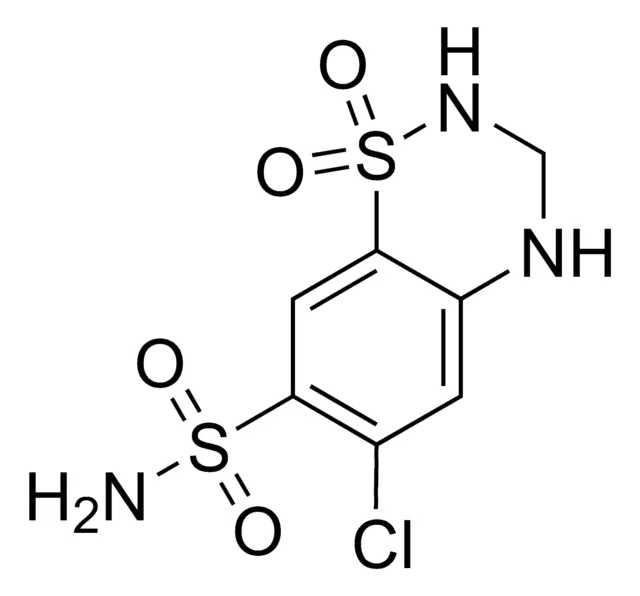
CAS Number58-93-5
SynonymsHCTZ; 6-Chloro-3,4-Dihydro-(2H)-1,2,4-Benzothiadiazine-7-Sulfonamide 1,1-Dioxide; 6-Chloro-3,4-dihydro-2H-1,2,4-benzothiadiazine-7-sulfonamide 1,1-dioxide; Hydrochlorothiazide; Dichlotride; MFCD00051765; Aquazide H; HCT; Esidrix; EINECS 200-403-3; Chlorsulfonamidodihydrobenzothiadiazine dioxide; 2H-1,2,4-Benzothiadiazine-7-sulfonamide, 6-chloro-3,4-dihydro-, 1,1-dioxide; Esidrex; HYDRODIURIL; ORETIC
Molecular FormulaC7H8ClN3O4S2
Molecular Weight297.74
Purity98.00%
Density1.7±0.1 g/cm3
Boiling Point577.0±60.0 °C at 760 mmHg
Melting Point273 °C
Appearanceliquid
EINECS200-659-6
Symbol
Signal WordWarning
| Chemical & Physical Properties | |
|---|---|
| CAS Number | 58-93-5 |
| Catalog No. | 2A-9016795 |
| Chinese Name | 氢氯噻嗪 |
| Synonyms | HCTZ; 6-Chloro-3,4-Dihydro-(2H)-1,2,4-Benzothiadiazine-7-Sulfonamide 1,1-Dioxide; 6-Chloro-3,4-dihydro-2H-1,2,4-benzothiadiazine-7-sulfonamide 1,1-dioxide; Hydrochlorothiazide; Dichlotride; MFCD00051765; Aquazide H; HCT; Esidrix; EINECS 200-403-3; Chlorsulfonamidodihydrobenzothiadiazine dioxide; 2H-1,2,4-Benzothiadiazine-7-sulfonamide, 6-chloro-3,4-dihydro-, 1,1-dioxide; Esidrex; HYDRODIURIL; ORETIC |
| Molecular Formula | C7H8ClN3O4S2 |
| Molecular Weight | 297.74 |
| Purity | 98.00 |
| Density | 1.7±0.1 g/cm3 |
| Boiling Point | 577.0±60.0 °C at 760 mmHg |
| Melting Point | 273 °C |
| Appearance | liquid |
| Storage Condition | This product should be sealed and stored away from |
| Application | Hydrochlorothiazide is a thiazide diuretic compound. |
| EINECS | 200-659-6 |
| HTC | 2935009090 |
| UN(IATA) | NA |
| SMILES | NS(=O)(=O)c1cc2c(NCNS2(=O)=O)cc1Cl |
| InChI | 1S/C7H8ClN3O4S2/c8-4-1-5-7(2-6(4)16(9,12)13)17(14,15)11-3-10-5/h1-2,10-11H,3H2,(H2,9,12,13) |
| InChI Key | JZUFKLXOESDKRF-UHFFFAOYSA-N |
| NACRES Code | NA.24 |
| UNSPSC | 41116107 |
| Hazard Symbols | Transport |
| MSDS | msds/16795_1_58_93_5.pdf |
| Bioactivity | Hydrochlorothiazide is a diuretic drug of the thiazide class. Target: OthersHydrochlorothiazide belongs to thiazide class of diuretics. It reduces blood volume by acting on the kidneys to reduce sodium (Na) reabsorption in the distal convoluted tubule. The major site of action in the nephron appears on an electroneutral Na+-Cl? co-transporter by competing for the chloride site on the transporter. By impairing Na transport in the distal convoluted tubule, hydrochlorothiazide induces a natriuresis and concomitant water loss. Thiazides increase the reabsorption of calcium in this segment in a manner unrelated to sodium transport. Additionally, by other mechanisms, Hydrochlorothiazide is believed to lower peripheral vascular resistance [1]. Related Catalog Signaling Pathways >> Stem Cell/Wnt >> TGF-beta/Smad Signaling Pathways >> TGF-beta/Smad >> TGF-beta/Smad Research Areas >> Metabolic Disease References [1]. Duarte, J.D. and R.M. Cooper-DeHoff, Mechanisms for blood pressure lowering and metabolic effects of thiazide and thiazide-like diuretics. Expert Rev Cardiovasc Ther, 2010. 8(6): p. 793-802. Chemical & Physical Properties Density 1.7±0.1 g/cm3 Boiling Point 577.0±60.0 °C at 760 mmHg Melting Point 273 °C Molecular Formula C7H8ClN3O4S2 Molecular Weight 297.739 Flash Point 302.7±32.9 °C Exact Mass 296.964478 PSA 135.12000 LogP -0.07 Vapour Pressure 0.0±1.6 mmHg at 25°C Index of Refraction 1.632 InChIKey JZUFKLXOESDKRF-UHFFFAOYSA-N SMILES NS(=O)(=O)c1cc2c(cc1Cl)NCNS2(=O)=O Stability Stable. Incompatible with strong oxidizing agents. |
| Use of | Hydrochlorothiazide is a diuretic drug of the thiazide class. Target: OthersHydrochlorothiazide belongs to thiazide class of diuretics. It reduces blood volume by acting on the kidneys to reduce sodium (Na) reabsorption in the distal convoluted tubule. The major site of action in the nephron appears on an electroneutral Na+-Cl? co-transporter by competing for the chloride site on the transporter. By impairing Na transport in the distal convoluted tubule, hydrochlorothiazide induces a natriuresis and concomitant water loss. Thiazides increase the reabsorption of calcium in this segment in a manner unrelated to sodium transport. Additionally, by other mechanisms, Hydrochlorothiazide is believed to lower peripheral vascular resistance [1]. Properties Articles127 Name hydrochlorothiazide Synonym More Synonyms Hydrochlorothiazide Biological Activity Description Hydrochlorothiazide is a diuretic drug of the thiazide class. Target: OthersHydrochlorothiazide belongs to thiazide class of diuretics. It reduces blood volume by acting on the kidneys to reduce sodium (Na) reabsorption in the distal convoluted tubule. The major site of action in the nephron appears on an electroneutral Na+-Cl? co-transporter by competing for the chloride site on the transporter. By impairing Na transport in the distal convoluted tubule, hydrochlorothiazide induces a natriuresis and concomitant water loss. Thiazides increase the reabsorption of calcium in this segment in a manner unrelated to sodium transport. Additionally, by other mechanisms, Hydrochlorothiazide is believed to lower peripheral vascular resistance [1]. Related Catalog Signaling Pathways >> Stem Cell/Wnt >> TGF-beta/Smad Signaling Pathways >> TGF-beta/Smad >> TGF-beta/Smad Research Areas >> Metabolic Disease References [1]. Duarte, J.D. and R.M. Cooper-DeHoff, Mechanisms for blood pressure lowering and metabolic effects of thiazide and thiazide-like diuretics. Expert Rev Cardiovasc Ther, 2010. 8(6): p. 793-802. Chemical & Physical Properties Exact Mass 296.964478 PSA 135.12000 LogP -0.07 Index of Refraction 1.632 InChIKey JZUFKLXOESDKRF-UHFFFAOYSA-N Stability Stable. Incompatible with strong oxidizing agents. |
| Tax Rebate | 9.0% |
| Supervision | None MFN tariff: 6.5% Ordinary tariff: 35.0% |
| Transport Info | Product name: Purity: 98.0% |
| MSDS Transport Info | Module 14. Shipping information 14.1 UN dangerous goods number European Land Transport Dangerous Regulations: -International Maritime Dangerous Regulations: -International Air Transport Dangerous Regulations: - 14.2 Names specified by the United Nations (UN) European Land Transport Dangerous Regulations: Non-dangerous goods IMDG Code: Non-dangerous goods International air transport dangerous goods regulations: non-dangerous goods 14.3 Transport hazard categories European Land Transport Dangerous Regulations: -International Maritime Dangerous Regulations: -International Air Transport Dangerous Regulations: - 14.4 Package group European Land Transport Dangerous Regulations: -International Maritime Dangerous Regulations: -International Air Transport Dangerous Regulations: - 14.5 Environmental hazards European Land Transport Dangerous Regulations: No International Maritime Transport Dangerous Regulations Maritime Pollutants: No International Air Transport Risk Regulations: No 14.6 Special reminder to users No data available |
| Related Products in API & Advanced Intermediates | ||
|---|---|---|
| Vincristine | 57-22-7 | 2A-9016735 |
| Ethynyl estradiol | 57-63-6 | 2A-9016751 |
| Progesterone | 57-83-0 | 2A-9016756 |
| Epiestradiol | 57-91-0 | 2A-9016760 |
| Streptomycin | 57-92-1 | 2A-9016761 |
| Tetracycline | 60-54-8 | 2A-9016845 |
| 17a-Methyl-1-testosterone | 65-04-3 | 2A-9016911 |
| 1-Testosterone | 65-06-5 | 2A-9016912 |
| Triamcinolone diacetate | 67-78-7 | 2A-9016962 |
| Norethindrone | 68-22-4 | 2A-9016970 |
| Browse all API & Advanced Intermediates products » | ||
Phone:
630-322-8886
630-322-8887
Email:
Office Locations:
Chicago, IL, USA
San Francisco, CA, USA


 EN
EN


 SDS
SDS