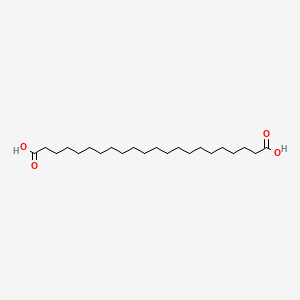
CAS Number505-56-6
Synonyms1,22-Docosanedioic acid; 1,20-Eicosanedicarboxylic acid; Phellogenic acid; docosanedicarboxylic acid; MFCD00002807; docosandioic acid; EINECS 204-010-8; Phelogenic acid; Docosanedioic acid; 1,22-Docosanedoic acid; Docosandisaeure; Felogenic acid
Molecular FormulaC22H42O4
Molecular Weight370.566
Purity98.00%
Density1.0±0.1 g/cm3
Boiling Point527.0±23.0 °C at 760 mmHg
Melting Point72-80 °C(lit.)
Appearancewhite solid
Symbol
Signal WordWarning
| Chemical & Physical Properties | |
|---|---|
| CAS Number | 505-56-6 |
| Catalog No. | 2A-1167648 |
| Chinese Name | 二十二烷二酸 |
| Synonyms | 1,22-Docosanedioic acid; 1,20-Eicosanedicarboxylic acid; Phellogenic acid; docosanedicarboxylic acid; MFCD00002807; docosandioic acid; EINECS 204-010-8; Phelogenic acid; Docosanedioic acid; 1,22-Docosanedoic acid; Docosandisaeure; Felogenic acid |
| Molecular Formula | C22H42O4 |
| Molecular Weight | 370.566 |
| Purity | 98.00 |
| Density | 1.0±0.1 g/cm3 |
| Boiling Point | 527.0±23.0 °C at 760 mmHg |
| Melting Point | 72-80 °C(lit.) |
| Appearance | white solid |
| Storage Condition | Store airtight in a cool, dry warehouse. |
| Application | Docosadienoic acid is a non-cleavable ADC linker used in the synthesis of antibody drug conjugates (ADCs). Docosadienoic acid is also a PROTAC linker based on alkyl chains and can be used to synthesiz |
| HTC | 2917190090 |
| PubChem ID | 105648 |
| SMILES | O=C(O)CCCCCCCCCCCCCCCCCCCCC(=O)O |
| InChI | InChI=1S/C22H42O4/c23-21(24)19-17-15-13-11-9-7-5-3-1-2-4-6-8-10-12-14-16-18-20-22(25)26/h1-20H2,(H,23,24)(H,25,26) |
| InChI Key | DGXRZJSPDXZJFG-UHFFFAOYSA-N |
| Hazard Symbols | transportation |
| MSDS | msds/167684_2_505_56_6.pdf |
| Bioactivity | Docosanedioic acid is a non-cleavable ADC linker used in the synthesis of antibody-drug conjugates (ADCs). Docosanedioic acid is also a alkyl chain-based PROTAC linker that can be used in the synthesis of PROTACs[1][2]. Related Catalog Research Areas >> Cancer Signaling Pathways >> Antibody-drug Conjugate >> ADC Linker Signaling Pathways >> PROTAC >> PROTAC Linker Target Non-cleavable In Vitro ADCs are comprised of an antibody to which is attached an ADC cytotoxin through an ADC linker[1]. PROTACs contain two different ligands connected by a linker; one is a ligand for an E3 ubiquitin ligase and the other is for the target protein. PROTACs exploit the intracellular ubiquitin-proteasome system to selectively degrade target proteins[2]. References [1]. Beck A, et al. Strategies and challenges for the next generation of antibody-drug conjugates. Nat Rev Drug Discov. 2017;16(5):315-337. [2]. Nalawansha DA, et al. PROTACs: An Emerging Therapeutic Modality in Precision Medicine. Cell Chem Biol. 2020;27(8):998-985. Chemical & Physical Properties Density 1.0±0.1 g/cm3 Boiling Point 527.0±23.0 °C at 760 mmHg Melting Point 72-80 °C(lit.) Molecular Formula C22H42O4 Molecular Weight 370.566 Flash Point 286.6±19.1 °C Exact Mass 370.308319 PSA 74.60000 LogP 8.24 Vapour Pressure 0.0±3.0 mmHg at 25°C Index of Refraction 1.474 InChIKey DGXRZJSPDXZJFG-UHFFFAOYSA-N SMILES O=C(O)CCCCCCCCCCCCCCCCCCCCC(=O)O Storage condition 2-8°C |
| Use of | Docosanedioic acid is a non-cleavable ADC linker used in the synthesis of antibody-drug conjugates (ADCs). Docosanedioic acid is also a alkyl chain-based PROTAC linker that can be used in the synthesis of PROTACs[1][2]. Properties Name docosanedioic acid Synonym More Synonyms Docosanedioic acid Biological Activity Description Docosanedioic acid is a non-cleavable ADC linker used in the synthesis of antibody-drug conjugates (ADCs). Docosanedioic acid is also a alkyl chain-based PROTAC linker that can be used in the synthesis of PROTACs[1][2]. Related Catalog Research Areas >> Cancer Signaling Pathways >> Antibody-drug Conjugate >> ADC Linker Signaling Pathways >> PROTAC >> PROTAC Linker Non-cleavable In Vitro ADCs are comprised of an antibody to which is attached an ADC cytotoxin through an ADC linker[1]. PROTACs contain two different ligands connected by a linker; one is a ligand for an E3 ubiquitin ligase and the other is for the target protein. PROTACs exploit the intracellular ubiquitin-proteasome system to selectively degrade target proteins[2]. References [1]. Beck A, et al. Strategies and challenges for the next generation of antibody-drug conjugates. Nat Rev Drug Discov. 2017;16(5):315-337. [2]. Nalawansha DA, et al. PROTACs: An Emerging Therapeutic Modality in Precision Medicine. Cell Chem Biol. 2020;27(8):998-985. Chemical & Physical Properties Molecular Formula C22H42O4 Exact Mass 370.308319 PSA 74.60000 Index of Refraction 1.474 InChIKey DGXRZJSPDXZJFG-UHFFFAOYSA-N SMILES O=C(O)CCCCCCCCCCCCCCCCCCCCC(=O)O |
| Tax Rebate | 9.0% |
| Supervision | None MFN tariff: 6.5% Ordinary tariff: 30.0% |
| Transport Info | Product name: Purity: 95.0% |
| MSDS Transport Info | Module 14. Shipping information 14.1 UN dangerous goods number European Land Transport Dangerous Regulations: -International Maritime Dangerous Regulations: -International Air Transport Dangerous Regulations: - 14.2 Names specified by the United Nations (UN) European Land Transport Dangerous Regulations: Non-dangerous goods IMDG Code: Non-dangerous goods International air transport dangerous goods regulations: non-dangerous goods 14.3 Transport hazard categories European Land Transport Dangerous Regulations: -International Maritime Dangerous Regulations: -International Air Transport Dangerous Regulations: - 14.4 Package group European Land Transport Dangerous Regulations: -International Maritime Dangerous Regulations: -International Air Transport Dangerous Regulations: - 14.5 Environmental hazards European Land Transport Dangerous Regulations: No International Maritime Transport Dangerous Regulations Maritime Pollutants: No International Air Transport Risk Regulations: No 14.6 Special reminder to users No data available |
| Related Products in Specialty Chemicals | ||
|---|---|---|
| 3,5-dibromo-4-methylpyridin-2-amine compound with 5-bromo-4-methylpyridin-2-amine | 2A-1167632 | 2A-1167632 |
| 4-bromo-1H-pyrazol-3-amine | 2A-1167635 | 2A-1167635 |
| 1,2-dimethyl-5-nitrocyclopenta-1,3-diene | 2A-1167636 | 2A-1167636 |
| N/A | 2A-1167641 | 2A-1167641 |
| EICOSANEDIOIC ACID | 2424-92-2 | 2A-1167647 |
| 2-(2-bromophenyl)propanoic acid | 153184-13-5 | 2A-1167649 |
| (E)-2-styrylquinazolin-4-ol | 2A-1167653 | 2A-1167653 |
| (E)-2-(4-methoxystyryl)quinazolin-4-ol | 2A-1167654 | 2A-1167654 |
| ethyl (E)-3,3,3-trifluoro-2-(methoxyimino)propanoate | 2A-1167656 | 2A-1167656 |
| tert-butyl (3-hydroxy-2-methylpropyl)carbamate | 480451-99-8 | 2A-1167658 |
| Browse all Specialty Chemicals products » | ||
Phone:
630-322-8886
630-322-8887
Email:
Office Locations:
Chicago, IL, USA
San Francisco, CA, USA


 EN
EN


 SDS
SDS