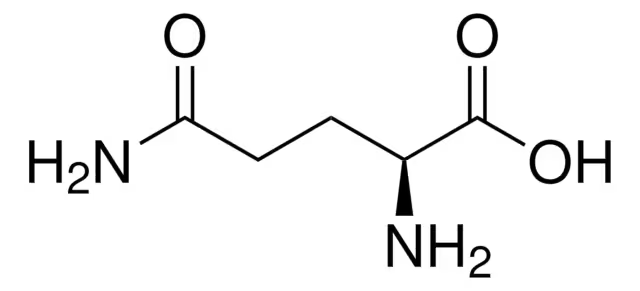
CAS Number56-85-9
SynonymsUNII-U5JDO2770Z; EINECS 200-292-1; (2S)-2-((2S)-2-Aminopropanoylamino)-4-carbamoylbutanoic acid; ZY1&VMYVQ2VZ &&L-L Form; glutaminic acid; Gln; L-Ala-L-Gln; glutamine; L-Gln; L-Alanyl-L-glutamine; Levoglutamide; (S)-5-Amino-2-[(S)-2-aminopropanamido]-5-oxopentanoic acid; L-Glutamine,L-alanyl; (2S)-2-amino-4-carbamoylbutanoic acid; Alanyl-glutamine,Glutamine-S; MFCD00008044; Ala-Gln; L-(+)-Glutamine; (S)-(+)-Glutamine; 5-Hydroxy-5-imino-L-norvaline; N(2)-L-alanyl-L-glutamine; Glutamine-S; Alanyl-glutamine; L-Glutamic Acid g-Amide; L-Glutamic acid γ-amide; N-L-alanyl-L-glutamine; L-Glutamine; l-alanyl-l-glutamin; l-(+)-glutamic acid-5-amide; L-Glutamic acid 5-amide
Molecular FormulaC5H10N2O3
Molecular Weight146.145
Purity98.00%
Density1.5±0.1 g/cm3
Boiling Point353.5±52.0 °C at 760 mmHg
Melting Point185ºC
Appearancesolution
EINECS200-292-1
Symbol
Signal WordWarning
| Chemical & Physical Properties | |
|---|---|
| CAS Number | 56-85-9 |
| Catalog No. | 2A-9016716 |
| Chinese Name | L-谷氨酰胺 |
| Synonyms | UNII-U5JDO2770Z; EINECS 200-292-1; (2S)-2-((2S)-2-Aminopropanoylamino)-4-carbamoylbutanoic acid; ZY1&VMYVQ2VZ &&L-L Form; glutaminic acid; Gln; L-Ala-L-Gln; glutamine; L-Gln; L-Alanyl-L-glutamine; Levoglutamide; (S)-5-Amino-2-[(S)-2-aminopropanamido]-5-oxopentanoic acid; L-Glutamine,L-alanyl; (2S)-2-amino-4-carbamoylbutanoic acid; Alanyl-glutamine,Glutamine-S; MFCD00008044; Ala-Gln; L-(+)-Glutamine; (S)-(+)-Glutamine; 5-Hydroxy-5-imino-L-norvaline; N(2)-L-alanyl-L-glutamine; Glutamine-S; Alanyl-glutamine; L-Glutamic Acid g-Amide; L-Glutamic acid γ-amide; N-L-alanyl-L-glutamine; L-Glutamine; l-alanyl-l-glutamin; l-(+)-glutamic acid-5-amide; L-Glutamic acid 5-amide |
| Molecular Formula | C5H10N2O3 |
| Molecular Weight | 146.145 |
| Purity | 98.00 |
| Density | 1.5±0.1 g/cm3 |
| Boiling Point | 353.5±52.0 °C at 760 mmHg |
| Melting Point | 185ºC |
| Appearance | solution |
| Storage Condition | This product should be sealed and stored in a cool |
| Application | L-Glutamine is a non-essential amino acid widely distributed throughout the body. |
| EINECS | 200-292-1 |
| HTC | 2932999099 |
| PubChem ID | 24895310 |
| MDL Number | MFCD00008044 |
| SMILES | N[C@@H](CCC(N)=O)C(O)=O |
| InChI | 1S/C5H10N2O3/c6-3(5(9)10)1-2-4(7)8/h3H,1-2,6H2,(H2,7,8)(H,9,10)/t3-/m0/s1 |
| InChI Key | ZDXPYRJPNDTMRX-VKHMYHEASA-N |
| NACRES Code | NA.75 |
| eCl@ss | 32160406 |
| UNSPSC | 12352209 |
| Hazard Symbols | Transport |
| Safety Description | S24/25 |
| MSDS | msds/16716_1_56_85_9.pdf |
| Bioactivity | L-Glutamine is a non-essential amino acid present abundantly throughout the body and is involved in gastrointestinal disorders.Target: mGluRGlutamine (abbreviated as Gln or Q) is one of the 20 amino acids encoded by the standard genetic code. It is not recognized as an essential amino acid, but may become conditionally essential in certain situations, including intensive athletic training or certain gastrointestinal disorders. Its side-chain is an amide formed by replacing the side-chain hydroxyl of glutamic acid with an amine functional group, making it the amide of glutamic acid. Its codons are CAA and CAG. In human blood, glutamine is the most abundant free amino acid, with a concentration of about 500-900 μmol/L. Glutamine is synthesized by the enzyme glutamine synthetase from glutamate and ammonia. The most relevant glutamine-producing tissue is the muscle mass, accounting for about 90% of all glutamine synthesized. Glutamine is also released, in small amounts, by the lung and the brain. Although the liver is capable of relevant glutamine synthesis, its role in glutamine metabolism is more regulatory than producing, since the liver takes up large amounts of glutamine derived from the gut. The most eager consumers of glutamine are the cells of intestines, the kidney cells for the acid-base balance, activated immune cells, and manycancer cells. In respect to the last point mentioned, different glutamine analogues, such as DON, Azaserine or Acivicin, are tested as anticancer drugs. Related Catalog Signaling Pathways >> GPCR/G Protein >> mGluR Research Areas >> Metabolic Disease Natural Products >> Others Target Human Endogenous Metabolite References [1]. Brosnan JT. Interorgan amino acid transport and its regulation. J Nutr. 2003 Jun;133(6 Suppl 1):2068S-2072S. [2]. Newsholme P, et al. Glutamine and glutamate as vital metabolites. Braz J Med Biol Res. 2003 Feb;36(2):153-63. Epub 2003 Jan 29. [3]. Newsholme P. Why is L-glutamine metabolism important to cells of the immune system in health, postinjury, surgery or infection? J Nutr. 2001 Sep;131(9 Suppl):2515S-22S; discussion 2523S-4S. Chemical & Physical Properties Density 1.5±0.1 g/cm3 Boiling Point 353.5±52.0 °C at 760 mmHg Melting Point 185ºC Molecular Formula C5H10N2O3 Molecular Weight 146.145 Flash Point 167.6±30.7 °C Exact Mass 146.069138 PSA 106.41000 LogP -1.28 Vapour Pressure 0.0±1.8 mmHg at 25°C Index of Refraction 1.564 InChIKey ZDXPYRJPNDTMRX-VKHMYHEASA-N SMILES NC(=O)CCC(N)C(=O)O |
| Use of | L-Glutamine is a non-essential amino acid present abundantly throughout the body and is involved in gastrointestinal disorders.Target: mGluRGlutamine (abbreviated as Gln or Q) is one of the 20 amino acids encoded by the standard genetic code. It is not recognized as an essential amino acid, but may become conditionally essential in certain situations, including intensive athletic training or certain gastrointestinal disorders. Its side-chain is an amide formed by replacing the side-chain hydroxyl of glutamic acid with an amine functional group, making it the amide of glutamic acid. Its codons are CAA and CAG. In human blood, glutamine is the most abundant free amino acid, with a concentration of about 500-900 μmol/L. Glutamine is synthesized by the enzyme glutamine synthetase from glutamate and ammonia. The most relevant glutamine-producing tissue is the muscle mass, accounting for about 90% of all glutamine synthesized. Glutamine is also released, in small amounts, by the lung and the brain. Although the liver is capable of relevant glutamine synthesis, its role in glutamine metabolism is more regulatory than producing, since the liver takes up large amounts of glutamine derived from the gut. The most eager consumers of glutamine are the cells of intestines, the kidney cells for the acid-base balance, activated immune cells, and manycancer cells. In respect to the last point mentioned, different glutamine analogues, such as DON, Azaserine or Acivicin, are tested as anticancer drugs. Properties Articles5202 Name L-glutamine Synonym More Synonyms L-Glutamine Biological Activity Description L-Glutamine is a non-essential amino acid present abundantly throughout the body and is involved in gastrointestinal disorders.Target: mGluRGlutamine (abbreviated as Gln or Q) is one of the 20 amino acids encoded by the standard genetic code. It is not recognized as an essential amino acid, but may become conditionally essential in certain situations, including intensive athletic training or certain gastrointestinal disorders. Its side-chain is an amide formed by replacing the side-chain hydroxyl of glutamic acid with an amine functional group, making it the amide of glutamic acid. Its codons are CAA and CAG. In human blood, glutamine is the most abundant free amino acid, with a concentration of about 500-900 μmol/L. Glutamine is synthesized by the enzyme glutamine synthetase from glutamate and ammonia. The most relevant glutamine-producing tissue is the muscle mass, accounting for about 90% of all glutamine synthesized. Glutamine is also released, in small amounts, by the lung and the brain. Although the liver is capable of relevant glutamine synthesis, its role in glutamine metabolism is more regulatory than producing, since the liver takes up large amounts of glutamine derived from the gut. The most eager consumers of glutamine are the cells of intestines, the kidney cells for the acid-base balance, activated immune cells, and manycancer cells. In respect to the last point mentioned, different glutamine analogues, such as DON, Azaserine or Acivicin, are tested as anticancer drugs. Related Catalog Signaling Pathways >> GPCR/G Protein >> mGluR Research Areas >> Metabolic Disease Natural Products >> Others Human Endogenous Metabolite References [1]. Brosnan JT. Interorgan amino acid transport and its regulation. J Nutr. 2003 Jun;133(6 Suppl 1):2068S-2072S. [2]. Newsholme P, et al. Glutamine and glutamate as vital metabolites. Braz J Med Biol Res. 2003 Feb;36(2):153-63. Epub 2003 Jan 29. [3]. Newsholme P. Why is L-glutamine metabolism important to cells of the immune system in health, postinjury, surgery or infection? J Nutr. 2001 Sep;131(9 Suppl):2515S-22S; discussion 2523S-4S. Chemical & Physical Properties Molecular Formula C5H10N2O3 Exact Mass 146.069138 PSA 106.41000 LogP -1.28 Index of Refraction 1.564 InChIKey ZDXPYRJPNDTMRX-VKHMYHEASA-N SMILES NC(=O)CCC(N)C(=O)O |
| Tax Rebate | 13.0% |
| Supervision | None. MFN tariff: 6.5%. Ordinary tariff: 30.0% |
| Transport Info | Shipping Name: UN |
| MSDS Transport Info | Module 14. Shipping information 14.1 UN dangerous goods number European Land Transport Dangerous Regulations: -International Maritime Dangerous Regulations: -International Air Transport Dangerous Regulations: - 14.2 United Nations shipping name European Land Transport Dangerous Regulations: Non-dangerous goods IMDG Code: Non-dangerous goods International air transport dangerous goods regulations: non-dangerous goods 14.3 Transport hazard categories European Land Transport Dangerous Regulations: -International Maritime Dangerous Regulations: -International Air Transport Dangerous Regulations: - 14.4 Package group European Land Transport Dangerous Regulations: -International Maritime Dangerous Regulations: -International Air Transport Dangerous Regulations: - 14.5 Environmental hazards European Land Transport Danger Regulations: No International Maritime Danger Regulations International Air Transport Danger Regulations: No Marine pollutants (yes/no): No 14.6 Special reminder to users No data available |
| Related Products in Nutritional Ingredients | ||
|---|---|---|
| Tetraamminepalladium (II) chloride | 13933-31-8 | 2A-9015889 |
| Toldimfos sodium | 575-75-7 | 2A-9015997 |
| L(+)-Ascorbic acid | 50-81-7 | 2A-9016580 |
| D-gamma-Tocopherol | 54-28-4 | 2A-9016660 |
| Pyridoxal phosphate | 54-47-7 | 2A-9016665 |
| Creatine | 57-00-1 | 2A-9016725 |
| Ergosterol | 57-87-4 | 2A-9016758 |
| Pyridoxine hydrochloride | 58-56-0 | 2A-9016784 |
| Vitamin E; D-alpha-tocopherol | 59-02-9 | 2A-9016801 |
| Folic acid | 59-30-3 | 2A-9016806 |
| Browse all Nutritional Ingredients products » | ||
Phone:
630-322-8886
630-322-8887
Email:
Office Locations:
Chicago, IL, USA
San Francisco, CA, USA


 EN
EN


 SDS
SDS