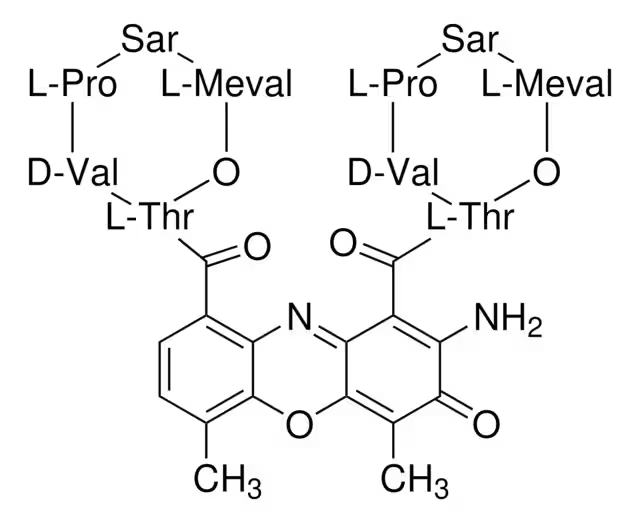
CAS Number50-76-0
Synonymsdactinomycin; noxazin-1,9-dicarboxamid; Actinomycin AIV; Actinomycin X1; EINECS 200-063-6; MFCD00070921; MERACTINOMYCIN; Actinomycin I1; Acto-D; Actinomycin D; Chounghwamycin B; Dilactone actinomycin D acid; ACT; Oncostatin K; noxazine-1,9-dicarboxamide
Molecular FormulaC62H86N12O16
Molecular Weight1255.42
Purity≥95 (HPLC)%
Density1.4±0.1 g/cm3
Boiling Point1386.0±65.0 °C at 760 mmHg
Melting Point251-253
Appearancepowder
EINECS200-063-6
Symbol
Signal WordWarning
| Chemical & Physical Properties | |
|---|---|
| CAS Number | 50-76-0 |
| Catalog No. | 2A-9016577 |
| Chinese Name | 放线菌素D |
| Synonyms | dactinomycin; noxazin-1,9-dicarboxamid; Actinomycin AIV; Actinomycin X1; EINECS 200-063-6; MFCD00070921; MERACTINOMYCIN; Actinomycin I1; Acto-D; Actinomycin D; Chounghwamycin B; Dilactone actinomycin D acid; ACT; Oncostatin K; noxazine-1,9-dicarboxamide |
| Molecular Formula | C62H86N12O16 |
| Molecular Weight | 1255.42 |
| Purity | ≥95 (HPLC) |
| Density | 1.4±0.1 g/cm3 |
| Boiling Point | 1386.0±65.0 °C at 760 mmHg |
| Melting Point | 251-253 |
| Appearance | powder |
| Water Solubility | SOLUBLE |
| Storage Condition | Store in a sealed, dry place at 4°C and away from |
| Packaging | II |
| Application | Actinomycin D inhibits DNA repair with an IC50 of 0.42 μM. |
| EINECS | 200-063-6 |
| HTC | 29419000 |
| PubChem ID | 24890842 |
| MDL Number | MFCD00005033 |
| SMILES | CC(C)[C@H]1NC(=O)[C@@H](NC(=O)c2ccc(C)c3OC4=C(C)C(=O)C(N)=C(C(=O)N[C@H]5[C@@H](C)OC(=O)[C@H](C(C)C)N(C)C(=O)CN(C)C(=O)[C@@H]6CCCN6C(=O)[C@H](NC5=O)C(C)C)C4=Nc23)[C@@H](C)OC(=O)[C@H](C(C)C)N(C)C(=O)CN(C)C(=O)[C@@H]7CCCN7C1=O |
| InChI | 1S/C62H86N12O16/c1-27(2)42-59(84)73-23-17-19-36(73)57(82)69(13)25-38(75)71(15)48(29(5)6)61(86)88-33(11)44(55(80)65-42)67-53(78)35-22-21-31(9)51-46(35)64-47-40(41(63)50(77)32(10)52(47)90-51)54(79)68-45-34(12)89-62(87)49(30(7)8)72(16)39(76)26-70(14)58(83)37-20-18-24-74(37)60(85)43(28(3)4)66-56(45)81/h21-22,27-30,33-34,36-37,42-45,48-49H,17-20,23-26,63H2,1-16H3,(H,65,80)(H,66,81)(H,67,78)(H,68,79)/t33-,34-,36+,37+,42-,43-,44+,45+,48+,49+/m1/s1 |
| InChI Key | RJURFGZVJUQBHK-IIXSONLDSA-N |
| Beilstein/REAXYS | 605235 |
| NACRES Code | NA.76 |
| UNSPSC | 51282001 |
| Hazard Symbols | 6.1(a) |
| Risk Codes | R28;R40;R61 |
| Safety Description | S1;S45 |
| MSDS | msds/16577_1_50_76_0.pdf |
| Bioactivity | Actinomycin D inhibits DNA repair with an IC50 of 0.42 μM. Related Catalog Signaling Pathways >> Autophagy >> Autophagy Signaling Pathways >> Cell Cycle/DNA Damage >> DNA/RNA Synthesis Natural Products >> Others Research Areas >> Cancer Target IC50: 0.42 μM (DNA repair)[1] In Vitro Actinomycin D is an inhibitor of DNA transcription and replication[1]. Actinomycin D markedly reduces the vascular smooth muscle cells (SMC) proliferation via the inhibition of BrdU incorporation at 80 nM. This is further supported by the G1-phase arrest using a flowcytometric analysis. Actinomycin D is extremely potent with an inhibitory concentration IC50 at 0.4 nM, whereas the lethal dose LD50 is at 260 microM. The protein expression levels of proliferating cell nuclear antigen (PCNA), focal adhesion kinase (FAK), and Raf are all suppressed by Actinomycin D. Extracellular signal-regulated kinases (Erk) involved in cell-cycle arrest are found to increase by Actinomycin D[2]. In Vivo The pluronic gel containing 80 nM and 80μM Actinomycin D is applied topically to surround the rat carotid adventitia, the thickness of neointima is substantially reduced (45 and 55%, respectively)[2]. Mice in the Actinomycin D and fludarabine group lives significantly longer than the control group with P values of <0.001 and 0.007, respectively. Interestingly, single treatment with Actinomycin D is superior to fludarabine regarding overall survival (P=0.026)[3]. Kinase Assay Actinomycin D is co-incubated for 3 h at 30°C with a reaction mixture containing: 120 mg of a whole-cell extract of HeLa cells, 70 mM KCl, 0.4 mM each of dGTP, dCTP, dATP, and digoxygenylated-dUTP in reaction buffer containing 40mM Hepes-KOH (pH 7.6), 5 mM MgCl2, 0.5 mM Dithiotreitol, 2 mM EGTA, 10 mM phosphocreatine, 50 mg/mL creatine phosphate, and 360 mg/mL of bovine serum albumin. During this reaction, DNA damage is recognized and the excised patches are replaced by neosynthesized DNA fragments. Throughout this DNA synthesis, digoxygenylated-dUMPs are incorporated. The DNA repair reaction is stopped by three washes[1]. Animal Admin Mice[3] The original Eμ-TCL1a transgenic mice have been backcrossed to C57BL/6 mice for >9 generations.The C57BL/6 wild-type mice are engrafted with tumor cells from Eμ-TCL-1 transgenic mice. The percentage of CD5+/CD19+ cells in the peripheral blood is routinely checked in mice by taking blood from the tail vein and analyzing it via flow cytometry. When the percentage of tumor cells in the peripheral blood reached 40-60%, treatment is started. Actinomycin D (0.06 mg/kg by 10 days) is applied daily via i.p. injections. References [1]. Barret JM, et al. Evaluation of DNA repair inhibition by antitumor or antibiotic drugs using a chemiluminescence microplateassay. Carcinogenesis. 1997 Dec;18(12):2441-5. [2]. Wu CH, et al. The molecular mechanism of actinomycin D in preventing neointimal formation in rat carotid arteries after balloon injury. J Biomed Sci. 2005;12(3):503-12. [3]. Merkel O, et al. Actinomycin D induces p53-independent cell death and prolongs survival in high-risk chronic lymphocytic leukemia. Leukemia. 2012 Dec;26(12):2508-16. Chemical & Physical Properties Density 1.4±0.1 g/cm3 Boiling Point 1386.0±65.0 °C at 760 mmHg Melting Point 251-253 °C Molecular Formula C62H86N12O16 Molecular Weight 1255.417 Flash Point 792.1±34.3 °C Exact Mass 1254.628418 PSA 359.98000 LogP -4.03 Vapour Pressure 0.0±0.3 mmHg at 25°C Index of Refraction 1.656 InChIKey RJURFGZVJUQBHK-UHFFFAOYSA-N SMILES Cc1c2oc3c(C)ccc(C(=O)NC4C(=O)NC(C(C)C)C(=O)N5CCCC5C(=O)N(C)CC(=O)N(C)C(C(C)C)C(=O)OC4C)c3nc-2c(C(=O)NC2C(=O)NC(C(C)C)C(=O)N3CCCC3C(=O)N(C)CC(=O)N(C)C(C(C)C)C(=O)OC2C)c(N)c1=O Stability Stable, but light sensitive, especially in dilute solution. Incompatible with strong acids, strong bases, strong oxidizing agents. Combustible. Water Solubility SOLUBLE |
| Use of | Actinomycin D inhibits DNA repair with an IC50 of 0.42 μM. Properties Articles352 Name actinomycin D Synonym More Synonyms Actinomycin D Biological Activity Description Actinomycin D inhibits DNA repair with an IC50 of 0.42 μM. Related Catalog Signaling Pathways >> Autophagy >> Autophagy Signaling Pathways >> Cell Cycle/DNA Damage >> DNA/RNA Synthesis Natural Products >> Others Research Areas >> Cancer IC50: 0.42 μM (DNA repair)[1] In Vivo The pluronic gel containing 80 nM and 80μM Actinomycin D is applied topically to surround the rat carotid adventitia, the thickness of neointima is substantially reduced (45 and 55%, respectively)[2]. Mice in the Actinomycin D and fludarabine group lives significantly longer than the control group with P values of <0.001 and 0.007, respectively. Interestingly, single treatment with Actinomycin D is superior to fludarabine regarding overall survival (P=0.026)[3]. References [1]. Barret JM, et al. Evaluation of DNA repair inhibition by antitumor or antibiotic drugs using a chemiluminescence microplateassay. Carcinogenesis. 1997 Dec;18(12):2441-5. [2]. Wu CH, et al. The molecular mechanism of actinomycin D in preventing neointimal formation in rat carotid arteries after balloon injury. J Biomed Sci. 2005;12(3):503-12. [3]. Merkel O, et al. Actinomycin D induces p53-independent cell death and prolongs survival in high-risk chronic lymphocytic leukemia. Leukemia. 2012 Dec;26(12):2508-16. Chemical & Physical Properties Molecular Formula C62H86N12O16 Exact Mass 1254.628418 PSA 359.98000 LogP -4.03 Index of Refraction 1.656 InChIKey RJURFGZVJUQBHK-UHFFFAOYSA-N Stability Stable, but light sensitive, especially in dilute solution. Incompatible with strong acids, strong bases, strong oxidizing agents. Combustible. Water Solubility SOLUBLE |
| Related Products in Specialty Chemicals | ||
|---|---|---|
| 6-Propoxypyridazin-3-amine | 90008-50-7 | 2A-9016572 |
| Alloxan | 50-71-5 | 2A-9016573 |
| 2,3,5-Trichlorobenzoic acid | 50-73-7 | 2A-9016574 |
| 2,3,4,5-Tetrachlorobenzoic acid | 50-74-8 | 2A-9016575 |
| 2,3,4-Trichlorobenzoic acid | 50-75-9 | 2A-9016576 |
| 4-Acetamidosalicylic acid | 50-86-2 | 2A-9016584 |
| D(+)-Glucose | 50-99-7 | 2A-9016588 |
| Piperonyl butoxide | 51-03-6 | 2A-9016589 |
| Procaine hydrochloride | 51-05-8 | 2A-9016590 |
| Tiratricol | 51-24-1 | 2A-9016596 |
| Browse all Specialty Chemicals products » | ||
Phone:
630-322-8886
630-322-8887
Email:
Office Locations:
Chicago, IL, USA
San Francisco, CA, USA


 EN
EN


 SDS
SDS