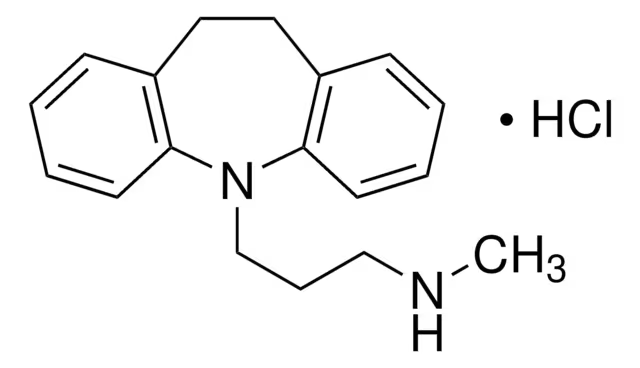
CAS Number50-47-5
SynonymsDesipramin; Demethylimipramine; Desipramine; 10,11-dihydro-5-[3-(methylamino)propyl]-5H-dibenz(b,f)azepin; Monodemethylimipramine; Norimipramine; 3-(10,11-Dihydro-5H-dibenzo[b,f]azepin-5-yl)-N-methylpropan-1-amine; 3-(5,6-dihydrobenzo[b][1]benzazepin-11-yl)-N-methylpropan-1-amine; Desimipramine; 5-(3-methylaminopropyl)-10,11-dihydro-5H-dibenzo[b,f]azepine; [3H]-Desipramine; Desmethylimipramine; Pertofrane; Dimethylimipramine; Dezipramine; EINECS 200-040-0
Molecular FormulaC18H22N2
Molecular Weight302.84
Purity98.00%
Density1.047 g/cm3
Boiling Point407.4ºC at 760 mmHg
Melting Point212°C
Appearancesolid
EINECS200-373-1
| Chemical & Physical Properties | |
|---|---|
| CAS Number | 50-47-5 |
| Catalog No. | 2A-9016557 |
| Chinese Name | 盐酸去甲咪嗪 |
| Synonyms | Desipramin; Demethylimipramine; Desipramine; 10,11-dihydro-5-[3-(methylamino)propyl]-5H-dibenz(b,f)azepin; Monodemethylimipramine; Norimipramine; 3-(10,11-Dihydro-5H-dibenzo[b,f]azepin-5-yl)-N-methylpropan-1-amine; 3-(5,6-dihydrobenzo[b][1]benzazepin-11-yl)-N-methylpropan-1-amine; Desimipramine; 5-(3-methylaminopropyl)-10,11-dihydro-5H-dibenzo[b,f]azepine; [3H]-Desipramine; Desmethylimipramine; Pertofrane; Dimethylimipramine; Dezipramine; EINECS 200-040-0 |
| Molecular Formula | C18H22N2 |
| Molecular Weight | 302.84 |
| Purity | 98.00 |
| Density | 1.047 g/cm3 |
| Boiling Point | 407.4ºC at 760 mmHg |
| Melting Point | 212°C |
| Appearance | solid |
| Storage Condition | This product should be sealed and stored in a cool |
| Application | Desipramine is a tricyclic antidepressant. Desipramine inhibits norepinephrine reuptake receptors in the central nervous system, reduces sleep-related loss of genioglossus muscle activity, and improve |
| EINECS | 200-373-1 |
| HTC | 2933990090 |
| MDL Number | MFCD00058108 |
| SMILES | Cl[H].CNCCCN1c2ccccc2CCc3ccccc13 |
| InChI | 1S/C18H22N2.ClH/c1-19-13-6-14-20-17-9-4-2-7-15(17)11-12-16-8-3-5-10-18(16)20;/h2-5,7-10,19H,6,11-14H2,1H3;1H |
| InChI Key | XAEWZDYWZHIUCT-UHFFFAOYSA-N |
| NACRES Code | NA.24 |
| UNSPSC | 41116107 |
| MSDS | msds/16557_1_50_47_5.pdf |
| Use of | Desipramine is a tricyclic antidepressant. Desipramine inhibits the norepinephrine reuptake receptor in the central nervous system and reduces the sleep-related loss of genioglossus activity and improves pharyngeal collapsibility[1][2]. Properties Name desipramine Synonym More Synonyms Desipramine hydrochloride Biological Activity Description Desipramine is a tricyclic antidepressant. Desipramine inhibits the norepinephrine reuptake receptor in the central nervous system and reduces the sleep-related loss of genioglossus activity and improves pharyngeal collapsibility[1][2]. Related Catalog Signaling Pathways >> GPCR/G Protein >> Adrenergic Receptor Research Areas >> Neurological Disease Norepinephrine Reuptake Receptor[1] References [1]. Garcia AS, et al. Autoreceptor-mediated inhibition of norepinephrine release in rat medial prefrontal cortex is maintained after chronic desipramine treatment. J Neurochem. 2004 Nov;91(3):683-93. [2]. Taranto-Montemurro L, et al. Desipramine improves upper airway collapsibility and reduces OSA severity in patients with minimal muscle compensation. Eur Respir J. 2016 Nov;48(5):1340-1350. Chemical & Physical Properties Molecular Formula C18H22N2 Exact Mass 266.17800 PSA 15.27000 LogP 3.98870 Index of Refraction 1.5200 (estimate) InChIKey HCYAFALTSJYZDH-UHFFFAOYSA-N Toxicological Information CHEMICAL IDENTIFICATION RTECS NUMBER : CHEMICAL NAME : 5H-Dibenz(b,f)azepine, 10,11-dihydro-5-(3-(methylamino)propyl)- CAS REGISTRY NUMBER : BEILSTEIN REFERENCE NO. : LAST UPDATED : DATA ITEMS CITED : MOLECULAR FORMULA : C18-H22-N2 MOLECULAR WEIGHT : WISWESSER LINE NOTATION : T C676 BN&T&J B3M1 HEALTH HAZARD DATA ACUTE TOXICITY DATA TYPE OF TEST : TDLo - Lowest published toxic dose ROUTE OF EXPOSURE : SPECIES OBSERVED : Human - man DOSE/DURATION : TOXIC EFFECTS : Behavioral - convulsions or effect on seizure threshold Cardiac - pulse rate increase, without fall in BP Nutritional and Gross Metabolic - body temperature increase TYPE OF TEST : LDLo - Lowest published lethal dose ROUTE OF EXPOSURE : SPECIES OBSERVED : Human - woman DOSE/DURATION : TOXIC EFFECTS : Brain and Coverings - other degenerative changes Behavioral - convulsions or effect on seizure threshold TYPE OF TEST : LDLo - Lowest published lethal dose ROUTE OF EXPOSURE : SPECIES OBSERVED : Human - child DOSE/DURATION : TOXIC EFFECTS : Behavioral - convulsions or effect on seizure threshold Behavioral - coma Lungs, Thorax, or Respiration - cyanosis TYPE OF TEST : LDLo - Lowest published lethal dose ROUTE OF EXPOSURE : SPECIES OBSERVED : DOSE/DURATION : TOXIC EFFECTS : Brain and Coverings - other degenerative changes Behavioral - coma Lungs, Thorax, or Respiration - cyanosis TYPE OF TEST : LD50 - Lethal dose, 50 percent kill ROUTE OF EXPOSURE : SPECIES OBSERVED : Rodent - rat DOSE/DURATION : TOXIC EFFECTS : Details of toxic effects not reported other than lethal dose value TYPE OF TEST : LD50 - Lethal dose, 50 percent kill ROUTE OF EXPOSURE : Intraperitoneal SPECIES OBSERVED : Rodent - rat DOSE/DURATION : TOXIC EFFECTS : Details of toxic effects not reported other than lethal dose value TYPE OF TEST : LD50 - Lethal dose, 50 percent kill ROUTE OF EXPOSURE : Subcutaneous SPECIES OBSERVED : Rodent - rat DOSE/DURATION : TOXIC EFFECTS : Details of toxic effects not reported other than lethal dose value TYPE OF TEST : LD50 - Lethal dose, 50 percent kill ROUTE OF EXPOSURE : Intravenous SPECIES OBSERVED : Rodent - rat DOSE/DURATION : TOXIC EFFECTS : Details of toxic effects not reported other than lethal dose value TYPE OF TEST : LD50 - Lethal dose, 50 percent kill ROUTE OF EXPOSURE : SPECIES OBSERVED : Rodent - mouse DOSE/DURATION : TOXIC EFFECTS : Details of toxic effects not reported other than lethal dose value TYPE OF TEST : LD50 - Lethal dose, 50 percent kill ROUTE OF EXPOSURE : Intraperitoneal SPECIES OBSERVED : Rodent - mouse DOSE/DURATION : TOXIC EFFECTS : Details of toxic effects not reported other than lethal dose value TYPE OF TEST : LD50 - Lethal dose, 50 percent kill ROUTE OF EXPOSURE : Subcutaneous SPECIES OBSERVED : Rodent - mouse DOSE/DURATION : TOXIC EFFECTS : Details of toxic effects not reported other than lethal dose value TYPE OF TEST : LD50 - Lethal dose, 50 percent kill ROUTE OF EXPOSURE : Intravenous SPECIES OBSERVED : Rodent - mouse DOSE/DURATION : TOXIC EFFECTS : Details of toxic effects not reported other than lethal dose value TYPE OF TEST : LD50 - Lethal dose, 50 percent kill ROUTE OF EXPOSURE : SPECIES OBSERVED : Rodent - rabbit DOSE/DURATION : TOXIC EFFECTS : Details of toxic effects not reported other than lethal dose value TYPE OF TEST : LD50 - Lethal dose, 50 percent kill ROUTE OF EXPOSURE : Intravenous SPECIES OBSERVED : Rodent - rabbit DOSE/DURATION : TOXIC EFFECTS : Details of toxic effects not reported other than lethal dose value TYPE OF TEST : TDLo - Lowest published toxic dose ROUTE OF EXPOSURE : SEX/DURATION : female 7-16 day(s) after conception TOXIC EFFECTS : Reproductive - Effects on Embryo or Fetus - fetotoxicity (except death, e.g., stunted fetus) Reproductive - Effects on Embryo or Fetus - fetal death TYPE OF TEST : TDLo - Lowest published toxic dose ROUTE OF EXPOSURE : Subcutaneous 16250 ug/kg SEX/DURATION : female 8-20 day(s) after conception TOXIC EFFECTS : Reproductive - Effects on Newborn - behavioral MUTATION DATA TEST SYSTEM : Insect - not otherwise specified DOSE/DURATION : REFERENCE : JCLBA3 Journal of Cell Biology. (Rockefeller Univ. Press, 1230 York Ave., New York, NY 10003) V.12- 1962- Volume(issue)/page/year: 47,182a,1970 *** REVIEWS *** TOXICOLOGY REVIEW DICPBB Drug Intelligence and Clinical Pharmacy. (POB 42435, Cincinnati, OH 45242) V.3- 1969- Volume(issue)/page/year: 8,690,1974 Safety Information Hazard Codes Xn: Harmful; Safety Phrases 36 WGK Germany 3 HS Code 2933990090 Synthetic Route 3-(5,6-dihydrob... Desipramine hyd... Literature: Benetton, Salete; Kameoka, Jun; Tan, Aimin; Wachs, Timothy; Craighead, Harold; Henion, Jack D. Analytical Chemistry, 2003 , vol. 75, # 23 p. 6430 - 6436 Imipramine hydr... Desipramine hyd... 11-[3-(dimethyl... Literature: Koyama, Eriko; Chiba, Kan; Tani, Masanao; Ishizaki, Takashi Journal of Pharmacology and Experimental Therapeutics, 1997 , vol. 281, # 3 p. 1199 - 1210 Desipramine hyd... Desipramine hyd... Literature: Burgess, Steven J.; Kelly, Jane X.; Shomloo, Shawheen; Wittlin, Sergio; Brun, Reto; Liebmann, Katherine; Peyton, David H. Journal of Medicinal Chemistry, 2010 , vol. 53, # 17 p. 6477 - 6489 Precursor & DownStream Precursor 9 CAS#:50-49-7 3-(5,6-dihydrob... CAS#:113-52-0 Imipramine hydr... CAS#:58-28-6 Desipramine hyd... CAS#:51018-29-2 (4S)-2,2,3,4r-t... DownStream 5 CAS#:50-49-7 3-(5,6-dihydrob... CAS#:1066-35-9 Chlorodimethylsilane CAS#:23047-25-8 Lofepramine CAS#:2095-95-6 didesipramine |
| Tax Rebate | 13.0% |
| Supervision | None. MFN tariff: 6.5%. Ordinary tariff: 20.0% |
| Transport Info | Product name: Summary 2933990090. heterocyclic compounds with nitrogen hetero-atom(s) only. VAT:17.0%. Tax rebate rate:13.0%. . MFN tariff:6.5%. General tariff:20.0% |
| Related Products in Specialty Chemicals | ||
|---|---|---|
| 2-Chloropropionic acid | 598-78-7 | 2A-9016218 |
| β-Methylnaphthalene | 91-57-6 | 2A-9016219 |
| Bistratene A | 115566-02-4 | 2A-9016534 |
| Benzo[a]pyrene | 50-32-8 | 2A-9016548 |
| Adiphenine hydrochloride | 50-42-0 | 2A-9016553 |
| Oxytocin | 50-56-6 | 2A-0200171 |
| Lypressin | 50-57-7 | 2A-9016565 |
| 5-Hydroxytryptamine | 50-67-9 | 2A-9016570 |
| 6-Propoxypyridazin-3-amine | 90008-50-7 | 2A-9016572 |
| Alloxan | 50-71-5 | 2A-9016573 |
| Browse all Specialty Chemicals products » | ||
Phone:
630-322-8886
630-322-8887
Email:
Office Locations:
Chicago, IL, USA
San Francisco, CA, USA


 EN
EN


 SDS
SDS